
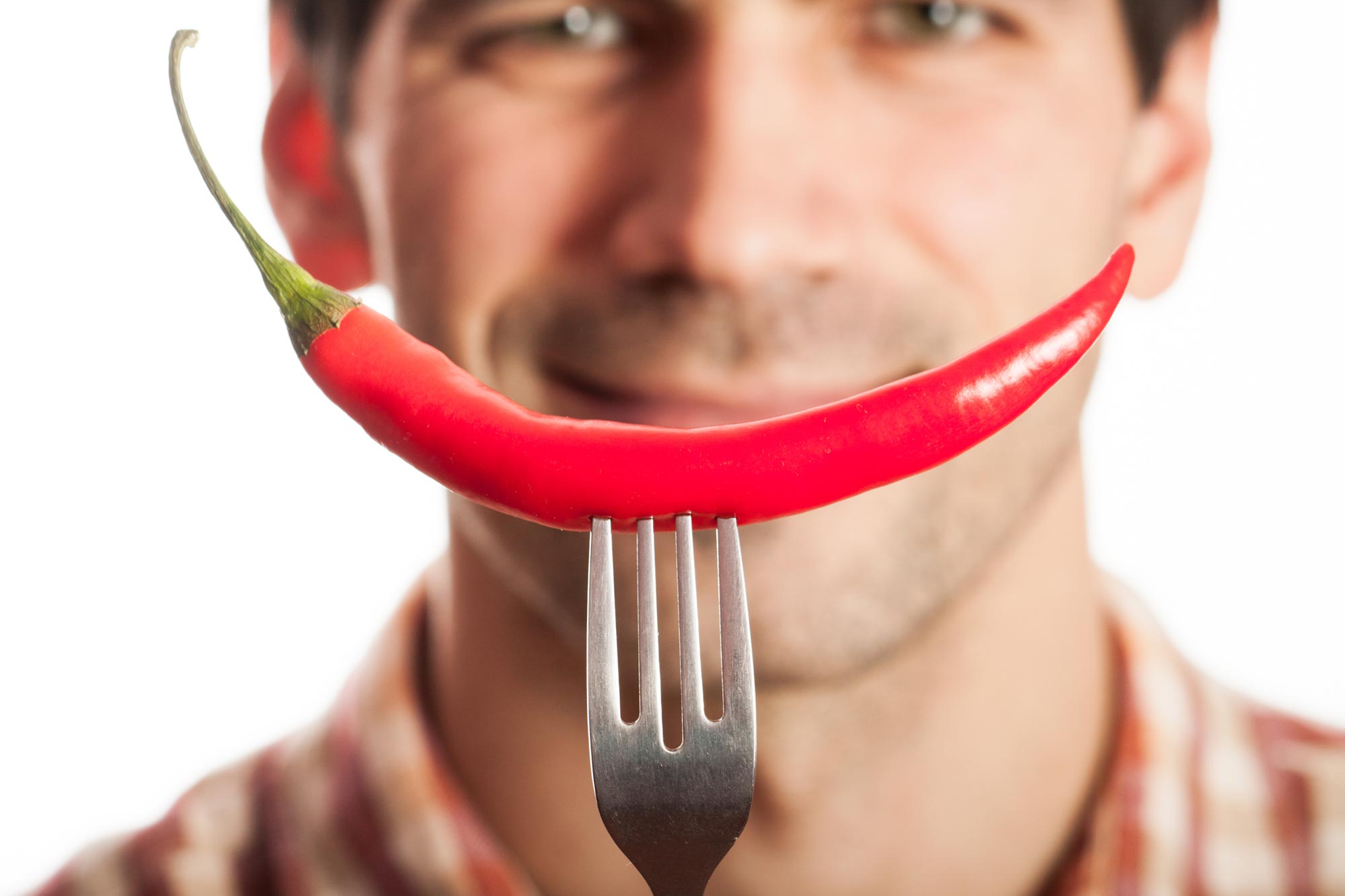
Research suggests a potential link between spicy food consumption and reduced mortality.
Spicy food may do more than wake up your taste buds. Research suggests it could also be linked to a longer life.
A 2017 study from the Larner College of Medicine at the University of Vermont found that Americans who ate hot red chili peppers had a 13 percent lower adjusted risk of death overall than those who did not. The research, published in PLOS ONE, analyzed data from 16,179 adults in the National Health and Nutritional Examination Survey (NHANES) III, a nationally representative U.S. dataset. Participants, who were surveyed between 1988 and 1994, were followed for a median of 18.9 years.
During 273,877 person-years of follow-up, researchers recorded 4,946 deaths. Overall mortality was 21.6 percent among people who ate hot red chili peppers, compared with 33.6 percent among those who did not. After adjusting for differences in age, lifestyle, and health factors, chili pepper consumption remained associated with a modest but statistically significant reduction in the risk of death.
Expanding Global Research
Since then, more research has pointed in a similar direction. In 2020, a large pooled analysis presented at the American Heart Association’s Scientific Sessions reviewed four major studies involving more than 570,000 people in the United States, Italy, China, and Iran.
Compared with people who rarely or never ate chili peppers, regular consumers had a 26 percent lower risk of death from cardiovascular disease, a 23 percent lower risk of death from cancer, and a 25 percent lower risk of death from any cause.
“We were surprised to find that in these previously published studies, regular consumption of chili pepper was associated with an overall risk-reduction of all cause, CVD, and cancer mortality,” said senior author Bo Xu, M.D., a cardiologist at Cleveland Clinic. At the same time, Xu stressed that the findings do not prove chili peppers directly help people live longer, and that more rigorous studies are still needed.
More Recent Findings and Nuanced Effects
Another study, published in 2024 in the Chinese Medical Journal, reported more modest but still notable results. Researchers followed about 486,000 Chinese adults for roughly 12 years and found that those who ate spicy food at least once a week had a slightly lower risk of vascular disease overall, particularly ischemic heart disease and major coronary events.
The reduction was small, about 3 percent to 5 percent, and the main analysis did not show a clear significant link for stroke. The association appeared stronger in younger individuals, people living in rural areas, and those with generally healthier lifestyles.
Research suggests spicy foods may have some health benefits, particularly for heart health, but the effects are modest and not definitive. Because these studies are observational, they can show associations but cannot prove cause and effect, and people who eat more chili peppers may also have healthier lifestyles overall.
Possible Mechanisms and Limitations
One possible explanation involves capsaicin, the compound that gives chili peppers their heat, which has been linked to anti-inflammatory, antioxidant, anticancer, and blood sugar-regulating effects.
Researchers have also suggested that capsaicin may support cholesterol metabolism, improve blood vessel function, reduce oxidative stress, and influence the gut microbiome. The 2017 study pointed to Transient Receptor Potential (TRP) channels as a possible mechanism, since these receptors respond to capsaicin and may affect processes related to metabolism and circulation.
However, key uncertainties remain, as studies differ widely in how they define spicy food, how much is consumed, and the types of peppers or dishes involved, making it unclear how much or how often chili peppers might be most beneficial.
References:
“The Association of Hot Red Chili Pepper Consumption and Mortality: A Large Population-Based Cohort Study” by Mustafa Chopan and Benjamin Littenberg, 9 January 2017, PLOS ONE.
DOI: 10.1371/journal.pone.0169876
“Spicy food consumption and risk of vascular disease: Evidence from a large-scale Chinese prospective cohort of 0.5 million people” by Dongfang You, Dianjianyi Sun, Ziyu Zhao, Mingyu Song, Lulu Pan, Yaqian Wu, Yingdan Tang, Mengyi Lu, Fang Shao, Sipeng Shen, Jianling Bai, Honggang Yi, Ruyang Zhang, Yongyue Wei, Hongxia Ma, Hongyang Xu, Canqing Yu, Jun Lv, Pei Pei, Ling Yang, Yiping Chen, Zhengming Chen, Hongbing Shen, Feng Chen, Yang Zhao, Liming Li and On behalf of the China Kadoorie Biobank Collaborative Group, 19 July 2024, Chinese Medical Journal.
DOI: 10.1097/CM9.0000000000003177
Never miss a breakthrough: Join the SciTechDaily newsletter.
Follow us on Google and Google News.