
Close Menu
    Facebook X (Twitter) Instagram
    SciTechDaily
    • Biology
    • Chemistry
    • Earth
    • Health
    • Physics
    • Science
    • Space
    • Technology
    Facebook X (Twitter) Pinterest YouTube RSS
    SciTechDaily
    Home»Physics»Harnessing Quasiparticles: The Next Wave of Super-Bright Light Sources
    Physics

    Harnessing Quasiparticles: The Next Wave of Super-Bright Light Sources

    By University of RochesterOctober 23, 2023No Comments3 Mins Read
    Facebook Twitter Pinterest Telegram LinkedIn WhatsApp Email Reddit
    Share
    Facebook Twitter LinkedIn Pinterest Telegram Email Reddit
    Quasiparticles Super Bright Light Sources
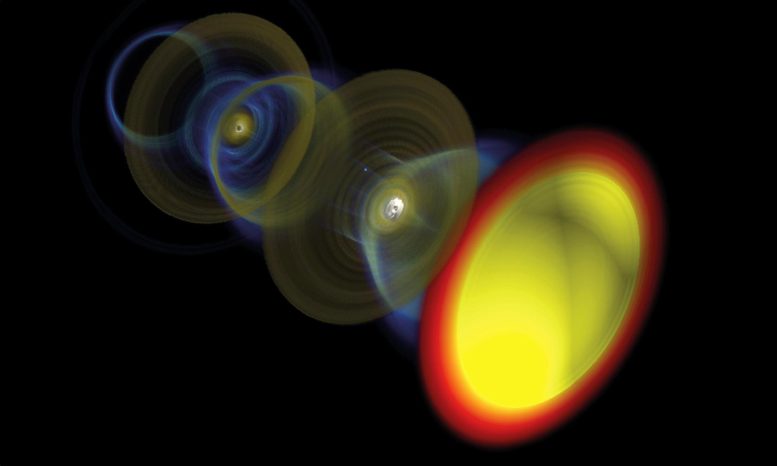
    Scientists studied the unique properties of quasiparticles in plasmas by running advanced computer simulations on supercomputers available through the European High-Performance Computing Joint Undertaking. They propose using quasiparticles to create light sources as powerful as the most advanced ones in existence today, but much smaller. Credit: Bernardo Malaca

    The seemingly physics-defying properties of quasiparticles could be harnessed for applications ranging from non-destructive imaging to computer-chip manufacturing.

    An international team of scientists has embarked on a mission to reshape the foundational principles of radiation physics with the intent of developing super-bright light sources. In a new study published in Nature Photonics, researchers from the Instituto Superior Técnico (IST) in Portugal, the University of Rochester, the University of California, Los Angeles, and Laboratoire d’Optique Appliquée in France proposed ways to use quasiparticles to create light sources as powerful as the most advanced ones in existence today, but much smaller.

    The Power of Quasiparticles

    Quasiparticles are remarkable entities formed by synchronized movements of multiple electrons. Intriguingly, they can travel at unparalleled speeds, even surpassing the speed of light, and can endure extraordinarily intense forces, akin to those near black holes.

    “The most fascinating aspect of quasiparticles is their ability to move in ways that would be disallowed by the laws of physics governing individual particles,” says John Palastro, a senior scientist at the Laboratory for Laser Energetics, an assistant professor in the Department of Mechanical Engineering, and an associate professor at the Institute of Optics.

    Advanced Research & Potential Applications

    Palastro and his colleagues studied the unique properties of quasiparticles in plasmas by running advanced computer simulations on supercomputers available through the European High-Performance Computing Joint Undertaking. They see promising applications for quasiparticle-based light sources including non-destructive imaging to scan for viruses, understanding biological processes like photosynthesis, manufacturing computer chips, and exploring the behavior of matter in planets and stars.

    “The flexibility is enormous,” says Bernardo Malaca, a doctoral student at IST and the study’s primary author. “Even though each electron is performing relatively simple movements, the total radiation from all the electrons can mimic that of a particle moving faster than light or an oscillating particle, even though there isn’t a single electron locally that’s faster than light or an oscillating electron.”

    Advantages Over Current Light Sources

    Quasiparticle-based light sources could have a distinct advantage over existing forms, like free electron lasers, which are scarce and massive, making them impractical for most laboratories, hospitals, and businesses. With the theory proposed in the study, quasiparticles could produce incredibly bright light with just a tiny distance to travel, potentially sparking widespread scientific and technological advances in labs across the globe.

    Reference: “Coherence and superradiance from a plasma-based quasiparticle accelerator” by B. Malaca, M. Pardal, D. Ramsey, J. R. Pierce, K. Weichman, I. A. Andriyash, W. B. Mori, J. P. Palastro, R. A. Fonseca and J. Vieira, 19 October 2023, Nature Photonics.
    DOI: 10.1038/s41566-023-01311-z

    Never miss a breakthrough: Join the SciTechDaily newsletter.
    Follow us on Google and Google News.

    Optics Photonics University of Rochester
    Share. Facebook Twitter Pinterest LinkedIn Email Reddit

    Related Articles

    Complex Shapes of Photons for Fast Photonic Quantum Computations and Safe Data Transfer

    “Breaking” the Laws of Physics: Steering Light to Places It Isn’t Supposed to Go

    Indestructible Light Beam: Special Light Waves Created That Can Penetrate Even Opaque Materials

    Self-Learning, Self-Evolving Smart Quantum Technologies for Secure Communication

    Scientists Capture Light in a Polymeric Quasicrystal – New Possibilities for Laser and Sensor Design

    Newly Discovered Memory Effect Alters Doppler Wave Signature

    More Powerful, Versatile Ultrafast Laser Pulse Created for Engineering and Biomedicine Applications

    Scientists Test Einstein’s Theory of General Relativity Using the Tokyo Skytree

    Physicists Test the Response Time of Electrons

    Leave A Reply Cancel Reply

    • Facebook
    • Twitter
    • Pinterest
    • YouTube

    Don't Miss a Discovery

    Subscribe for the Latest in Science & Tech!

    Trending News

    Nanoscale “Defects” Unlock a Major Heat Transfer Breakthrough

    Adults Taking More Vitamin D Scored 13% Higher on a Cognitive Test

    A 35,000-Year-Old Neanderthal Pelvis May Explain Why Men and Women Walk Differently

    Dual Stem Cell Treatment Restores Vision in First Human Trial

    Your Waist Size May Reveal More About Your Health Than You Think

    Scientists Turn Red Strawberries White With a Single Gene Edit

    A SpaceX Falcon 9 Rocket Hit the Moon and Blasted Open a 60-Foot Crater

    Study Reveals Your Organs May Be Aging at Very Different Speeds

    Follow SciTechDaily
    • Facebook
    • Twitter
    • YouTube
    • Pinterest
    • Newsletter
    • RSS
    SciTech News
    • Biology News
    • Chemistry News
    • Earth News
    • Health News
    • Physics News
    • Science News
    • Space News
    • Technology News
    Recent Posts
    • FDA Clears First-of-Its-Kind Nonmedication Treatment for PTSD
    • Quantum Simulators Put a 40-Year-Old Physics Theory to the Test
    • 125-Million-Year-Old Crocodile Fossil Reveals Astonishing New Secrets
    • Scientists Discover an “Impossible” Way Muscle Filaments Can Grow
    • Scientists Discover a Mysterious New Snake Species Hiding in New Guinea
    Copyright © 1998 - 2026 SciTechDaily. All Rights Reserved.
    • Science News
    • About
    • Contact
    • Editorial Board
    • Privacy Policy
    • Terms of Use

    Type above and press Enter to search. Press Esc to cancel.