
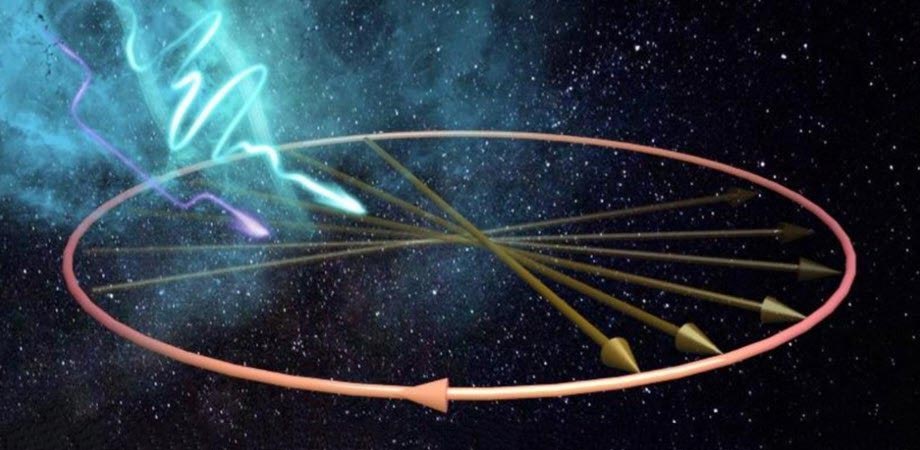
Remembrance of Waves Past: Memory Imprints Motion on Scattered Waves
Between relativistic and classical wave regimes, newly discovered memory effect alters the Doppler wave signature.
Wave scattering appears practically everywhere in everyday life—from conversations across rooms, to ocean waves breaking on a shore, from colorful sunsets, to radar waves reflecting from aircraft. Scattering phenomena also appear in realms as diverse as quantum mechanics and gravitation. According to Pavel Ginzburg, professor at Tel Aviv University’s School of Electrical Engineering, these phenomena become especially interesting when the waves in question encounter a moving object.
The everyday Doppler effect is familiar—witnessed as the audible shift in pitch that occurs, for example, as a fire engine’s siren approaches, passes, and recedes. The idea that the observed frequency of a wave depends on the relative speed of the source and the observer, a popularized aspect of Einstein’s theory of relativity, entails cosmic implications for the Doppler effect, particularly for light waves. Now, it appears that between relativity and the classical (stationary) wave regime, there exists another regime of wave phenomena, where memory influences the scattering process.
Memory effect alters the Doppler wave signature
As recently demonstrated by a team of scientists led by Ginzburg, including lead author Vitali Kozlov and coauthors Sergey Kosulnikov and Dmytro Vovchuk, the Doppler effect can be dramatically altered by memories of prior wave interactions. Specifically, when rotating dipoles are arranged to retain a long memory of past interactions with an incident wave, the Doppler signature displays asymmetric peaks in the scattered spectrum. Rather than fading quickly, these long-lasting past interactions affect the present and future evolution of the system under study.
“The newly discovered memory effect is universal,” observes Ginzburg, “It can emerge in a variety of wave-related scenarios—from optics, where lasers are rotating molecules, to astronomy, where rotating dipoles can approximate neutron stars.” Although the effect is universal, Ginzburg notes that not every scatterer possesses a long memory. “The effect is introduced on purpose, for instance with lumped circuitry in the case of electromagnetic applications,” explains Ginzburg. He speculates that the memory effect may contribute to increased efficiency of radar target identification and classification, among other applications, such as stellar radiometry.
Ginzburg’s team set out to answer the question of whether there is “an overlooked interaction regime, which on the one hand does not require relativistic velocities yet on the other hand cannot be straightforwardly explained with classical stationary physics.” The team chose a simple case of a rotating dipole as a mathematical model that is “capable of describing properties of many real objects, such as quasars in astronomy or rotating blades of a helicopter in radar applications,” according to Ginzburg.
The researchers hope that these newly demonstrated memory effects will be used to advance our understanding of the universe around us and help give rise to new technological applications that take advantage of long-memory materials to imprint motion signatures on scattered waves.
Reference: “Memory effects in scattering from accelerating bodies” by Vitali Kozlov, Sergei Kosulnikov, Dmytro Vovchuk and Pavel Ginzburg , 22 September 2020, Advanced Photonics.
DOI: 10.1117/1.AP.2.5.056003
Never miss a breakthrough: Join the SciTechDaily newsletter.
Follow us on Google and Google News.
5 Comments
I noticed this effect after posting an online video of myself using nunchucks in an ascending crescendo, I find that when replaying on an Android device ,I can influence the speed of replay with mental focus..As the Android AI redefraculates the motion over repetitive veiws
Also the use of a plasma lighter will change color to influential emotional connection
String theory and quantum knotting through fiber optic systems can anititise Lunch from Uranus….yesterday..now im spamming
Does eating levitating food alter the brains Top quark value? (Serious question, I wanna cook pancake ufo with hydrogen and helium under uv light, safe for my kids birthday breakfast?
I understand to heat with hydrogen but as it is easily acidic, I can whip helium into cornststarch honey, or then microwave it with baking powder for light honeycomb