
Close Menu
    Facebook X (Twitter) Instagram
    SciTechDaily
    • Biology
    • Chemistry
    • Earth
    • Health
    • Physics
    • Science
    • Space
    • Technology
    Facebook X (Twitter) Pinterest YouTube RSS
    SciTechDaily
    Home»Earth»Flat-Slab Subduction in South America Mirrors Formation of Rocky Mountains
    Earth

    Flat-Slab Subduction in South America Mirrors Formation of Rocky Mountains

    By Jim Shelton, Yale UniversityAugust 13, 2015No Comments3 Mins Read
    Facebook Twitter Pinterest Telegram LinkedIn WhatsApp Email Reddit
    Share
    Facebook Twitter LinkedIn Pinterest Telegram Email Reddit
    Researchers Get an Unprecedented Look at a Geological Process in South America
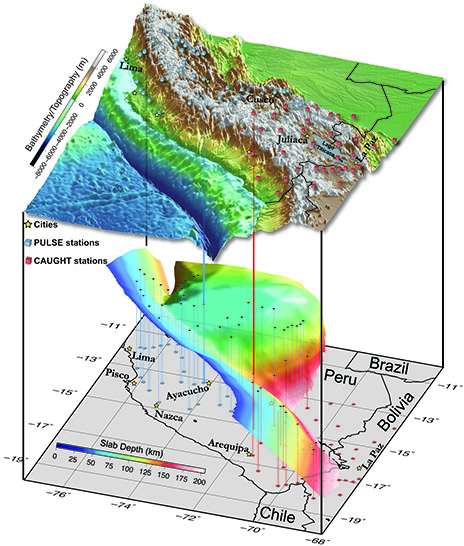
    The revised geometry of the downgoing Nazca plate beneath the Andean mountains in southern Peru and northern Bolivia. Seismic stations are shown as colored cubes. Vertical lines show the location of these stations projected onto the slab. (Image courtesy of Lara Wagner)

    For the first time, Yale University geophysicists are getting to look at a geological process in South America that mirrors the formation of America’s Rocky Mountains.

    Writing in the journal Nature, a team of geophysicists says its findings may help scientists better understand phenomena such as earthquakes and volcanoes, in addition to the development of the Rockies. The data comes from 40 broadband seismometers placed throughout southern Peru as part of the Peru Lithosphere and Slab Experiment (PULSE).

    At the heart of the study is the interaction between plates that make up the Earth’s crust. Typically, where two plates meet, one will slide under the other and sink steeply into the Earth’s mantle over a period of millions of years. That process is known as subduction.

    However, sometimes the lower plate behaves differently. Rather than sinking steeply, the plate slides horizontally for several hundred kilometers before bending and resubducting. This is called flat-slab subduction.

    “This behavior is not well understood at all, but it’s very important for how mountains develop on the plate above the slab,” said co-author Maureen Long, assistant professor of geology and geophysics at Yale. “We think that the Rocky Mountains developed because of an episode of flat-slab subduction.”

    The world’s largest flat slab is located beneath Peru. There, the oceanic Nazca Plate is being subducted under the continental South American Plate.

    The researchers used data from their seismometers to image the subducted plate in unprecedented detail. They identified a probable tear in the slab that is likely starting to subduct normally again.

    “Our model provides insights into the way that the Peruvian flat slab formed and evolved over time that can be applied to the studies of other flat-slab subduction events, such as the one that formed the Rocky Mountains,” said co-author Lara Wagner, of the Carnegie Institution for Science.

    The lead author of the paper was Sanja Knezevic Antonijevic of the University of North Carolina-Chapel Hill. Other co-authors were Susan Beck and George Zandt of the University of Arizona; Abhash Kumar of the University of North Carolina-Chapel Hill; and Hernando Tavera and Cristobal Condori of Instituto Geofisico del Peru.

    The National Science Foundation supported the research.

    Reference: “The role of ridges in the formation and longevity of flat slabs” by Sanja Knezevic Antonijevic, Lara S. Wagner, Abhash Kumar, Susan L. Beck, Maureen D. Long, George Zandt, Hernando Tavera and Cristobal Condori, 12 August 2015, Nature.
    DOI: 10.1038/nature14648

    Never miss a breakthrough: Join the SciTechDaily newsletter.
    Follow us on Google and Google News.

    Carnegie Institution for Science Earth Science Geology Geophysics Yale University
    Share. Facebook Twitter Pinterest LinkedIn Email Reddit

    Related Articles

    Earth’s Strangest Magnetic Era: Scientists Decode the Ediacaran Mystery

    Arctic Sea Ice Loss is Impacting Atlantic Ocean Water Circulation System

    Yale Researchers Find a Soft Spot in the Nazca Plate

    Temperature of Ancient Seas May Shape Global Climate

    New Research Reveals Earth’s Inner Core Was Formed 1 – 1.5 Billion Years Ago

    Yale Scientists Solve the Problem of Sea Ice Thickness Distribution

    New Calculations Challenge Assumptions about Rigid Lithosphere

    “Iron-Rich Blobs” Penetrate Deep Into Earth’s Mantle

    Unusual Indian Ocean Earthquakes May Signal Tectonic Breakup

    Leave A Reply Cancel Reply

    • Facebook
    • Twitter
    • Pinterest
    • YouTube

    Don't Miss a Discovery

    Subscribe for the Latest in Science & Tech!

    Trending News

    Your Blood Pressure Reading Could Be Wrong Because of One Simple Mistake

    Astronomers Stunned by Ancient Galaxy With No Spin

    Physicists May Be on the Verge of Discovering “New Physics” at CERN

    Scientists Solve 320-Million-Year Mystery of Reptile Skin Armor

    Scientists Say This Daily Walking Habit May Be the Secret to Keeping Weight Off After Dieting

    New Therapy Rewires the Brain To Restore Joy in Depression Patients

    Giant Squid Detected off Western Australia in Stunning Deep-Sea Discovery

    Popular Sugar-Free Sweetener Linked to Liver Disease, Study Warns

    Follow SciTechDaily
    • Facebook
    • Twitter
    • YouTube
    • Pinterest
    • Newsletter
    • RSS
    SciTech News
    • Biology News
    • Chemistry News
    • Earth News
    • Health News
    • Physics News
    • Science News
    • Space News
    • Technology News
    Recent Posts
    • Hidden Warm Water Beneath Antarctica Could Rapidly Raise Global Sea Levels
    • Scientists Revive Ancient Chemistry Trick To Engineer Next-Generation Glass
    • Scientists Use AI To Supercharge Ultrafast Laser Simulations by More Than 250x
    • Scientists Just Found a Surprising Way To Destroy “Forever Chemicals”
    • Popular Supplement Ingredient Linked to Shorter Lifespan in Men
    Copyright © 1998 - 2026 SciTechDaily. All Rights Reserved.
    • Science News
    • About
    • Contact
    • Editorial Board
    • Privacy Policy
    • Terms of Use

    Type above and press Enter to search. Press Esc to cancel.