
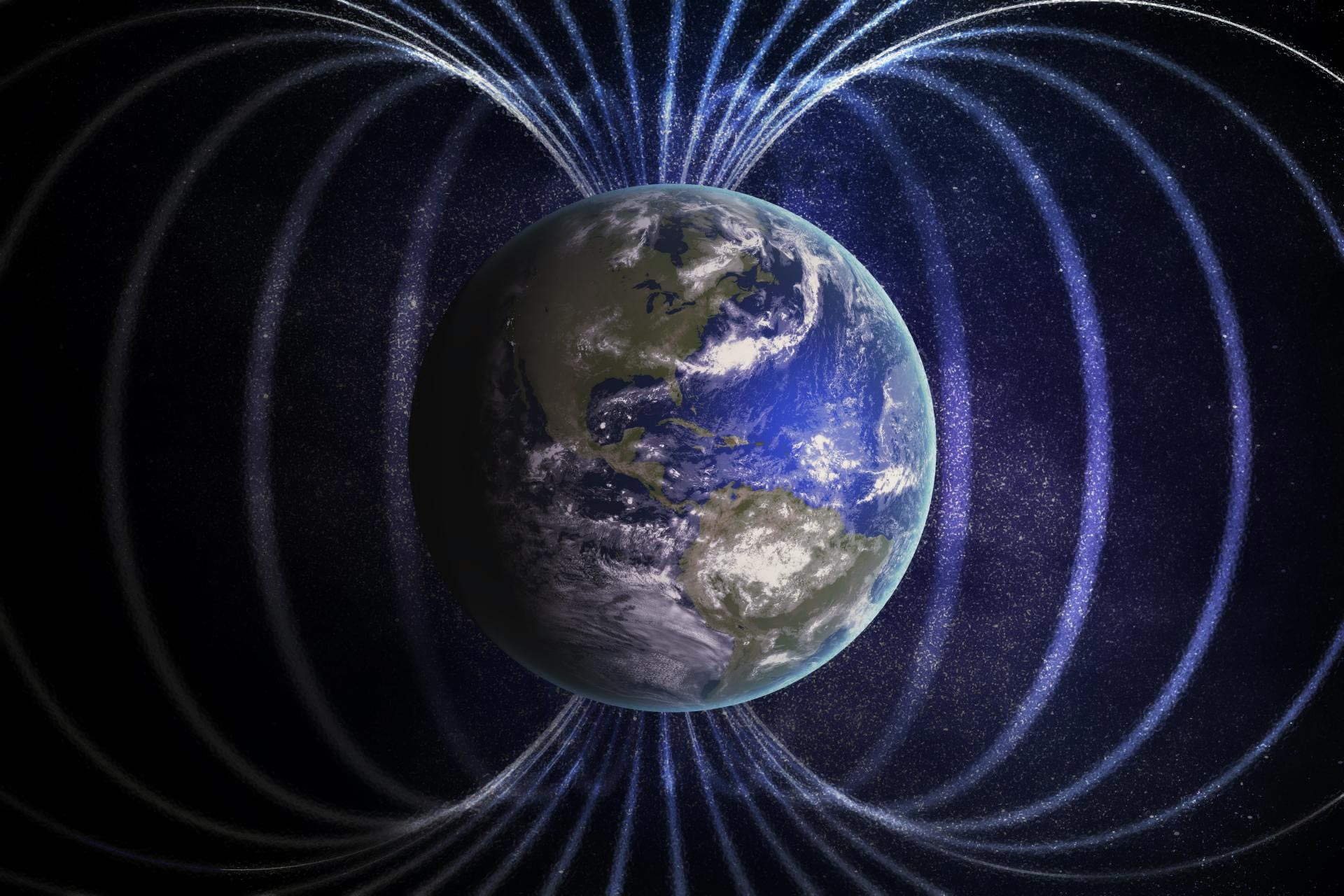
Ancient rocks reveal that Earth’s magnetic field during the Ediacaran may not have been chaotic after all.
Earth’s Ediacaran Period, which lasted from about 630 to 540 million years ago, has long puzzled scientists studying the planet’s magnetic history.
In most other eras, tectonic plates moved at relatively steady rates, climate zones remained stable, and Earth’s magnetic field shifted gently around the north and south poles (while occasionally reversing).
However, the Ediacaran does not follow this pattern. Decades of research have revealed extreme and irregular changes in the magnetic signals preserved in rocks from this time. This level of variability is not seen in older or younger rocks. As a result, scientists have struggled to use ancient magnetic records, known as paleomagnetism, to reconstruct how tectonic plates were arranged and moved during this period.
Explanations for these unusual magnetic shifts have varied. Some researchers have suggested that tectonic plates were moving unusually fast. Others have proposed that the entire planet shifted relative to its spin axis, a process called “true polar wander.”
A New Hypothesis Emerges
A new study published in Science Advances offers a different perspective. Instead of viewing the magnetic changes as random, the researchers argue that they may follow a global pattern with an underlying structure.
“We are proposing a new model for the Earth’s magnetic field that finds structure in its variability rather than simply dismissing it as randomly chaotic,” said David Evans, a professor of Earth and planetary sciences at Yale and co-author of the study. “We have developed a new method of statistical analysis of Ediacaran paleomagnetic data that we think will hold the key to producing robust maps of the continents and oceans from that period.”
To investigate this idea, the team focused on the Anti-Atlas region of Morocco. In this mountain range, researchers from Cadi Ayyad University identified well-preserved volcanic rock layers dating back to the Ediacaran.
Scientists collected carefully oriented samples from these layers and analyzed them at Yale using highly sensitive instruments. This allowed them to examine changes in magnetism with fine detail across successive rock layers.
“Previous studies of rocks from this time period often employed traditional analytical tools that assumed the Earth’s magnetic field behaved similarly in the past as it does now,” said lead author James Pierce, a Ph.D. student at Yale.
“We took a fresh approach. We were able to determine precisely how fast the Earth’s magnetic poles were changing by sampling for paleomagnetism at high stratigraphic (layer-by-layer) resolution and determining precise ages for these rocks,” Pierce said.
Timing and Implications
Additional data from Dartmouth College and research groups in Switzerland and Germany provided precise dating of the rock layers. These results showed that the magnetic changes occurred over thousands of years, not millions.
This timing rules out earlier explanations involving rapid plate motion or true polar wander, since those processes would take much longer to occur.
The researchers also found that the magnetic variations were not entirely random. Instead, they followed an unusual but organized pattern. Based on this, the team developed a new statistical method to track how Earth’s magnetic poles shifted. Their results suggest the poles may have moved across the globe in a more complex way than simple wobbling around the spin axis.
This new approach could help scientists reconstruct the geography of the Ediacaran world with greater accuracy.
Toward a Unified Geological Record
“My entire career has been dedicated to charting the motions of continents, oceans, and tectonic plates over the Earth’s surface, throughout its history,” said Evans, who is also director of the Yale Paleomagnetic Laboratory.
“The Ediacaran Period in particular, has posed a major barrier in that long-term goal, because global paleomagnetic data just didn’t make much sense,” he said. “If our proposed, new statistical methods prove to be robust, we can bridge the gap between older and younger time periods to produce a consistent visualization of plate tectonics spanning billions of years, from the earliest rock record to the present day.”
Reference: “Magnetostratigraphic constraints on the late Ediacaran paleomagnetic enigma” by James S. Pierce, David A. D. Evans, Dana E. Polomski, Nasrrddine Youbi, Mohamed A. Mediany, Jihane Ounar, Rachid Oukhro, M. Ahmed Boumehdi, Justin V. Strauss, C. Brenhin Keller, Andres Gärtner, Maria Ovtcharova, Jörn-Frederik Wotzlaw and Ulf Linnemann, 3 October 2025, Science Advances.
DOI: 10.1126/sciadv.ady3258
The research was funded, in part, by grants from the National Science Foundation.
Never miss a breakthrough: Join the SciTechDaily newsletter.
Follow us on Google and Google News.