
Close Menu
    Facebook X (Twitter) Instagram
    SciTechDaily
    • Biology
    • Chemistry
    • Earth
    • Health
    • Physics
    • Science
    • Space
    • Technology
    Facebook X (Twitter) Pinterest YouTube RSS
    SciTechDaily
    Home»Earth»Jakobshavn Glacier Sheds a Massive Chunk of Ice
    Earth

    Jakobshavn Glacier Sheds a Massive Chunk of Ice

    By European Space AgencyAugust 23, 2015No Comments3 Mins Read
    Facebook Twitter Pinterest Telegram LinkedIn WhatsApp Email Reddit
    Share
    Facebook Twitter LinkedIn Pinterest Telegram Email Reddit
    Jakobshavn Glacier Sheds a Massive Chunk of Ice
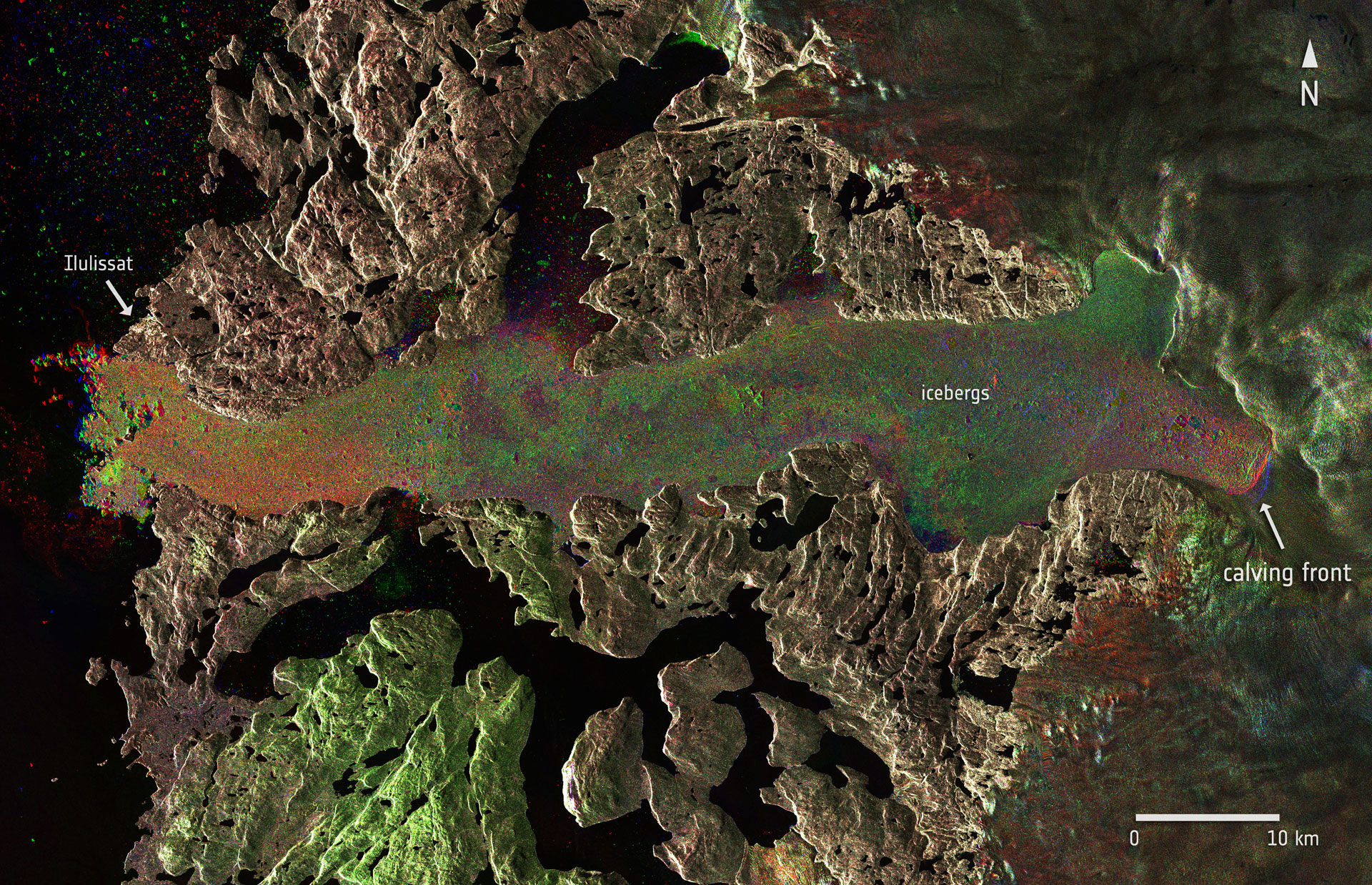
    Radar images from Sentinel-1A captured the Jakobshavn glacier in western Greenland before and after a massive calving event, which took place between 14 and 16 August 2015. The image composite includes different Sentinel-1A images from 27 July, and 13 and 19 August. The red, green, and blue indicate the position of the calving front and other dynamic features on each respective date.

    New ESA satellite images show that the fastest-moving glacier in the world (the Jakobshavn glacier) shed a massive chunk of ice measuring around 12.5 square kilometers – one of the most significant calving events on record.

    Radar images from Sentinel-1A captured the Jakobshavn glacier in western Greenland before and after the event, which took place between 14 and 16 August.

    Comparing images taken on 27 July, and 13 and 19 August, the new face of the glacier has been pushed inland by several kilometers to what appears to be its furthest easterly location since monitoring began in the mid-1880s.

    The image time series suggests that between 27 July and 13 August, the glacier advanced westward before the calving caused the rapid retreat of the ice front to its position on 19 August.

    It is estimated that the glacier lost a total area of 12.5 square kilometers (4.8 square miles). Assuming the ice is about 1,400m (4,600ft)deep, this equates to a volume of 17.5 cubic kilometers (4 cubic miles) – which could cover the whole of Manhattan Island with a layer of ice about 300m (1,000ft) thick.

    Optical Image of Jakobshavn Glacier in Western Greenland
    This optical image of Jakobshavn glacier in western Greenland, acquired by Sentinel-2A on 16 August 2015, offers a valuable perspective of the scale of the calving event that took place between 14 and 16 August. The contour indicates the area of ice lost between images acquired on 6 and 16 August. All-weather radar images from the Sentinel-1A satellite provide a year-round view of glacier dynamics.

    The history of this last calving event is also revealed in images taken by Sentinel-2A on 6 and 16 August.

    Jakobshavn glacier drains 6.5% of the Greenland ice sheet, producing around 10% of its icebergs. This amounts to some 35 billion tonnes of ice that calve every year.

    Other similar events have been documented where the glacier parted with 7 square kilometers (2.7 square miles) of ice, both earlier this year and back in 2010.

    Icebergs are often so large that they cannot float away easily. They remain, sometimes for years, stuck on the bottom in shallower areas of the fjord until they finally melt enough to disperse, break into pieces, or are pushed out by icebergs coming up from behind.

    Studied for over 250 years, the Jakobshavn glacier has helped to develop our understanding of the importance of ice streams and glaciers in climate change, icecap glaciology, and how they affect sea level.

    Sentinel-1A and Sentinel-2A are the first two satellites in orbit for Europe’s Copernicus program. While Sentinel-1A is an all-weather, day-and-night radar imaging mission, Sentinel-2A carries a multispectral imager.

    Since radar can ‘see’ through clouds and in the dark, Sentinel-1A is particularly useful for maritime surveillance, ship safety, sea-ice charting, and ice-sheet monitoring. Sentinel-2A also demonstrates here that it is also valuable for ice and climate monitoring.

    Together, these and future Sentinels, in particular the upcoming Sentinel-3 mission, will add further complementary measurements for operational applications and scientific purposes.

    Never miss a breakthrough: Join the SciTechDaily newsletter.
    Follow us on Google and Google News.

    Climate Science European Space Agency Glaciology Greenland Ice Melt
    Share. Facebook Twitter Pinterest LinkedIn Email Reddit

    Related Articles

    Machine Learning Helps Predict the Geothermal Heat Flux in Greenland

    New Research Shows Greenland Ice Sheet Movement is Decreasing Despite Warming

    NASA’s Oceans Melting Greenland Mission Maps Greenland’s Coastline

    Study Shows Greenland’s Undercut Glaciers Melting Faster than Thought

    CryoSat Satellite Shows Increased Volume of Arctic Sea Ice

    New Threat to East Antarctic Ice

    NASA Data Reveal Subglacial Lakes Refilling in Greenland

    Rivers of Glacial Meltwater Contribute to Rising Sea Levels

    NASA Data Reveal New Insight Into the Hidden Movements of the Greenland Ice Sheet

    Leave A Reply Cancel Reply

    • Facebook
    • Twitter
    • Pinterest
    • YouTube

    Don't Miss a Discovery

    Subscribe for the Latest in Science & Tech!

    Trending News

    Study Finds Natural Dairy Trans Fats Behave Very Differently From Industrial Fats

    Your Voice May Reveal How Fast Your Brain Is Aging

    These Fingernail-Sized Animals Are Moving Astonishing Amounts of California Beach Sand

    NASA’s Perseverance Rover Finds Mars Had a Far More Complicated Water History Than Expected

    Why Do Muscles Weaken With Age? Scientists May Have Found an Important Missing Piece

    Cancer’s “Obesity Paradox” May Have a Surprising Explanation

    Engineers Have Created the World’s First Floating Titanium

    More Than 1 in 3 Adults Had High Blood Pressure – Most Didn’t Know It

    Follow SciTechDaily
    • Facebook
    • Twitter
    • YouTube
    • Pinterest
    • Newsletter
    • RSS
    SciTech News
    • Biology News
    • Chemistry News
    • Earth News
    • Health News
    • Physics News
    • Science News
    • Space News
    • Technology News
    Recent Posts
    • A Strange New Material Breaks the Usual Rules of Heat and Stiffness
    • Scientists Detect a Major Shift Beneath the Sun’s Surface
    • James Webb Telescope Detects the Fingerprints of Catastrophic Planetary Collisions
    • Aging Cells May Be Hiding From the Immune System – Scientists Think They Know How
    • Night Owls Were 70% More Likely To Leave Work on Disability, 12-Year Study Finds
    Copyright © 1998 - 2026 SciTechDaily. All Rights Reserved.
    • Science News
    • About
    • Contact
    • Editorial Board
    • Privacy Policy
    • Terms of Use

    Type above and press Enter to search. Press Esc to cancel.