
Close Menu
    Facebook X (Twitter) Instagram
    SciTechDaily
    • Biology
    • Chemistry
    • Earth
    • Health
    • Physics
    • Science
    • Space
    • Technology
    Facebook X (Twitter) Pinterest YouTube RSS
    SciTechDaily
    Home»Space»NASA’s Mars Reconnaissance Orbiter Views Martian Sand Dunes
    Space

    NASA’s Mars Reconnaissance Orbiter Views Martian Sand Dunes

    By Mike Mellon, NASAOctober 8, 20151 Comment2 Mins Read
    Facebook Twitter Pinterest Telegram LinkedIn WhatsApp Email Reddit
    Share
    Facebook Twitter LinkedIn Pinterest Telegram Email Reddit
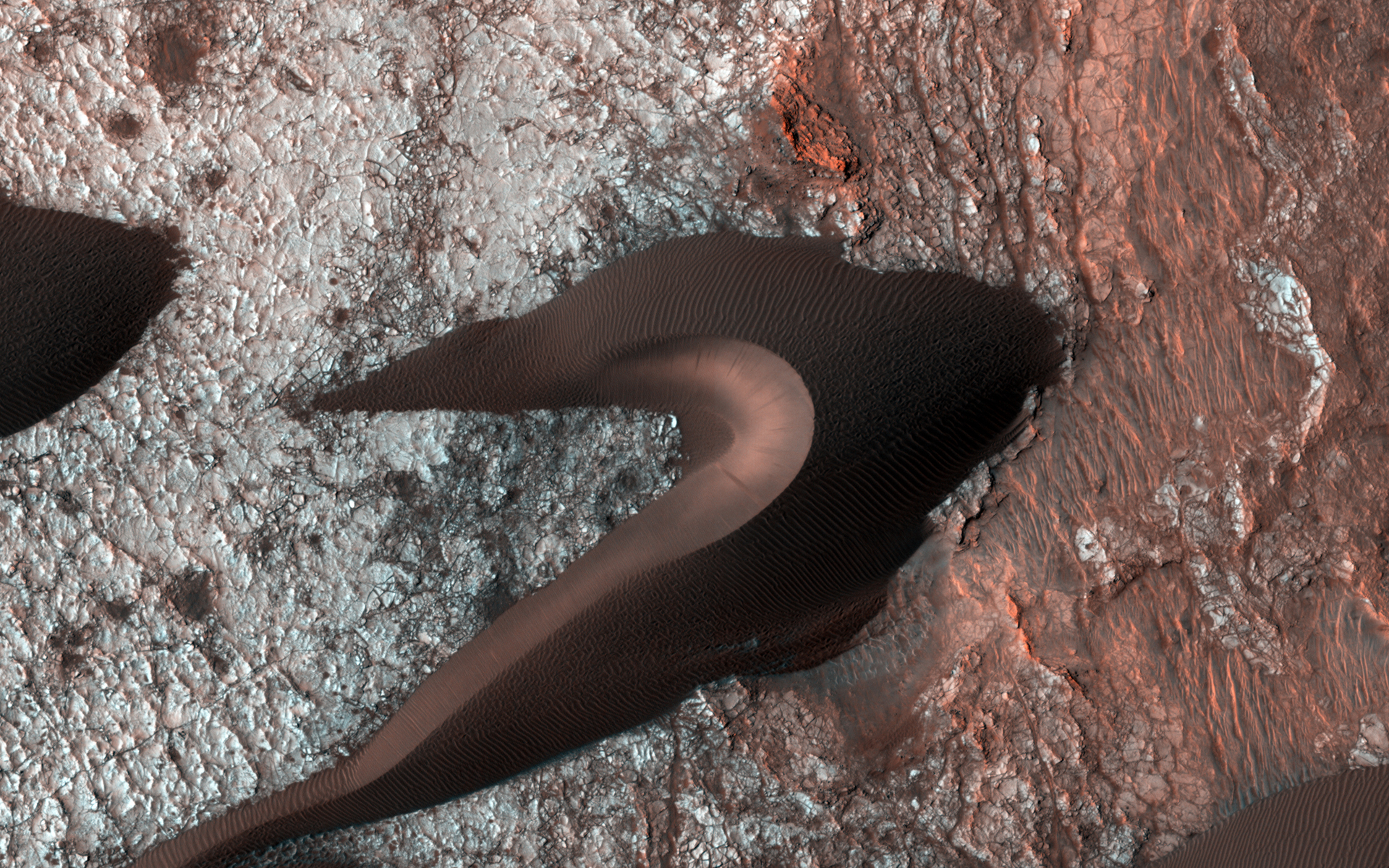
    Mars Reconnaissance Orbiter Views Martian Sand Dunes
    Martian sand dunes. Credit: NASA/JPL-Caltech/University of Arizona

    A new image from NASA’s Mars Reconnaissance Orbiter reveals a highly fractured surface among Martian sand dunes.

    The High Resolution Imaging Science Experiment (HiRISE) camera aboard NASA’s Mars Reconnaissance Orbiter often takes images of Martian sand dunes to study the mobile soils. These images provide information about erosion and movement of surface material, about wind and weather patterns, even about the soil grains and grain sizes. However, looking past the dunes, these images also reveal the nature of the substrate beneath.

    Within the spaces between the dunes, a resistant and highly fractured surface is revealed. The fractured ground is resistant to erosion by the wind, and suggests the material is bedrock that is now shattered by a history of bending stresses or temperature changes, such as cooling, for example.

    Alternately, the surface may be a sedimentary layer that was once wet and shrunk and fractured as it dried, like gigantic mud cracks. In either case, the relatively small and indistinct fractures have trapped the dark dune sand marching overhead. Now the fractures have become quite distinct, allowing us to examine the orientation and spacing of the fractures to learn more about the processes that formed them.

    This view is one image product from HiRISE observation ESP_042223_1890, taken July 30, 2015, at 2:33 p.m. local Mars time, 8.719 degrees north latitude, 67.347 degrees east longitude.

    Never miss a breakthrough: Join the SciTechDaily newsletter.
    Follow us on Google and Google News.

    Astronomy Mars Mars Reconnaissance Orbiter NASA Planetary Science
    Share. Facebook Twitter Pinterest LinkedIn Email Reddit

    Related Articles

    Ten Years and Counting, Mars Orbiter Still Going Strong

    New NASA Image of the Northern Plains of Mars

    Mars Orbiter Preparing for Mars InSight Lander’s 2016 Arrival

    NASA’s Mars Reconnaissance Orbiter Completes 40,000 Mars Orbits

    Orbiter Examines Clues to Possible Water Flows on Mars

    Mars Reconnaissance Orbiter Examines a New Impact Crater

    Scientists Find Evidence for Granite on Mars

    Data Indicates Temperatures Rise and Fall Twice a Day on Mars

    Mars Orbiter Shows McLaughlin Crater May Have Once Held a Groundwater-Fed Lake

    1 Comment

    1. Madanagopal.V.C. on October 9, 2015 5:11 am

      The wonderful sand dunes on Mars is nothing but due to soil erosion and sedimentary layers formed by flow of water in a rough terrain. The wind helps to put them straight clearing other non deep sands to get cleared. Water, Water and water everywhere in the universe on planets
      exo-planets, comets, asteroids and what not? Thank You.

      Reply
    Leave A Reply Cancel Reply

    • Facebook
    • Twitter
    • Pinterest
    • YouTube

    Don't Miss a Discovery

    Subscribe for the Latest in Science & Tech!

    Trending News

    Scientists Find Two New Ways To Break Down “Forever Chemicals” in Water

    Pesticide Exposure May Carry a Serious Neurological Risk Years Later

    Ozempic Could Fight Addiction Too – Scientists Finally Know How

    Two Mysterious ‘Ghost’ Ancestors Are Hiding in Our DNA

    This Widely Used Plastic Could Be Harming Your Liver

    Don’t Miss: August Brings Two Eclipses and the Perseid Meteor Shower

    Brain Waves Once Dismissed As Noise May Help Build Our Reality

    Perseverance Finds Organic Carbon Preserved Just Beneath the Martian Surface

    Follow SciTechDaily
    • Facebook
    • Twitter
    • YouTube
    • Pinterest
    • Newsletter
    • RSS
    SciTech News
    • Biology News
    • Chemistry News
    • Earth News
    • Health News
    • Physics News
    • Science News
    • Space News
    • Technology News
    Recent Posts
    • This Simple Daily Habit May Ease Pain and Depression
    • New Research Questions a Textbook Theory of How Insect Societies Evolve
    • Only Three Are Known To Exist: China’s Mysterious Eyeless Cave Snail
    • “I Couldn’t Do It Anymore” – Antarctic Guides Quit Their Dream Jobs After Witnessing Tourism’s Damage
    • Scientists Discover a Hidden Cell Signal That May Explain Congenital Heart Defects
    Copyright © 1998 - 2026 SciTechDaily. All Rights Reserved.
    • Science News
    • About
    • Contact
    • Editorial Board
    • Privacy Policy
    • Terms of Use

    Type above and press Enter to search. Press Esc to cancel.