
Close Menu
    Facebook X (Twitter) Instagram
    SciTechDaily
    • Biology
    • Chemistry
    • Earth
    • Health
    • Physics
    • Science
    • Space
    • Technology
    Facebook X (Twitter) Pinterest YouTube RSS
    SciTechDaily
    Home»Health»Yale Researchers Identify Molecular Link between Obesity and Fatty Liver Disease
    Health

    Yale Researchers Identify Molecular Link between Obesity and Fatty Liver Disease

    By Ziba Kashef, Yale UniversityJanuary 26, 20161 Comment2 Mins Read
    Facebook Twitter Pinterest Telegram LinkedIn WhatsApp Email Reddit
    Share
    Facebook Twitter LinkedIn Pinterest Telegram Email Reddit
    New Link between Obesity and a Common Liver Disease Discovered
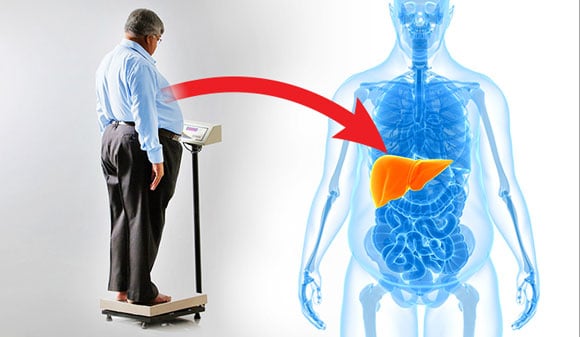
    Obesity in the US is strongly associated with fatty liver disease. A recent study by Yale University identifies molecular links between the two, suggesting a potential therapy.

    The high levels of obesity in the United States contribute to fatty liver disease, the most common form of liver disease. A newly published study from Yale University identifies molecular links between the two, and points to a possible therapy.

    Fatty liver disease — also known as nonalcoholic steatohepatitis or NASH — frequently progresses to cirrhosis and liver cancer. Currently there are no approved therapies. A team of researchers, led by Dr. Wajahat Mehal, director of the Yale Weight Loss Program, conducted a study to examine how obesity triggers a receptor protein, TLR9, which plays a key role in NASH development.

    First, the researchers confirmed the role of TLR9 by observing that TLR9-deficient mice did not develop fatty liver disease even after being fed a high-fat diet. They also identified the ligands, or TLR9-activating molecules, that are elevated in both mice and human subjects with NASH. Finally, in collaboration with Dynavax Technologies, they tested a TLR9 blocker in mice fed a high-fat diet and found that it protected them from the development of NASH.

    The findings have important implications for this life-threatening disease. “TLR9 could be targeted as therapy for NASH,” said Mehal, adding that other drugs that target the same pathway could be potential therapies.

    “From other clinical trials, we know humans can take this TLR9-blocking drug, and it’s not toxic,” he said. The next step for Mehal and his colleagues is to determine the appropriate dosage of the TLR9-blocking drug in animal models before conducting clinical trials for patients with NASH.

    The study was published January 25 in The Journal of Clinical Investigation. Mehal can be contacted at [email protected].

    Reference: “Hepatocyte mitochondrial DNA drives nonalcoholic steatohepatitis by activation of TLR9” by Irma Garcia-Martinez, Nicola Santoro, Yonglin Chen, Rafaz Hoque, Xinshou Ouyang, Sonia Caprio, Mark J. Shlomchik, Robert Lee Coffman, Albert Candia and Wajahat Zafar Mehal, 25 January 2016, The Journal of Clinical Investigation.
    DOI: 10.1172/JCI83885

    Never miss a breakthrough: Join the SciTechDaily newsletter.
    Follow us on Google and Google News.

    Disease Obesity Yale University
    Share. Facebook Twitter Pinterest LinkedIn Email Reddit

    Related Articles

    New Insight on RNA Molecule miR-33 & Its Role in Heart Disease, Obesity

    Do Community Factors Affect Your Weight?

    Bypass Surgery Results in Long Term Health Benefits and Weight Loss

    New Class of Proteins Inhibit HIV Infection in Cell Cultures

    New Antibody Drug Boosts the Immune System’s Capacity to Fight Cancer

    Intensive Glycemic Control Does Not Definitively Reduce the Risk of Impaired Kidney Function

    Obese Children with Genetic Variants Susceptible to Fatty Liver Disease

    Ticks, Lyme Disease and Public Health

    Worldwide Rise in Type 1 Diabetes Could Be Linked to Obesity

    1 Comment

    1. Madanagopal.V.C. on January 31, 2016 7:15 am

      Fatty liver disease is an automatic corollary of Obesity for anyone. If TLR9 blocking drug can cure fatty liver it can automatically cure obesity also. Generally any amount of dieting may help but only temperarily the weight loss and the regimen should be strictly followed all through the life. Thank You.

      Reply
    Leave A Reply Cancel Reply

    • Facebook
    • Twitter
    • Pinterest
    • YouTube

    Don't Miss a Discovery

    Subscribe for the Latest in Science & Tech!

    Trending News

    Millions Take This Joint Supplement but Scientists Found a Concerning Alzheimer’s Link

    Why Evolution Stalled for Millions of Years Before Suddenly Exploding

    New Feathered Dinosaur May Have Solved a 120-Million-Year-Old Fossil Mystery

    Ozempic and Similar Drugs Linked to Dramatic Drop in Addiction Rates

    Ancient Meteorite Reveals a Forgotten Planet That Existed 4.5 Billion Years Ago

    Scientists Reveal What Happened When 12 People Were Trapped Together in Antarctica for 10 Months

    The “Impossible” Earthquake Beneath Utah Was Real After All

    A Major Update Just Hit Cholesterol Guidelines – Here’s What Every Adult Needs To Know

    Follow SciTechDaily
    • Facebook
    • Twitter
    • YouTube
    • Pinterest
    • Newsletter
    • RSS
    SciTech News
    • Biology News
    • Chemistry News
    • Earth News
    • Health News
    • Physics News
    • Science News
    • Space News
    • Technology News
    Recent Posts
    • Your Diet Could Be Missing the Key Ingredient for Heart Protection
    • New Study Reveals Unexpected Way To Destroy Pancreatic Cancer Cells
    • Researchers Warn Widely Prescribed Blood Pressure Drugs Could Be Harming Diabetic Kidneys
    • JUNO’s First Results Bring the Neutrino Mass Mystery Into Focus
    • Astronomers Confirm Dark Energy After Shock Challenge Rocked Cosmology
    Copyright © 1998 - 2026 SciTechDaily. All Rights Reserved.
    • Science News
    • About
    • Contact
    • Editorial Board
    • Privacy Policy
    • Terms of Use

    Type above and press Enter to search. Press Esc to cancel.