
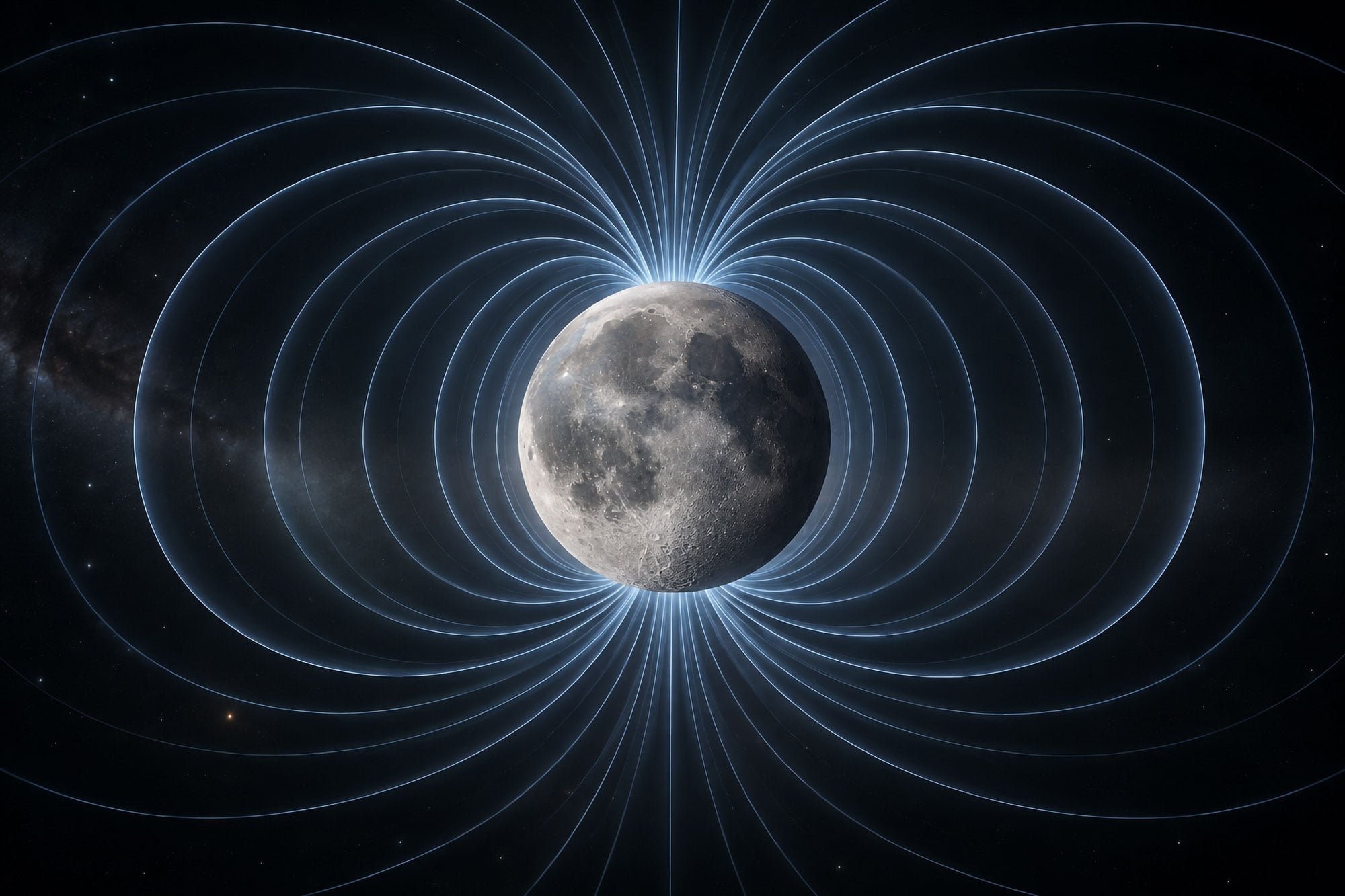
New orbital evidence suggests the young Moon may once have generated its own magnetic field from deep within its interior.
A buried volcanic structure on the Moon’s far side may provide some of the strongest evidence yet that the young Moon once generated its own magnetic field.
Researchers combined gravity data from NASA’s GRAIL mission with magnetic measurements from Lunar Prospector and Kaguya. In the Dewar region, they identified a dense, strongly magnetized body of rock about 60 kilometers (37 miles) wide and extending roughly 9 kilometers (5.6 miles) below the surface.
Evidence for an Ancient Lunar Dynamo
The Moon has no global magnetic field today, but scientists have debated for decades whether its core once powered a dynamo similar to Earth’s. Apollo rock samples have produced conflicting evidence, with some studies pointing to a strong ancient field and others finding little support for one.
“Today, there is an ongoing heated debate as to whether the Moon also operated a dynamo in the past,” says Xi Yang, a PhD student in the Department of Earth and Planetary Sciences at ETH Zurich.
The Dewar structure appears to be solidified magma that rose from the lunar interior about 4.2 billion years ago. Because the researchers can estimate how much iron the rock contains, they can also calculate the minimum magnetic field needed to magnetize it as it slowly cooled.
“We have found that the magnetic field on the Moon at that time was very likely stronger than 10 microtesla. On Earth today, the magnetic field strength stands at around 50 microtesla,” says Yang.
The team also considered whether a major asteroid or meteorite impact could have created the magnetization. Dewar lies outside the regions thought to be plausible sources for such an effect, leading the researchers to favor a longer-lasting field generated inside the Moon.
“We can therefore be almost certain that the magnetic field must originate from a longer-lasting dynamo generated in the core,” says Yang.
A Link to Lunar Swirls
Dewar also contains a lunar swirl, one of the Moon’s bright, curved surface patterns associated with local magnetic anomalies. One proposed explanation is that horizontal magnetic fields partly deflect the solar wind, slowing the space weathering that normally darkens lunar soil.
“This is important information for future astronauts,” says geophysicist Anna Mittelholz: “Magnetic field lines could offer protection from solar winds, and swirls indicate the locations of such constellations.”
The study strengthens the case for an early lunar dynamo, although researchers still do not know how the Moon’s relatively small core could have generated such a strong field. As Mittelholz puts it, the question may be shifting from “Was there a dynamo?” to “How did it work?”
The same approach, combining orbital gravity and magnetic data, could eventually be used to investigate the magnetic histories of other worlds. Mars is one possible target, although the available data are not yet detailed enough for the same type of analysis.
Reference: “Magmatic origin of the Dewar magnetic anomaly: Implications for an early lunar dynamo” by Xi Yang, Anna Mittelholz, Adrien Broquet and Max Moorkamp, 23 September 2026, Science Advances.
DOI: 10.1126/sciadv.aec0341
Never miss a breakthrough: Join the SciTechDaily newsletter.
Follow us on Google and Google News.