
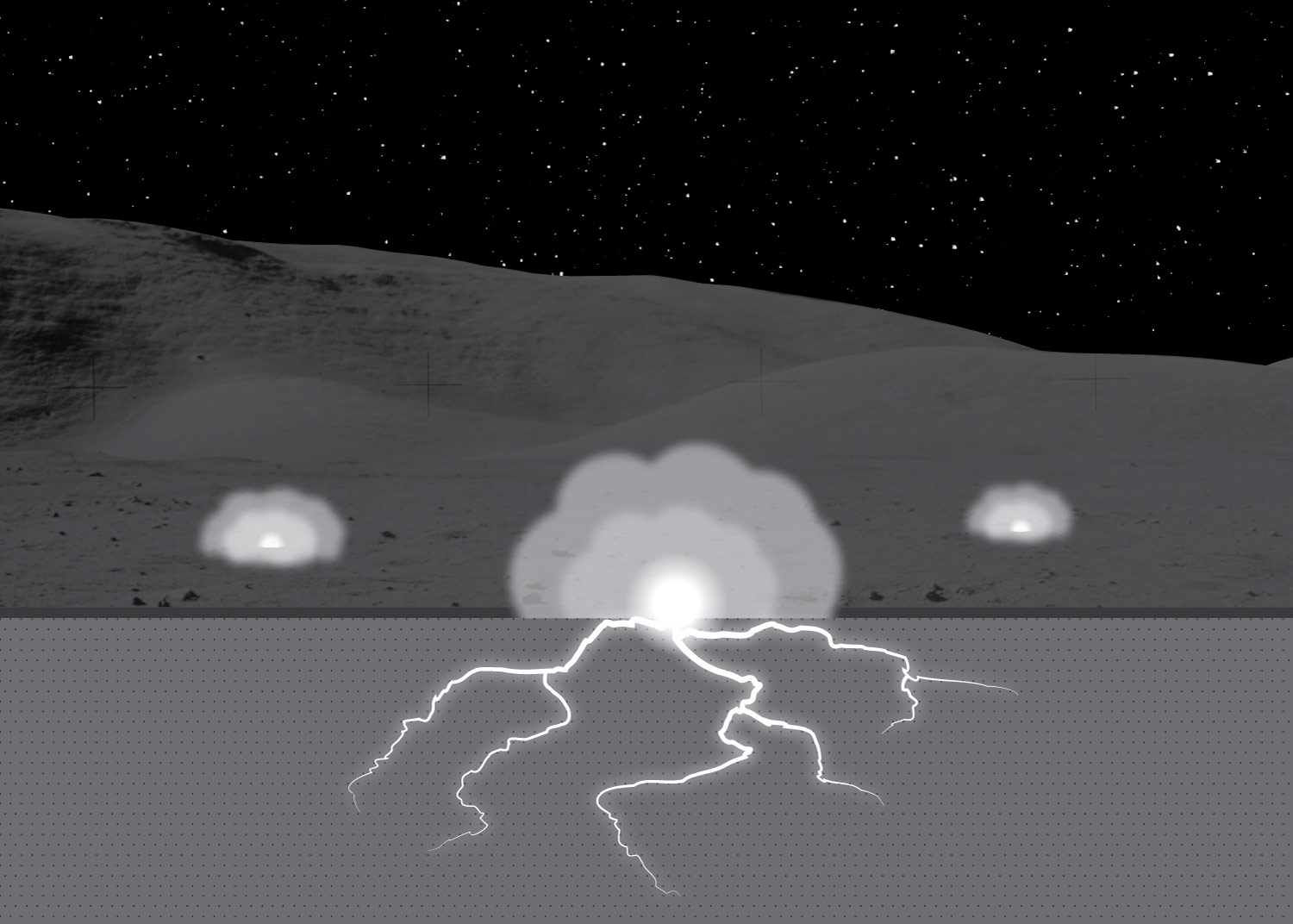
New research shows that high-energy particles from large solar storms can penetrate the moon’s polar regions and electrically charge the soil, causing electrostatic breakdown and altering the properties of the soil on the moon.
The moon appears to be a tranquil place, but modeling done by University of New Hampshire (UNH) and NASA scientists suggests that, over the eons, periodic storms of solar energetic particles may have significantly altered the properties of the soil in the moon’s coldest craters through the process of sparking — a finding that could change our understanding of the evolution of planetary surfaces in the solar system.
The study, published August 8 in the Journal of Geophysical Research-Planets, proposes that high-energy particles from uncommon, large solar storms penetrate the moon’s frigid, polar regions and electrically charge the soil. The charging may create sparking, or electrostatic breakdown, and this “breakdown weathering” process has possibly changed the very nature of the moon’s polar soil, suggesting that permanently shadowed regions, which hold clues to our solar system’s past, may be more active than previously thought.
“Decoding the history recorded within these cold, dark craters requires understanding what processes affect their soil,” said Andrew Jordan of the UNH Institute for the Study of Earth, Oceans, and Space and lead author of the paper. “To that end, we built a computer model to estimate how high-energy particles detected by the Cosmic Ray Telescope for the Effects of Radiation (CRaTER) instrument onboard NASA’s Lunar Reconnaissance Orbiter (LRO) can create significant electric fields in the top layer of lunar soil.”
The scientists also used data from the Electron, Proton, and Alpha Monitor (EPAM) on the Advanced Composition Explorer. CRaTER, which is led by scientists from UNH, and EPAM both detect high-energy particles, including solar energetic particles (SEPs). SEPs, after being created by solar storms, stream through space and bombard the moon. These particles can build up electric charges faster than the soil can dissipate them and may cause sparking, particularly in the polar cold of permanently shadowed regions—unique lunar sites as cold as minus 240 degrees Celsius (minus 400 degrees Fahrenheit) that may contain water ice.
“Sparking is a process in which electrons, released from the soil grains by strong electric fields, race through the material so quickly that they vaporize little channels,” said Jordan. Repeated sparking with each large solar storm could gradually grow these channels large enough to fragment the grains, disintegrating the soil into smaller particles of distinct minerals, Jordan and colleagues hypothesize.
The next phase of this research will involve investigating whether other instruments aboard LRO could detect evidence for sparking in lunar soil, as well as improving the model to better understand the process and its consequences.
“If breakdown weathering occurs on the moon, then it has important implications for our understanding of the evolution of planetary surfaces in the solar system, especially in extremely cold regions that are exposed to harsh radiation from space,” said coauthor Timothy Stubbs of NASA’s Goddard Space Flight Center in Greenbelt, Maryland.
Coauthors from the UNH CRaTER team include Jody Wilson, Nathan Schwadron, Harlan Spence, and Colin Joyce.
The University of New Hampshire, founded in 1866, is a world-class public research university with the feel of a New England liberal arts college. A land, sea, and space-grant university, UNH is the state’s flagship public institution, enrolling 12,300 undergraduate and 2,200 graduate students.
NASA’s Goddard Space Flight Center developed and manages the LRO mission. LRO’s current science mission is implemented for NASA’s Science Mission Directorate. NASA’s Exploration Systems Mission Directorate sponsored LRO’s initial one-year exploration mission that concluded in September 2010. The research was supported in part by NASA’s Solar System Exploration Research Virtual Institute (SSERVI) at NASA’s Ames Research Center in Moffett Field, California. It was also funded by the DREAM2 SSERVI science team (Dynamic Response of the Environments at Asteroids, the Moon, and the moons of Mars).
Reference: “Deep dielectric charging of regolith within the Moon’s permanently shadowed regions” by A. P. Jordan, T. J. Stubbs, J. K. Wilson, N. A. Schwadron, H. E. Spence and C. J. Joyce, 4 July 2014, Journal of Geophysical Research: Planets.
DOI: 10.1002/2014JE004648
Never miss a breakthrough: Join the SciTechDaily newsletter.
Follow us on Google and Google News.