
Close Menu
    Facebook X (Twitter) Instagram
    SciTechDaily
    • Biology
    • Chemistry
    • Earth
    • Health
    • Physics
    • Science
    • Space
    • Technology
    Facebook X (Twitter) Pinterest YouTube RSS
    SciTechDaily
    Home»Space»Simulation May Explain Saturnian System
    Space

    Simulation May Explain Saturnian System

    By SciTechDailyOctober 18, 2012No Comments2 Mins Read
    Facebook Twitter Pinterest Telegram LinkedIn WhatsApp Email Reddit
    Share
    Facebook Twitter LinkedIn Pinterest Telegram Email Reddit
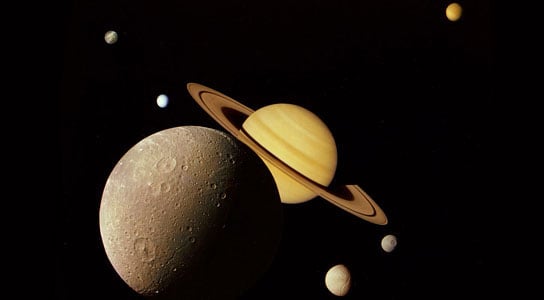
    Saturnian system montage
    Saturnian system montage made up from images taken by Voyager I. Credit: JPL/NASA

    Saturn’s odd mix of mid-sized satellites are among the strangest in the outer Solar System. With widely varying densities and locations, measuring between 300 to 1,500 kilometers (1906 to 930 miles) in diameters, these moons have some distinctive characteristics. Some are made up almost completely of ice, and some are rockier and geologically active. Some even show evidence of submoons and rings.

    According to a new model proposed by Eric Asphaug, a planetary scientist at the University of California, Santa Cruz, Saturn and its satellites initially resembled the Jovian system, with four larger satellites similar to the Galilean moons. However, Saturn’s moons began to merge, eventually forming Titan. The model was presented at the annual meeting of the American Astronomical Society’s Division for Planetary Sciences in Reno, Nevada.

    The mid-sized satellites could have been formed from the debris left over by the formation of Titan, with subsequent mergers perhaps explaining Titan’s elongated orbit. The merging could have been triggered by an instability in the Solar System, 3.8 billion years ago. At that time, theorists think that the orbits of Uranus and Neptune were migrating. Since Jupiter’s gravitational grip is more substantial, its moons were relatively impervious to the disturbance.

    Other astronomers think that the model is too simplistic to work, but the theory is worth exploring further.


    In this model of how Saturn’s moons formed, two proto-moons merge to produce Titan, and fling away water-rich material that later forms the icy mid-size satellites. Courtesy: E. Asphaug and A. Reufer.

    Never miss a breakthrough: Join the SciTechDaily newsletter.
    Follow us on Google and Google News.

    Astronomy Moon Planetary Science Popular Saturn System Titan
    Share. Facebook Twitter Pinterest LinkedIn Email Reddit

    Related Articles

    NASA’s Cassini Spacecraft Completes Final Flyby of Titan

    New Study Reveals Amount of Water Present in the Moon May Have Been Overestimated

    Cassini Reveals Clues about Saturn’s Moon Titan

    Hubble Data Reveals a New Neptune Moon

    Astronomers Discover Rain Falling From Saturn’s Rings

    Presence of Water in the Primary Crust Indicates That the Early Moon Was Wet

    Storm Spawns the Largest Tropospheric Vortex Ever Seen on Saturn

    Titan Experiences Seasonal Changes

    A Closer Look at Titan’s Chemical Production

    Leave A Reply Cancel Reply

    • Facebook
    • Twitter
    • Pinterest
    • YouTube

    Don't Miss a Discovery

    Subscribe for the Latest in Science & Tech!

    Trending News

    Breakthrough Bowel Cancer Trial Leaves Patients Cancer-Free for Nearly 3 Years

    Natural Compound Shows Powerful Potential Against Rheumatoid Arthritis

    100,000-Year-Old Neanderthal Fossils in Poland Reveal Unexpected Genetic Connections

    Simple “Gut Reset” May Prevent Weight Gain After Ozempic or Wegovy

    2.8 Days to Disaster: Scientists Warn Low Earth Orbit Could Suddenly Collapse

    Common Food Compound Shows Surprising Power Against Superbugs

    5 Simple Ways To Remember More and Forget Less

    The Atomic Gap That Could Cost the Semiconductor Industry Billions

    Follow SciTechDaily
    • Facebook
    • Twitter
    • YouTube
    • Pinterest
    • Newsletter
    • RSS
    SciTech News
    • Biology News
    • Chemistry News
    • Earth News
    • Health News
    • Physics News
    • Science News
    • Space News
    • Technology News
    Recent Posts
    • After 37 Years, the World’s Longest-Running Soil Warming Experiment Uncovers a Startling Climate Secret
    • NASA Satellite Captures First-Ever High-Res View of Massive Pacific Tsunami
    • ADHD Isn’t Just a Deficit: Study Reveals Powerful Hidden Strengths
    • Scientists Uncover “Astonishing” Hidden Property of Light
    • Scientists Discover Stem Cells That Could Regrow Teeth and Bone
    Copyright © 1998 - 2026 SciTechDaily. All Rights Reserved.
    • Science News
    • About
    • Contact
    • Editorial Board
    • Privacy Policy
    • Terms of Use

    Type above and press Enter to search. Press Esc to cancel.