
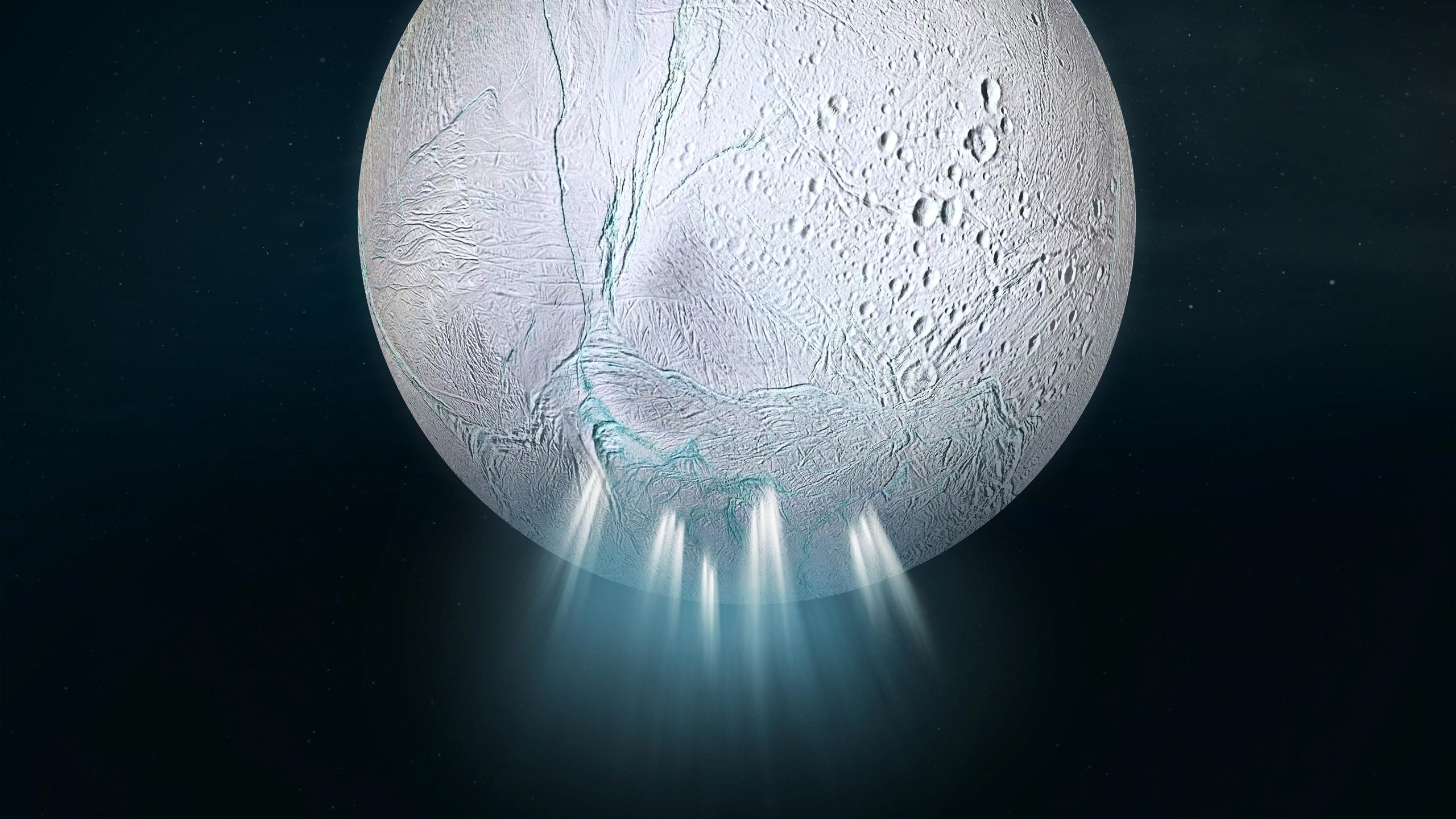
Two new studies suggest that Saturn’s moon Enceladus may be an even more compelling target in the search for extraterrestrial life.
If scientists want to search an alien ocean for life, Enceladus offers a rare advantage: the ocean sends samples into space.
Saturn’s icy moon hides a global ocean beneath its frozen surface, but researchers do not necessarily need to drill through kilometers of ice to study it. Powerful plumes erupt from fractures near the south pole, carrying water vapor and frozen material from the ocean hundreds of kilometers (hundreds of miles) above the surface, where spacecraft can sample it directly.
Now, two studies published in Science Advances suggest that Enceladus may be even more favorable for the search for life than previously understood. One shows that the process creating its plume particles naturally separates and concentrates chemicals from the ocean. The other demonstrates that a methane-producing microorganism from Earth can remain active under laboratory conditions designed to resemble the moon’s unusual chemistry.
An Ocean That Comes to the Spacecraft
Enceladus has become one of the leading places to investigate potentially habitable environments beyond Earth. Although its surface is frozen, gravitational interactions within the Saturn system generate internal heating that helps keep water liquid beneath the crust. That ocean is thought to lie above a rocky interior, creating opportunities for water and rock to interact.
Similar processes on Earth can supply chemical energy to ecosystems that survive without sunlight. At hydrothermal vents on the deep seafloor, microorganisms live by exploiting chemical reactions rather than photosynthesis.
NASA’s Cassini mission transformed scientists’ understanding of Enceladus by repeatedly flying through its south polar plumes. Instruments aboard the spacecraft detected salts, organic compounds, and other material linked to the subsurface ocean. Cassini data have also provided evidence consistent with hydrothermal activity on the ocean floor.
That makes Enceladus extraordinary among known ocean worlds. Instead of requiring a mission to land, drill through thick ice, and reach the water below, the moon continuously ejects material from its ocean into space.
The Ice Grains May Be Naturally Sorted
Professor Frank Postberg, a planetary scientist at Freie Universität Berlin, led an international team investigating what happens to that ocean material before it reaches space.
Their study combined Cassini measurements with laboratory experiments and theoretical modeling.
The researchers reconstructed a process that begins at the ocean surface. Gas bubbles rise through the water and burst, producing tiny droplets. Water vapor carries those droplets upward through fractures in the overlying ice.
The important discovery is that the droplets apparently do not freeze all at once.
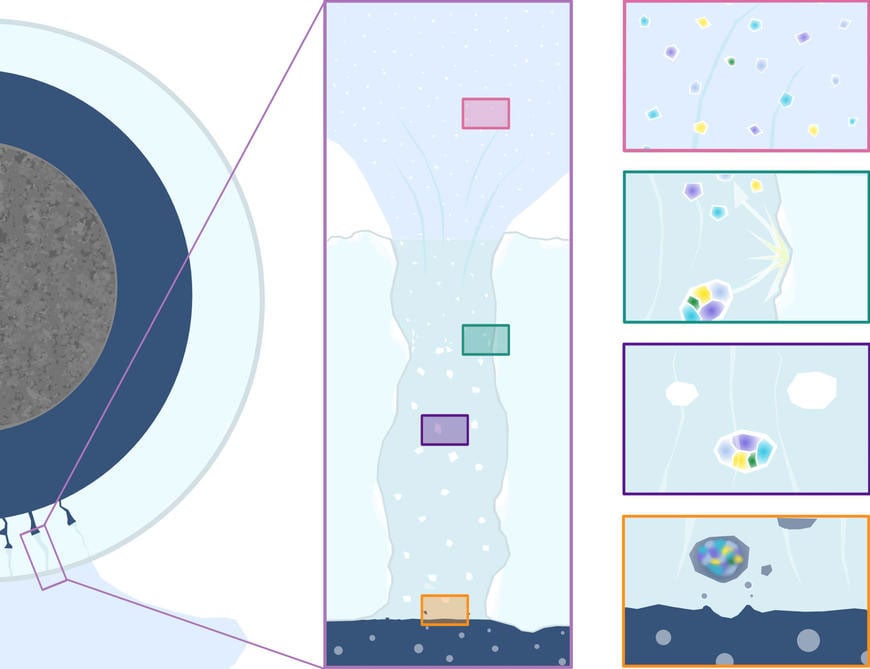
As freezing progresses, substances dissolved in the water can become separated and concentrated in different regions of each droplet. Salts, organic materials, and other compounds that began mixed together may therefore end up distributed unevenly through the resulting ice.
Different salts can also separate from one another. Sodium chloride (table salt), for example, can become segregated from sodium carbonate.
That physical sorting could make the plume far more informative than a collection of chemically uniform ice grains.
Tiny Collisions Create Concentrated Samples
The droplets undergo another transformation as they move toward space.
They can accelerate to speeds of up to 1,000 km/h (about 620 mph) while traveling through the icy fractures. When frozen droplets collide with the walls, they can shatter into fragments only a few micrometers (roughly 0.0001 inch) across.
Some of those fragments may therefore contain highly concentrated amounts of substances that were originally diluted throughout the ocean water.
“Enceladus actually does a lot of the work for us in preparing samples for analysis that usually take a lot of effort in chemical labs on Earth,” says Postberg, who led the study. “The oceanic constituents are separated from each other and simultaneously concentrated into individual ice particles.”
Why a Rare Particle Could Matter
The same process could apply to material originating from microorganisms.
If a droplet contained pieces of a cell or other biologically associated material, freezing could separate that material from surrounding salts and chemicals. Fragmentation could then confine it to a relatively small number of ice grains.
Most particles might contain nothing biological at all. But a rare grain carrying microbial material could contain it at a much higher concentration than existed in the original ocean water.
“That is great news in the search for life,” says Postberg. “Future spacecraft will have to analyze many individual ice particles in the plume. But if they come across one with microbial material in it, they could identify biosignatures in the particle relatively easy with already available technology.”
Rather than analyzing only the average composition of the plume, instruments may benefit from examining large numbers of individual particles. An unusual grain could contain information that would disappear if thousands of particles were blended into a single measurement.
Postberg’s laboratory at Freie Universität Berlin has previously shown in experiments that specialized instruments can detect microbial cellular material in individual particles resembling those found in Enceladus’s plumes.
The findings could therefore influence future missions designed to search the moon for signs of life, including proposed European exploration concepts focused on Enceladus.
Could Anything Actually Live There?
Detecting life is only part of the problem. Scientists must also determine whether Enceladus could provide an environment in which organisms can function in the first place.
A second Science Advances study approached that question experimentally.
Researchers at Ludwig-Maximilians-Universität München (LMU), with contributions from Postberg and Freie Universität scientist Dr. Nozair Khawaja, recreated important aspects of Enceladus’s ocean chemistry in the laboratory.
The study focused on an environment very different from most familiar ecosystems on Earth.
Enceladus’s ocean is believed to contain very little oxygen and large amounts of carbonate. It is also strongly alkaline (with pH values of 10 or 11). Researchers recreated those conditions while also simulating interactions between ocean water and the moon’s rocky interior.
They then introduced Methanothermococcus okinawensis, an archaeon found near deep-sea hydrothermal vents on Earth.
This organism does not depend on oxygen. Instead, it can obtain energy using hydrogen and carbon dioxide while producing methane, a process known as methanogenesis.
Methanogenesis is scientifically interesting in the search for extraterrestrial life because it represents a simple form of metabolism that can operate without sunlight or oxygen. Conditions similar to those needed for such reactions may exist where Enceladus’s ocean contacts its rocky seafloor.
An Experiment With an Unexpected Result
The microorganism initially appeared poorly suited to one major feature of the moon’s chemistry.
At very high pH and with little dissolved carbon dioxide available, it failed to grow in an otherwise favorable laboratory medium.
Yet the result changed when researchers placed it in the more complete Enceladus simulation.
There, the organism continued growing and produced methane. Hydrogen needed for its metabolism was generated through reactions involving water and rock, while the microorganisms adapted to the extremely limited availability of carbon dioxide.
“This was really a surprise to us,” Khawaja said. “This was an experiment for which we did not expect such a successful outcome.”
What makes Enceladus especially compelling is the combination of liquid water, chemical energy, an interacting rocky seafloor, organic material, and a natural mechanism that continually transports ocean samples into space.
“On Enceladus the specific geochemical conditions might allow one of the oldest known metabolic systems on Earth to work, even in very alkaline environments,” Postberg says. “While that doesn’t mean that there is life on Saturn’s moon, our first study shows that – in the event that there is – future space missions might have a good chance of finding traces if they analyze individual ice grains from Enceladus’s plume.”
References:
“Cassini CDA observes compositional segregation of Enceladus’ ice grains from slow freezing and fragmentation of oceanic spray” by Frank Postberg, Zenghui Zou, Yasuhito Sekine, Minori Koga, Jürgen Schmidt, Mark Fox-Powell, Fabian Klenner, Jon K. Hillier, Nozair Khawaja, Toshihiko Kadono, Melih Çakar, Sascha Kempf and Ralf Srama, 25 September 2026, Science Advances.
DOI: 10.1126/sciadv.aee7256
“Enceladus-like geochemistry fuels methanogenesis under extreme CO2 limitation” by Vanessa Helmbrecht, Frank Postberg, Nozair Khawaja, Robert Reichelt, Frieder Klein, Dina Grohmann and William D. Orsi, 25 September 2026, Science Advances.
DOI: 10.1126/sciadv.aei0167
Never miss a breakthrough: Join the SciTechDaily newsletter.
Follow us on Google and Google News.
1 Comment
These people that want to find life everywhere can’t even deal with the life we have on this planet. 99% of the life on this planet is trying to kill us by propagating themselves being fungi, bacteria and viruses.
And let’s talk about the UFO BS. Any civilization that can find a way to get here from huge distances looks on us as primitive ants and maybe as the Twilight zone episode said:
” To serve man “. 💥💯🧠