
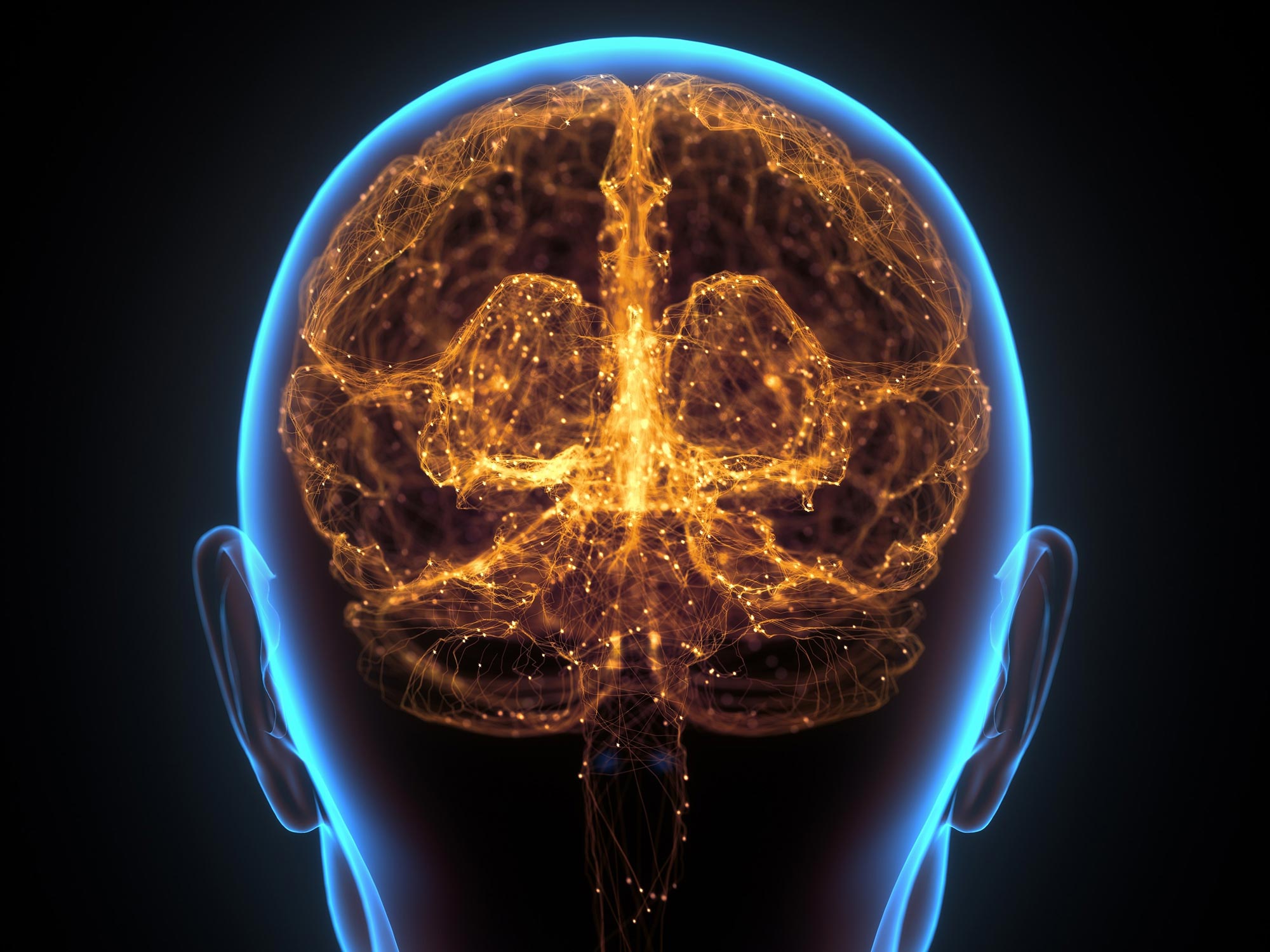
A split in early brain development helped researchers grow human hindbrain neurons that could shed light on SMA and ALS.
The human hindbrain, the region at the back of the brain that helps control breathing and swallowing, has been difficult to study in the laboratory. For decades, scientists have struggled to grow its neurons, leaving them without an important tool for investigating diseases that gradually take away those abilities.
Researchers led by Stanford Medicine have now grown functional human hindbrain motor neurons, the nerve cells that control muscles, by identifying a developmental split that begins as an embryo takes shape. Their work suggests that making these cells requires a different starting point from the one that produces the brain’s other major regions.
The team began with human pluripotent stem cells, which can become any cell type in the body, and guided them along the newly identified pathway. The resulting neurons generated action potentials, the electrical signals nerve cells use to communicate. They also produced proteins characteristic of the hindbrain regions that control facial and swallowing muscles.
Hindbrain neurons offer a disease model
Having access to these cells could help researchers investigate spinal muscular atrophy, or SMA, and amyotrophic lateral sclerosis, or ALS, also known as Lou Gehrig’s disease. Scientists cannot obtain brainstem tissue from living patients, and the difficulty of growing human hindbrain neurons has severely limited their ability to study how these diseases affect the cells.
SMA is a leading genetic cause of death in children younger than 1. ALS, often diagnosed between ages 40 and 70, affects both the hindbrain and the forebrain, the region responsible for higher-level thinking. In both diseases, certain hindbrain neurons gradually stop functioning. Patients lose the ability to swallow, allowing food or liquid to enter the lungs and cause pneumonia. Eventually, they lose the ability to breathe.

“Now we have a model to better understand these devastating diseases, and work toward regenerative therapies for them,” said Rayyan Jokhai, a Stanford graduate student and co-first author of the study. “This is a very exciting new frontier in brain research.”
Two starting points for one brain
To work out how to grow the neurons, Jokhai and fellow graduate student and co-first author Carolyn Dundes returned to gastrulation, the early stage of embryonic development when the body first takes shape.
“In stem cell biology, people are always fixated with creating the end cell type, like the neuron,” Jokhai said. “But it’s important to begin at the earliest stages of embryonic development. Our careful attention to that early time point allowed us to find this fundamental split in brain development.”
For decades, the prevailing model held that a single kind of progenitor, or precursor, cell gave rise to the entire brain. Under that model, the adult brain’s three main regions, the forebrain, midbrain, and hindbrain, all shared the same developmental starting point.
Those regions eventually take on different roles. The forebrain supports language, consciousness, and abstract reasoning, including abilities such as mathematics and poetry. The hindbrain regulates automatic functions such as heartbeat, breathing, sleep, and hunger. Its neurons also control muscles in the face, tongue, and throat involved in speech and swallowing.
Examining developing mouse embryos, the researchers identified two separate populations of brain progenitor cells. Cells expressing a gene called Otx2 went on to form the forebrain and midbrain. Cells expressing another gene, Gbx2, were committed to becoming the hindbrain. The populations did not overlap, even at the earliest stages the team examined. The hindbrain pathway ran alongside the pathway producing the forebrain and midbrain rather than branching from it.
“We’ve shown for the first time that the front of the brain arises from a totally different progenitor cell than the back of the brain,” said Kyle Loh, PhD, an associate professor of developmental biology and the study’s senior author. “Our discovery means that we can now grow neurons from the back of the brain, the hindbrain, in a petri dish and study their functions.”
The distinction also appeared in the cells’ chromatin, the packaging that makes some parts of DNA accessible while keeping others bundled away. Because that packaging influences which genes a cell can use, it helps determine what the cell can become.

The anterior neural ectoderm, the embryonic tissue destined to produce the forebrain and midbrain, had a fundamentally different chromatin configuration from the posterior neural ectoderm, which produces the hindbrain. Those differences locked the progenitors into their respective developmental paths, offering an explanation for why earlier laboratory efforts had struggled.
“Previous attempts to make hindbrain neurons likely tried to coax forebrain and midbrain progenitors into hindbrain cells, which our study shows is not possible,” Jokhai said.
Did two nervous systems become one?
The findings, published in Nature Neuroscience, also raise a question about the brain’s evolutionary history. If its front and back develop separately, could they have begun as separate nervous systems?
Looking across more than 550 million years of evolutionary history, the researchers found the same pattern of two developmental origins in chickens, zebrafish, and acorn worms. These small ocean-floor animals share a distant common ancestor with humans. Jellyfish, whose lineage diverged from the human lineage about 600 to 700 million years ago, have two nervous systems at different ends of their bodies.
The researchers interpret the evidence as suggesting that the brain brings together two ancient nervous systems that evolved independently over hundreds of millions of years.
“Our research suggests that evolution took two existing neural systems and pushed them together spatially,” Loh said. “Having the brain as one organ would probably be more efficient, but we rely on this primordial way to make the brain as two separate pieces.”
“I was surprised at our findings because the word ‘brain’ implies a contiguous organ that likely has a singular origin,” Jokhai said. “But even 500 million years ago, there were these separate neural systems, which now almost operate as one, which is very cool.”
Beyond diseases affecting movement, swallowing, and breathing, the hindbrain’s role in regulating hunger connects the research to obesity treatment. Weight-loss drugs such as semaglutide act on hunger-regulating circuits in this region.
The team plans to investigate the developmental origins of the spinal cord and determine exactly how SMA and ALS impair hindbrain neurons.
Reference: “Two parallel neural ectoderm progenitors contribute to the developing brain” by Rayyan T. Jokhai, Carolyn E. Dundes, Hadia S. Ahsan, Rachel S. Kang, Rachel E. A. Salomon-Shulman, Arjun Rajan, Yoon Seok Kim, Liam J. Stanton, Christine Xu, Stephanie Do, Brennan D. McDonald, José Miguel Andrade López, Hugo A. Urrutia, Hannah Greenfeld, Alicia Wong, Yimiao Qu, Andrew S. Petkovic, Yi Miao, K. Christopher Garcia, Michelle Monje, Daniel E. Wagner, Marianne E. Bronner, Christopher J. Lowe and Kyle M. Loh, 18 September 2026, Nature Neuroscience.
DOI: 10.1038/s41593-026-02433-7
This work was supported by the National Institutes of Health (grants DP5OD024558, DP2GM146258, R00GM121852, R01DK115728, R01DE027538, T32GM119995, T32GM007365, T32GM007790 and F31DE031154); the National Science Foundation; the California Institute for Regenerative Medicine; the Spinal Muscular Atrophy Foundation; a Stanford Maternal and Child Health Research Institute grant; the Stanford Beckman and Ludwig Centers; the Siebel Stem Cell Institute; a Stinehart-Reed Foundation grant; the Gatsby Charitable Foundation; the Howard Hughes Medical Institute; the Packard Foundation; the Pew Charitable Trusts; the Baxter Foundation; the Human Frontier Science Program; and the anonymous, Fickel, Gilbert, and Stinehart-Reed families.
Never miss a breakthrough: Join the SciTechDaily newsletter.
Follow us on Google and Google News.