
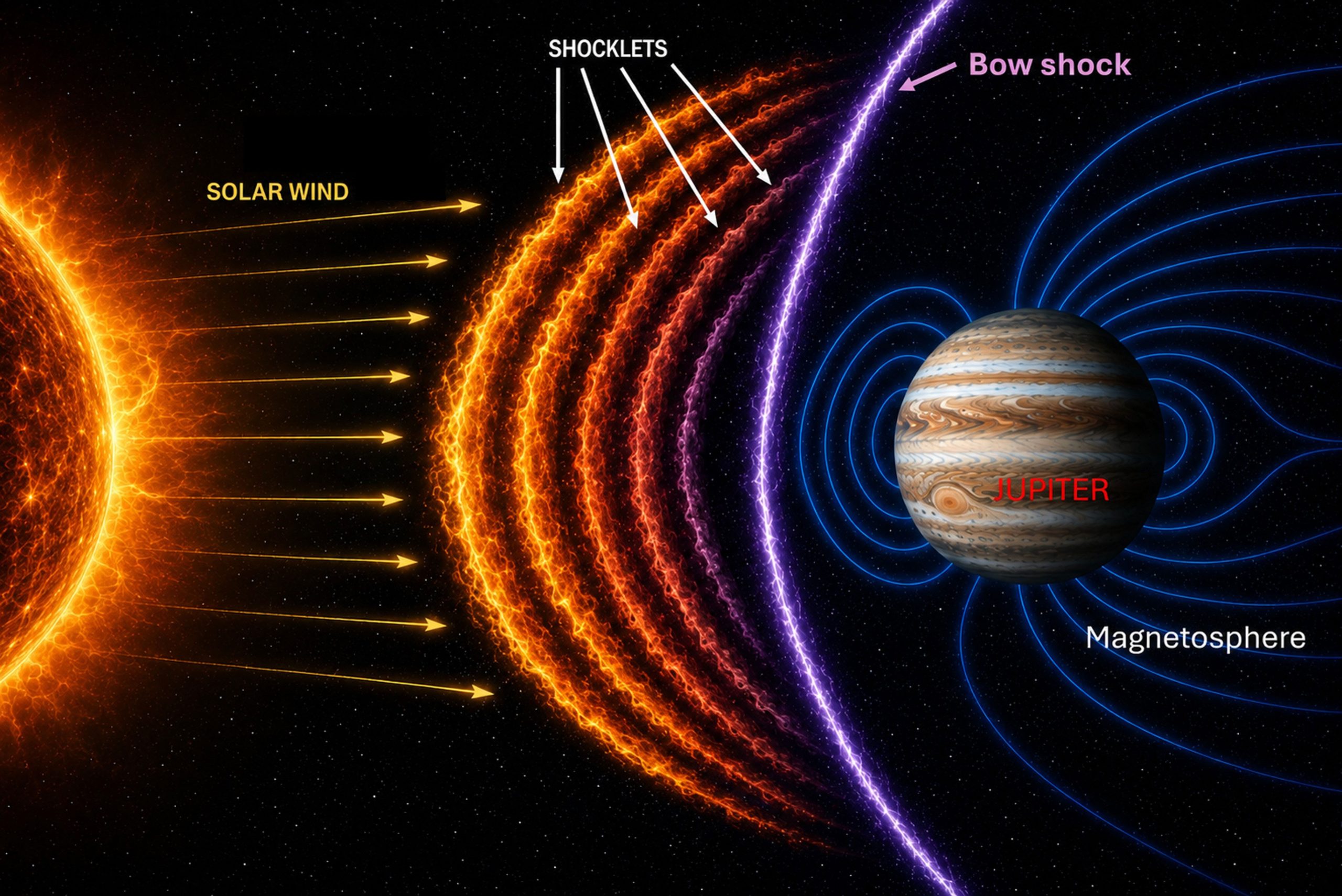
New observations from NASA’s Juno mission are revealing that Jupiter’s bow shock behaves in more complex ways than its counterpart at Earth.
NASA’s Juno spacecraft has captured the most detailed measurements yet of Jupiter’s bow shock, the vast boundary where the solar wind crashes into the planet’s magnetic environment. The observations show that Jupiter manages this high-energy interaction very differently from Earth, using a more complex mix of plasma waves and smaller shock structures to slow incoming particles.
The results, reported by a University of Iowa-led team, also give researchers a nearby example of shock physics that could help them study far more energetic environments, including the remnants of exploded stars.
A bow shock forms when the solar wind, a supersonic stream of charged particles flowing from the Sun, encounters a planet’s magnetosphere. The collision forces the particles to slow, heat up, and change direction before they can penetrate farther into the planet’s magnetic surroundings.
At Earth, this process takes place mainly at a single large bow shock. That boundary helps divert much of the solar wind around the planet rather than allowing it to interact directly with the upper atmosphere.
Jupiter Uses a Broader Mix of Plasma Waves
Jupiter’s bow shock operates under much more extreme conditions. The gas giant has the largest planetary magnetosphere in the solar system, creating a much larger region where charged particles, magnetic fields, and plasma waves can interact.
The Juno observations showed that Jupiter’s bow shock contains plasma waves spread across multiple frequencies, which the researchers describe as “harmonics.” Instead of relying mainly on one dominant frequency, as occurs at Earth, Jupiter appears to use a richer spectrum of waves that can transfer energy to a wider range of incoming particles.
That interaction helps heat and slow the solar wind before it moves deeper into Jupiter’s magnetic environment.
“Jupiter has found its own way to deal with the solar wind, through plasma waves that are stronger and exhibit richer harmonic structures,” says Jayasri Joseph, a postdoctoral researcher in the Department of Physics and Astronomy at Iowa and the study’s corresponding author. “That’s important because if you have multiple frequencies, you can heat more particles in the solar wind and slow them down.”
Smaller Shocklets Slow Particles Before the Main Boundary
Jupiter also appears to begin processing the solar wind before it reaches the planet’s primary bow shock. Juno detected a series of smaller regions called shocklets that interact with incoming particles and slow them in stages.
Earth does not show the same level of complexity. Its main bow shock carries out most of the work of decelerating and redirecting the solar wind.
“Earth does not need to take these extra steps to handle the solar wind because the impact isn’t as powerful,” says Bill Kurth, research scientist in the Department of Physics and Astronomy at Iowa and study co-author, who has been involved with the Juno mission since its launch in 2011.
A Nearby Test Case for More Extreme Cosmic Shocks
Shock waves also occur in far more energetic astrophysical settings, including supernova remnants. These expanding structures form after certain stars explode and can accelerate particles while converting enormous amounts of bulk motion into heat and other forms of energy.
Jupiter cannot reproduce the full conditions around a supernova remnant, but its bow shock provides a much closer environment where researchers can directly measure some of the plasma processes involved.
“Because even more powerful shocks occur around astrophysical objects such as supernova remnants, Jupiter’s bow shock offers a nearby natural laboratory for exploring and for understanding how nature converts enormous amounts of flow energy into heat and energetic particles,” Joseph says.nbs
The findings are based on data Juno collected in December 2024. The spacecraft has been orbiting Jupiter since July 2016, repeatedly passing through regions shaped by the planet’s enormous magnetic field.
University of Iowa physicists designed and built Juno’s Waves instrument, which measures radio and plasma waves around Jupiter. Earlier spacecraft had confirmed the presence of Jupiter’s bow shock, but Juno provided the measurements needed to resolve the more complicated wave structures occurring within it.
Reference: “Plasma wave observations from Juno spacecraft at the Jovian bow shock” by J. Joseph, W. S. Kurth, L. B. Wilson III, J. E. P. Connerney, F. Allegrini, R. J. Wilson, A. H. Sulaiman, R. W. Ebert, J. B. Faden, C. W. Piker, A. N. Jaynes, B. H. Mauk and S. J. Bolton, 31 July 2026, Nature Communications.
DOI: 10.1038/s41467-026-76223-x
NASA funded the research.
Never miss a breakthrough: Join the SciTechDaily newsletter.
Follow us on Google and Google News.