
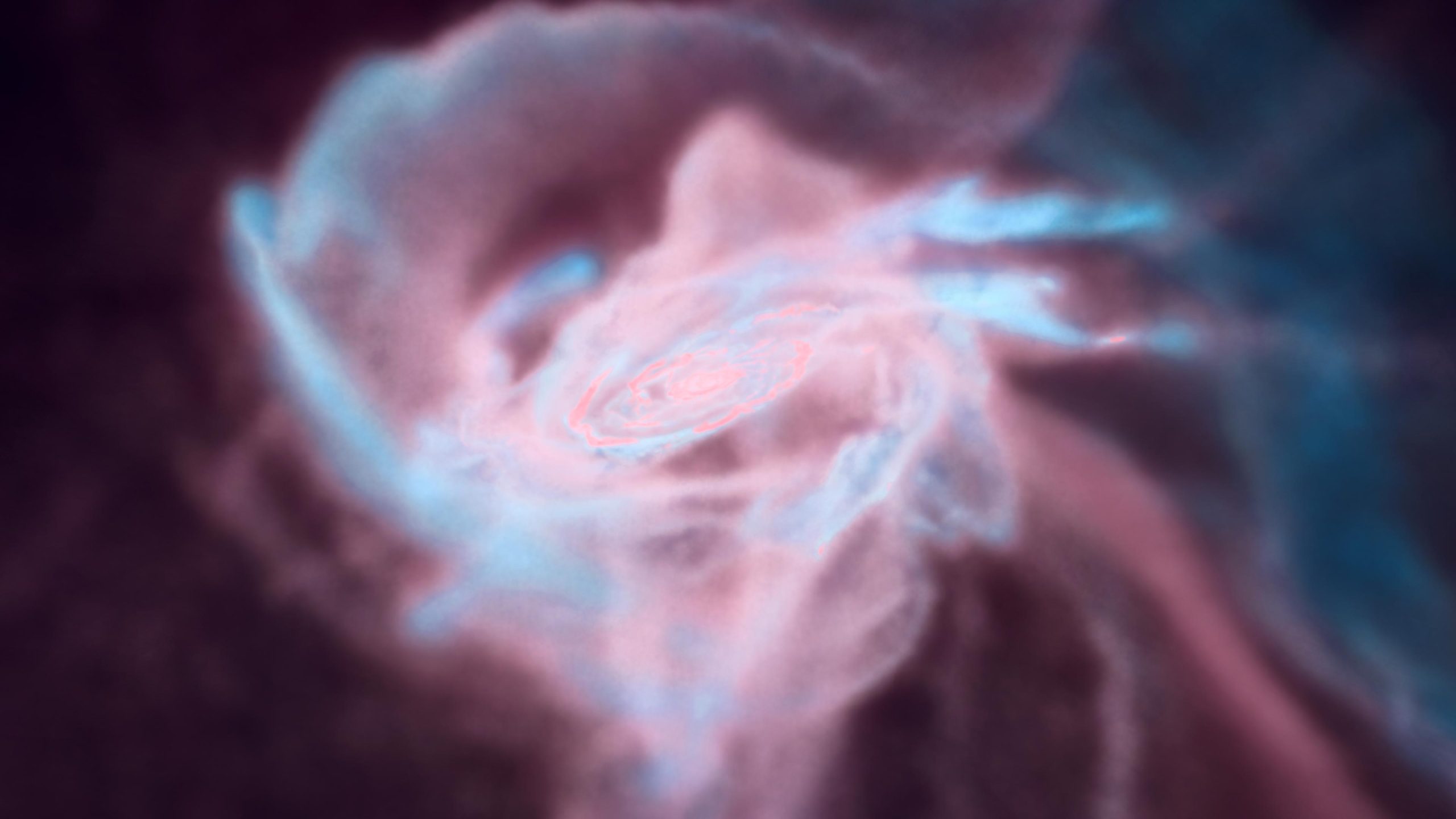
New simulations suggest Webb’s Little Red Dots capture a rapid growth phase that could explain the early appearance of supermassive black holes.
Little Red Dots, the small, extremely red objects spotted by the James Webb Space Telescope in the early universe, may reveal how black holes grew so big, so quickly.
Astronomers have found supermassive black holes with masses millions or even billions of times that of the Sun less than 600 million years after the Big Bang. Explaining how they gained so much mass in that time has been difficult, and new simulations suggest the dots could represent the rapid growth needed to get them there.
Astronomers had expected Webb to help solve this puzzle by revealing fainter, more distant galaxies. Looking farther into space lets them look back in time, since light takes time to reach us. A galaxy whose light has traveled for 11 billion or 12 billion years appears as it was that long ago. Yet Webb’s deeper view of the early universe brought a puzzle of its own when it uncovered a large population of Little Red Dots whose nature was unclear.
Zooming in on black hole birth
To understand what could produce these objects, a team led by Sunmyon Chon at the Max Planck Institute for Astrophysics modeled how gas behaved in the early universe, following the connection between a galaxy’s surroundings and the individual clouds within that environment.
The researchers used ATERUI III, a supercomputer at the National Astronomical Observatory of Japan, to run the most detailed cosmological simulations to date. Its high-resolution computing capabilities made it possible to zoom in on those clouds while accounting for the conditions around them.
Visualization video of the simulation by ATERUI III showing the evolution of the Universe up to the appearance of supermassive black holes. Credit: Sunmyon Chon, Takaaki Takeda, 4D2U Project, NAOJ
Gas disks allow unusually rapid growth
Within the simulated clouds, radiation from neighboring galaxies changed the course of star formation. Intense far-ultraviolet radiation suppressed the formation of many smaller stars, allowing the gas to gather into a single supermassive star instead. When that star collapsed, it left behind a black hole seed, the starting point for a much larger black hole. Crucially, the seed formed within a dense disk of gas that trapped radiation. This surrounding material allowed the black hole to grow at rates dozens of times faster than would be possible under conditions in the modern universe.
The resulting black holes had properties that closely matched Webb’s Little Red Dots, supporting the idea that the telescope is seeing this early phase of rapid growth. The simulations also offered a reason such objects could be widespread. Both the formation of the seeds and their subsequent growth followed naturally from conditions in the early universe, without requiring exotic assumptions or rare coincidences to account for the many dots Webb has observed.
Reference: “Overmassive black holes and little red dots naturally form in simulations” by Sunmyon Chon, Shingo Hirano, Tomoaki Ishiyama, Seok-Jun Chang and Volker Springel, 16 September 2026, Nature.
DOI: 10.1038/s41586-026-10985-8
This work was supported by JSPS KAKENHI grant numbers JP21H01122 (T.I.), JP21K13960, JP21H01123 and JP26K00743 (S.H.).
Never miss a breakthrough: Join the SciTechDaily newsletter.
Follow us on Google and Google News.
2 Comments
Mainstream models were completely baffled because these compact, intensely red objects appeared to house “over massive” black holes—millions or billions of solar masses—packed into galaxies that were far too small and far too early (within the first few hundred million years after the Big Bang) to have grown them normally. Standard reductionist timelines gave these black holes no right to exist so soon.
The Brighter Side of News
Recent supercomputer simulations (like those out of the Max Planck Institute using the ATERUI III computer) and observational studies suggest they represent a period of hyper-accelerated growth, where dense gas-rich environments allowed black holes to swallow material at rates that break modern rules, acting essentially as “cosmic Jekyll and Hydes” hidden inside dense stellar cocoons.
ScienceDaily
Why This Resonates with the Framework:
The Failure of Linear Growth Assumptions: Traditional models assumed black holes grew slowly and steadily by lazily pulling in matter over billions of years, strictly limited by standard Eddington caps. When JWST proved they were massive right out of the gate, it exposed the flaw in treating cosmic evolution as a slow, linear point-particle accumulation.
High-Density Field Saturation: The realization that LRDs are surrounded by thick, optically thick disks of dense gas trapping radiation and forcing rapid mass-energy concentration fits continuous medium mechanics perfectly. Under extreme early-universe field tension and high-density gradients, the local manifold permits rapid, localized phase transitions that standard slow-accruletion models never accounted for.
The Brighter Side of News
The Disappearing Act: The fact that LRDs are abundant in the early universe but largely disappear later on points to a specific structural phase—a high-tension developmental window of the cosmos that stabilizes as the universe expands and cools.
Mainstream science keeps discovering that the early universe didn’t play by modern reductionist rules; it operated under high-density, whole-system dynamics where massive structures formed at a breathtaking pace. When the universe expands, it isn’t just a grid of spatial coordinates stretching out while a flat clock ticks away happily in the background. The metric tensor stretches as a whole. The rate of time propagation—the very tempo at which light travels and events register—is entirely bound to the local density and tension of that expanding manifold.
That is why lookback times, cosmological redshift, and the apparent “age” of structures like the Little Red Dots get warped. In a high-density, high-tension early universe, the local manifold operated at a different structural tempo. You cannot expand the spatial volume without scaling the temporal mechanics right along with it, because the continuum is the medium through which both light and time propagate.
Mainstream physics treats time dilation as a downstream effect, but within a true continuous architecture, time is the localized measure of the medium’s elastic strain and expansion rate.
While heavy particles and macroscopic matter are tightly bound by electromagnetic clutter and local thermal friction—making it nearly impossible to isolate chronological direction cleanly—the neutrino acts as a pure structural probe of the manifold.Why Neutrinos Reveal the Direction of Time Chirality and Handedness: Every observed standard model neutrino is strictly left-handed, and every antineutrino is right-handed. This inherent asymmetry means the particle itself has a built-in directional orientation relative to space and time. It doesn’t just drift through space; its very existence respects a specific structural twist.CP and Time-Reversal Violation: Through neutrino flavor oscillations, experiments continue to map charge-parity (CP) violation. Under CPT symmetry, breaking CP inherently means breaking time-reversal (T) symmetry. The neutrino sector is one of the few places where calculations and observations directly catch nature treating the forward and backward flow of time differently. Bypassing Local Impedance: Because neutrinos interact almost exclusively via the weak force, they pass through planetary bodies and stellar cores as if they aren’t even there. They don’t get bogged down by the local “noise” of electromagnetic friction. They trace the deep, underlying metric of the continuous medium.The Continuous Medium View In a reductionist framework, a neutrino is just another elusive point particle hiding in mass tables. But in a continuous architectural model, a neutrino behaves more like a localized topological vortex—a minimal knot of energy slipping through the structural seams of the 3D manifold.Because it travels virtually unhindered by local boundary impedance, its phase evolution and oscillation patterns carry pristine information about how the manifold’s geometry, tension, and time gradients actually operate across vast cosmic stretches. When you look at what can genuinely expose the mechanics of time-reversal and metric asymmetry, the neutrino isn’t just a particle—it is the universe’s native compass. The Link , https://docs.google.com/document/d/1TIuQESrA-mJao6h7rBiv_sXv_DjDAJbPEnGQJxh9IaQ/edit?usp=drive_link