
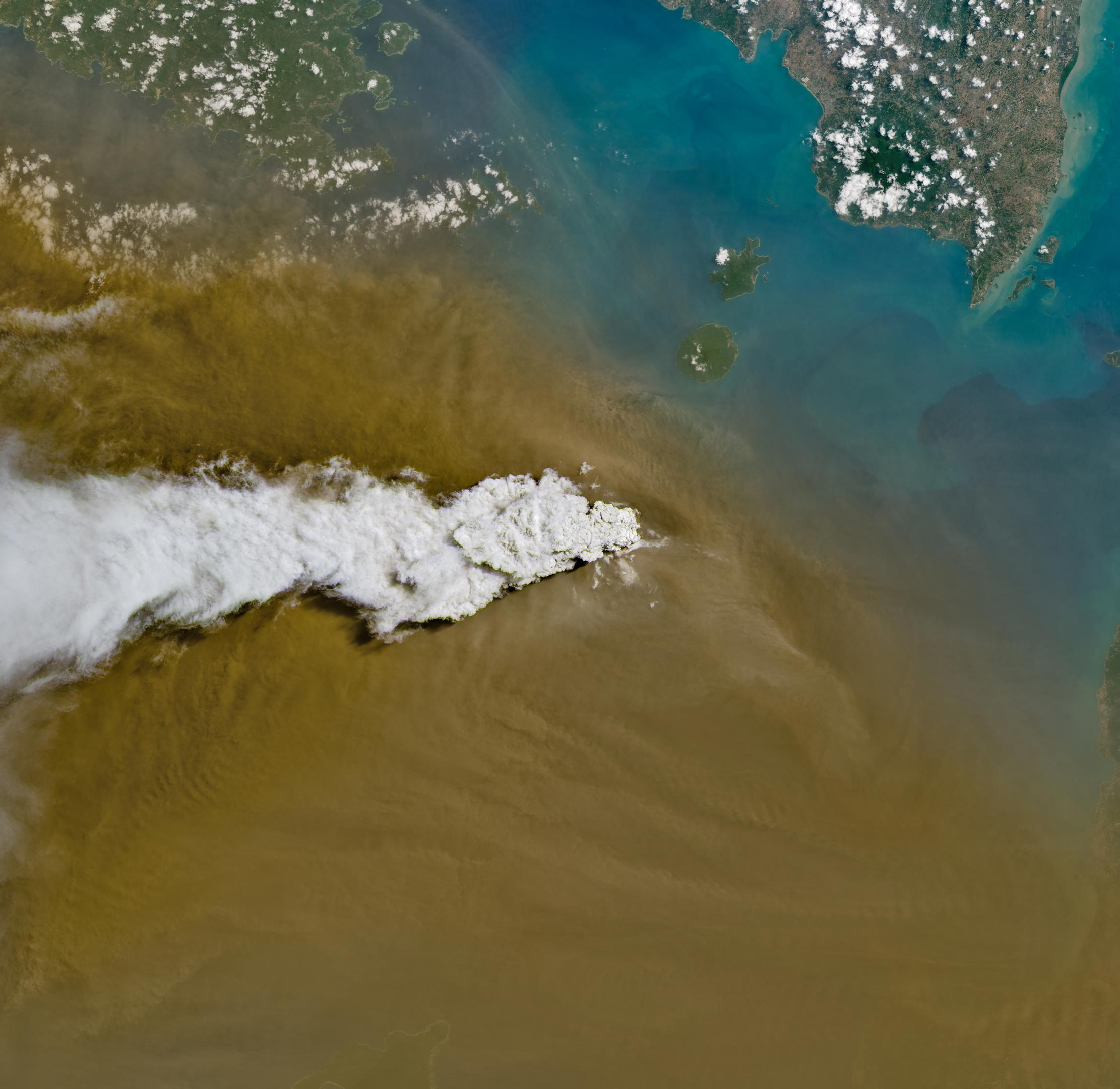
Anak Krakatau blasted ash nearly 10 miles high, disrupting thousands of flights and sending a vast plume across Indonesia.
A powerful eruption from Indonesia’s Anak Krakatau volcano sent ash high into the atmosphere, disrupting thousands of flights and worsening air quality.
Anak Krakatau, a small but highly active volcano located between the Indonesian islands of Java and Sumatra, erupts frequently. Most of its activity is relatively modest, but stronger episodes can create significant hazards. In early September 2026, the volcano produced a powerful eruption that continued for more than 24 hours, sending large amounts of gas and ash into the atmosphere. The event disrupted thousands of flights and reduced air quality in several parts of Indonesia, including Jakarta.
Satellites Capture Anak Krakatau’s Eruption
Satellites passing over the region on September 5 documented the eruption from above. The image shown above was captured by the OLI (Operational Land Imager) aboard the NASA-USGS Landsat 8 satellite. It shows a white plume of volcanic gas rising above a brown cloud of ash.
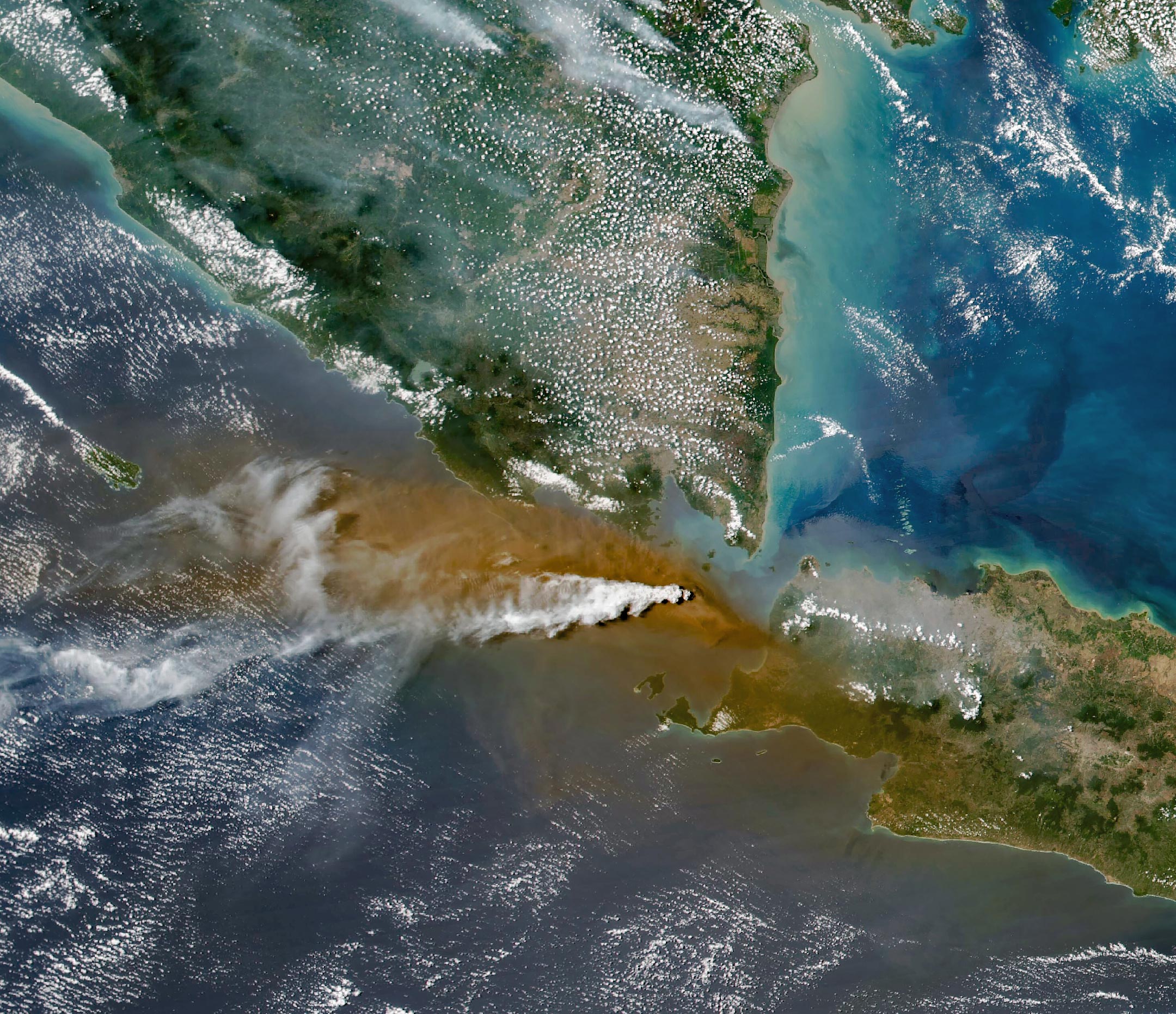
A broader view from the VIIRS (Visible Infrared Imaging Radiometer Suite) aboard the Suomi NPP satellite (below) reveals how widely the volcanic material spread across the surrounding region.
Ash Reaches 50,000 Feet
By September 6, Indonesia’s meteorological agency reported that volcanic ash had climbed as high as 6,000 meters (20,000 feet) east of Anak Krakatau and 15,000 meters (50,000 feet) west of the volcano.
The ash posed a serious hazard to aviation, leading authorities to temporarily close eight airports on Java and Sumatra. According to news reports, nearly 3,000 flights traveling into and out of the region were disrupted.
Volcanic Ash Affects Jakarta and West Java
Ashfall also reached populated areas, particularly east of Anak Krakatau in Jakarta and other parts of West Java, according to the Indonesian Humanitarian Coordination Platform (IHCP).
Volcanic ash can pose health risks because fine particles may irritate the respiratory tract, eyes, and skin. The IHCP noted, however, that the hazards associated with volcanic ash differ from those caused by smoke produced by peatland fires elsewhere in Indonesia. The two hazards differ in their particle properties, how they spread through the atmosphere, and the protective measures recommended for people exposed to them.
Anak Krakatau Continues to Rumble
The continuous explosive phase of the eruption eased on September 6, although Anak Krakatau remained active. The volcano shifted back toward its more typical pattern of Strombolian eruptions, which produce intermittent bursts of ash and other volcanic material.
Airports had resumed operation by September 8. Even so, Anak Krakatau remained at the second-highest alert level on Indonesia’s warning scale, where it has remained since early July.
Never miss a breakthrough: Join the SciTechDaily newsletter.
Follow us on Google and Google News.
4 Comments
What effect does the heat released by such localized, but very high, temperatures, have on the atmosphere?
I think it dissipates fairly quickly. The main effect of explosive volcano’s is that the ash and gases released reflect heat from the sun and hence have a cooling effect. Don’t quote me though. I may be wrong.
OK, I won’t quote you. Is it alright if I paraphrase you? 🙂
Let me rephrase my original question: If a heat dome sits over a region of a country for several days, the news media generally is concerned about the speculated excess deaths, the CO2 released into the atmosphere from above-typical levels because of the demand on air conditioning, and the impact on wildlife, especially fish. Now, instead of a heat dome, what if there is a volcanic eruption that that lasts a similar length of time spewing hot gases and laying down hot ash over a large area, which decreases the surface reflectivity? Do we just ignore it because it is ‘natural?’
Incidentally, NASA investigators Dale Quattrochi (deceased) et al. have established that the Urban Heat Island effect in Atlanta (GA), and its associated pollution, affects the precipitation and air quality for several miles down wind of urban Atlanta.