
Close Menu
    Facebook X (Twitter) Instagram
    SciTechDaily
    • Biology
    • Chemistry
    • Earth
    • Health
    • Physics
    • Science
    • Space
    • Technology
    Facebook X (Twitter) Pinterest YouTube RSS
    SciTechDaily
    Home»Earth»A Deadly Day on Mount Semeru: Destructive Rivers of Debris on Indonesian Volcano
    Earth

    A Deadly Day on Mount Semeru: Destructive Rivers of Debris on Indonesian Volcano

    By Adam Voiland, NASA Earth ObservatoryDecember 11, 2021No Comments3 Mins Read
    Facebook Twitter Pinterest Telegram LinkedIn WhatsApp Email Reddit
    Share
    Facebook Twitter LinkedIn Pinterest Telegram Email Reddit
    Mount Semeru Destructive Rivers of Debris Annotated
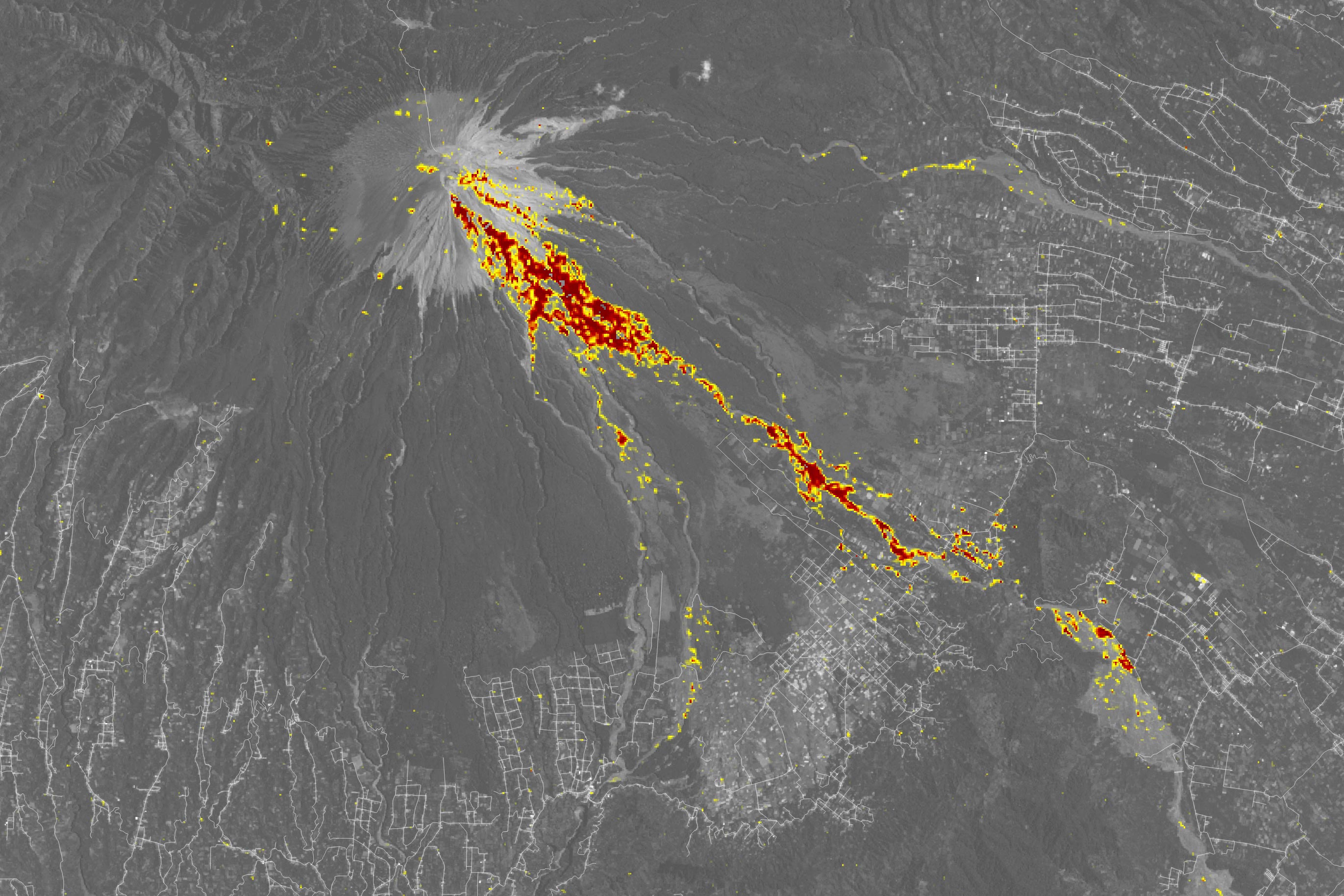
    Destructive rivers of debris on the Indonesian Mount Semeru volcano, December 7, 2021

    Flows of superheated ash and tephra mixed with rain to create destructive rivers of debris on the Indonesian volcano.

    Mount Semeru, the tallest and most active volcano on the Indonesian island of Java, has routinely spit up small, mostly harmless plumes of ash and gas for years. The circumstances changed on December 4, 2021.

    Following a partial collapse of the summit lava dome early in December, sensors began to detect elevated seismic activity, according to the Volcanological Survey of Indonesia (PVMBG). After more of Semeru’s lava dome gave way, billowing fronts of superheated ash, tephra, soil, and other debris raced down several channels on the mountain’s southeastern flank.

    Pyroclastic flows are among the most dangerous hazards posed by volcanoes. Sometimes accelerating to speeds of hundreds of kilometers per hour, these masses of volcanic material and landscape debris can be impossible to outrun. They destroy most living things in their path. Though explosive eruptions at the summit were likely small, the pyroclastic flows at Mount Semeru on December 4 were still hot enough that they likely helped propel a billowing “Phoenix cloud” that rose as high as 15 kilometers (9 miles) into the air.

    Since heavy rains preceded and accompanied the eruption, the pyroclastic flows mixed with large amounts of rainwater and morphed into muddy lahars that rushed down the mountain into populated areas. Lahars are mixtures of water and volcanic debris that behave like rivers of concrete, flattening or burying much of what they encounter.

    The damage proxy maps above show areas on the surface that were likely damaged by pyroclastic flows and lahars in December 2021. Dark red pixels represent the most severe damage, while orange and yellow areas are moderately or partially damaged. Each colored pixel represents an area of 30 meters by 30 meters (about the size of a baseball infield). Researchers from The Earth Observatory of Singapore – Remote Sensing Lab (EOS-RS) made the maps by comparing a post-eruption image from December 7, 2021, with a set of pre-eruption images from August 9, 2021, through November 21, 2021.

    The slurry of debris that swept down Semeru proved catastrophic to villagers living around the mountain’s base in the Lumajang Regency, particularly Curah Kobokan. According to The Jakarta Post, at least 39 people have died. Large numbers of homes were destroyed or damaged, and many animals are among the eruption’s victims.

    The maps were derived from synthetic aperture radar (SAR) images acquired by the Copernicus Sentinel-1 satellites, operated by the European Space Agency (ESA). The researchers used the Advanced Rapid Imaging and Analysis (ARIA) system originally developed at NASA’s Jet Propulsion Laboratory, California Institute of Technology, and modified at EOS-RS. The ARIA team is supported by NASA’s Earth Science Disasters Program.

    NASA Earth Observatory image by Lauren Dauphin, using modified Copernicus Sentinel data (2021) processed by ESA and analyzed by Earth Observatory of Singapore (EOS) in collaboration with NASA-JPL and Caltech, Landsat data from the U.S. Geological Survey., and data from OpenStreetMap.

    Never miss a breakthrough: Join the SciTechDaily newsletter.
    Follow us on Google and Google News.

    Geography NASA NASA Earth Observatory Volcano
    Share. Facebook Twitter Pinterest LinkedIn Email Reddit

    Related Articles

    Massive Tonga Volcano Plume Reached the Mesosphere – 36 Miles Into the Atmosphere

    Island Obliterated: Dramatic Changes at Hunga Tonga-Hunga Ha’apai

    Hunga Tonga Island Obliterated – NASA Satellites Capture Massive Blast

    A Wolf Awakens in the Galápagos Islands at Night

    Wall of Lava Burns a Path Through La Palma

    Cumbre Vieja Lights Up the Night – Astronaut Photo Captures Volcanic Eruption From Space

    Socked in Stratovolcano: Astronaut on ISS Captures Incredible View of Uninhabited Atlasov Island

    Kilauea’s Lava Lake Returns – Hawaii’s Most Active Volcano Is Erupting Again

    Newberry Volcano Photographed by Astronaut Onboard the International Space Station

    Leave A Reply Cancel Reply

    • Facebook
    • Twitter
    • Pinterest
    • YouTube

    Don't Miss a Discovery

    Subscribe for the Latest in Science & Tech!

    Trending News

    The Universe Is Expanding Too Fast and Scientists Can’t Explain Why

    “Like Liquid Metal”: Scientists Create Strange Shape-Shifting Material

    Early Warning Signals of Esophageal Cancer May Be Hiding in Plain Sight

    Common Blood Pressure Drug Shows Surprising Power Against Deadly Antibiotic-Resistant Superbug

    Scientists Uncover Dangerous Connection Between Serotonin and Heart Valve Disease

    Scientists Discover a “Protector” Protein That Could Help Reverse Hair Loss

    Bone-Strengthening Discovery Could Reverse Osteoporosis

    Scientists Uncover Hidden Trigger Behind Stem Cell Aging

    Follow SciTechDaily
    • Facebook
    • Twitter
    • YouTube
    • Pinterest
    • Newsletter
    • RSS
    SciTech News
    • Biology News
    • Chemistry News
    • Earth News
    • Health News
    • Physics News
    • Science News
    • Space News
    • Technology News
    Recent Posts
    • Scientists Overcome Major Quantum Bottleneck, Potentially Transforming Teleportation and Computing
    • Quantum Physics’ Strangest Problem May Hold the Key to Time Itself
    • Scientists Create “Liquid Gears” That Spin Without Touching
    • The Simple Habit That Could Help Prevent Cancer
    • Forgotten Medicinal Plant Shows Promise in Fighting Dangerous Superbugs
    Copyright © 1998 - 2026 SciTechDaily. All Rights Reserved.
    • Science News
    • About
    • Contact
    • Editorial Board
    • Privacy Policy
    • Terms of Use

    Type above and press Enter to search. Press Esc to cancel.