
Close Menu
    Facebook X (Twitter) Instagram
    SciTechDaily
    • Biology
    • Chemistry
    • Earth
    • Health
    • Physics
    • Science
    • Space
    • Technology
    Facebook X (Twitter) Pinterest YouTube RSS
    SciTechDaily
    Home»Earth»Socked in Stratovolcano: Astronaut on ISS Captures Incredible View of Uninhabited Atlasov Island
    Earth

    Socked in Stratovolcano: Astronaut on ISS Captures Incredible View of Uninhabited Atlasov Island

    By NASA Earth ObservatoryJanuary 10, 20214 Comments2 Mins Read
    Facebook Twitter Pinterest Telegram LinkedIn WhatsApp Email Reddit
    Share
    Facebook Twitter LinkedIn Pinterest Telegram Email Reddit
    Atlasov Island Annotated
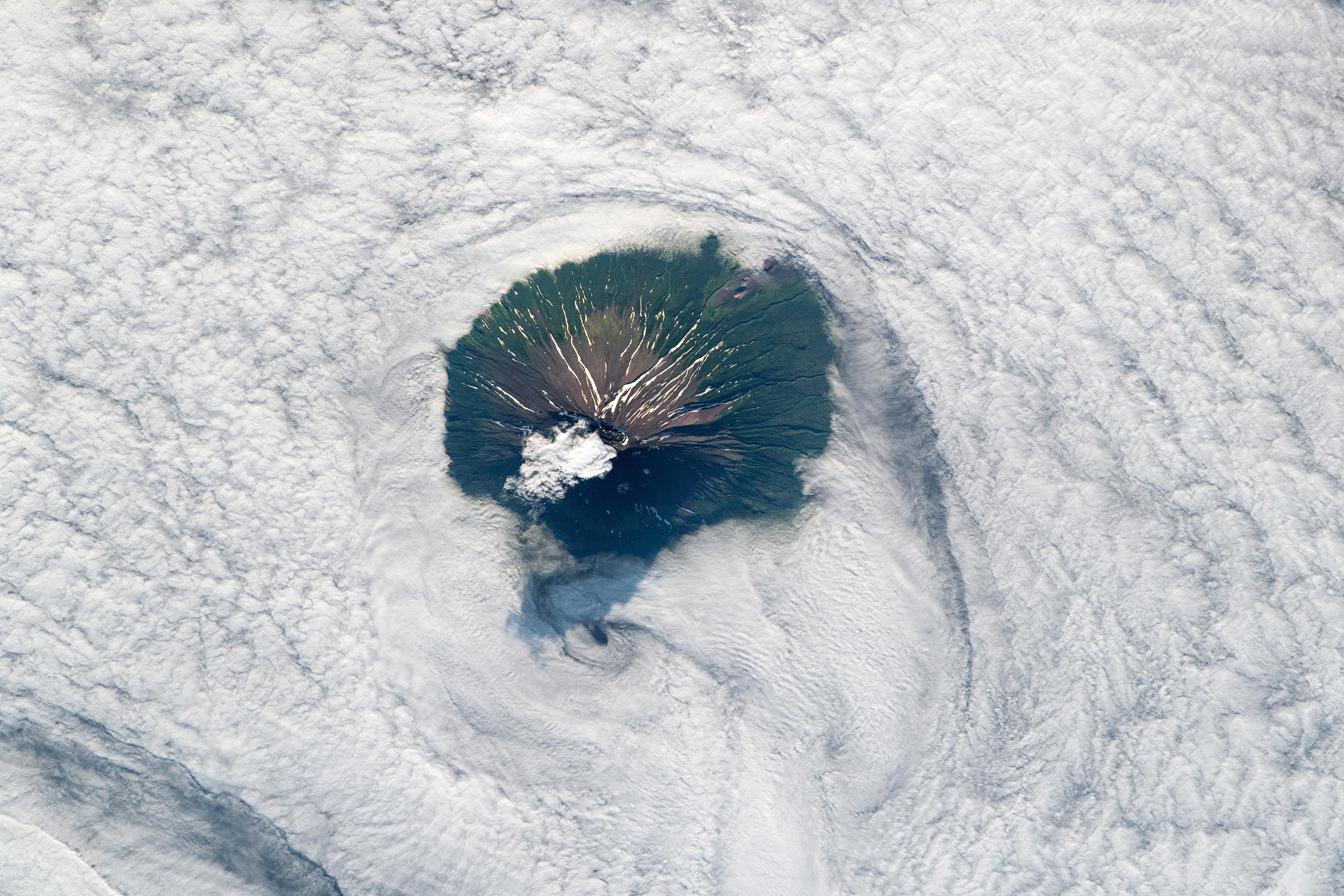
    Atlasov Island August 2, 2019. Click the image for high-resolution view.

    Atlasov Island’s Alaid Volcano, captured by the ISS, shows signs of past eruptions and lies in the tectonically active Kuril chain.

    Rising above the clouds and the Sea of Okhotsk, the uninhabited Atlasov Island appears as a distinctive dark landform from the view of an astronaut onboard the International Space Station (ISS). Formed by Alaid Volcano, Atlasov lies near the southern tip of the Kamchatka Peninsula.

    Along the slopes of the central mountain, radial features—channels, and gullies carved by liquid water and ice—are highlighted by snow as they extend towards the shoreline, which is obscured by low-lying clouds. Brown hues near the summit mark areas that are mostly barren due to steep slopes and high-altitude winter snowpack.

    Downslope among the vegetated terrain, a few parasitic cones appear on the flanks of the volcano. These small secondary cones are sites where magma has taken alternate routes to reach the surface. The area around the northwest cluster of cones lacks vegetation due to a 1972 eruption.

    This stratovolcano is not as isolated as this picture might imply. It is part of a volcanic archipelago known as the Kuril Islands, which stretch from northeast Japan to Kamchatka. The islands are situated above a boundary where the Pacific and Okhotsk tectonic plates converge. At this margin, the denser Pacific Plate subducts below the other, leading to volcanism. Alaid is still active, with reports of ash plumes as recently as September 2019.

    Astronaut photograph ISS060-E-21034 was acquired on August 2, 2019, with a Nikon D5 digital camera using a 400 millimeter lens and is provided by the ISS Crew Earth Observations Facility and the Earth Science and Remote Sensing Unit, Johnson Space Center. The image was taken by a member of the Expedition 64 crew. The image has been cropped and enhanced to improve contrast, and lens artifacts have been removed. The International Space Station Program supports the laboratory as part of the ISS National Lab to help astronauts take pictures of Earth that will be of the greatest value to scientists and the public, and to make those images freely available on the Internet. Additional images taken by astronauts and cosmonauts can be viewed at the NASA/JSC Gateway to Astronaut Photography of Earth. Caption by Andrew Britton, Jacobs, JETS Contract at NASA-JSC.

    Never miss a breakthrough: Join the SciTechDaily newsletter.
    Follow us on Google and Google News.

    Astronaut Geography International Space Station NASA NASA Earth Observatory Volcano
    Share. Facebook Twitter Pinterest LinkedIn Email Reddit

    Related Articles

    Eroded Beauty in the Sahara Desert Revealed in Stunning Astronaut Photo

    Paleozoic Plymouths: Plymouth, Massachusetts, and Plymouth, England, Share a Historical Connection Even Older Than the First Thanksgiving

    Cumbre Vieja Lights Up the Night – Astronaut Photo Captures Volcanic Eruption From Space

    NASA Picturing Earth: Behind the Scenes [Video]

    Fisheye Over Sinai: Capturing the Intersection of Two Continents From Space

    Ecologically Important El Bibane Lagoon Photographed by Astronaut Aboard the Space Station

    NASA Picturing Earth: Astronaut Photography In Focus [Video]

    Coloring the Great Salt Lake – Astronaut Takes Beautiful Photograph From Space Station

    Dazzling Photo of Chinese Port Cities at Night Taken by an Astronaut on the International Space Station

    4 Comments

    1. Michael DeZelar on January 10, 2021 7:11 pm

      The article is incorrect. At the time the photograph was taken, it was Expedition 60, not ex m Expedition 64 (which is the current crew on station).

      Reply
    2. Yawn AtMichael on November 28, 2024 8:57 am

      Thank you Michael. Please pick up your humble-brag reward upon leaving the exhibit. It was very important information you relayed. I feel forever changed.

      Reply
      • Enlightened by Michael on January 1, 2025 5:25 am

        Thank you YAM! 😂

        Reply
    3. Enlightened by Michael on January 1, 2025 5:26 am

      Thank you YAM! 😂

      Reply
    Leave A Reply Cancel Reply

    • Facebook
    • Twitter
    • Pinterest
    • YouTube

    Don't Miss a Discovery

    Subscribe for the Latest in Science & Tech!

    Trending News

    Scientists May Have Solved a Long-Standing Melanoma Treatment Mystery

    This Flesh-Eating Fly Is Back in the U.S. – Scientists Are Tracking Where It Could Strike Next

    Scientists Have Uncovered a Troubling New Pattern Hidden in America’s Rivers

    “Entirely Surprising” – Scientists Have Found a Martian Meteorite Unlike Any Known Before

    “Find of the Year” – Archaeologists Discover the Smallest Ice Age Figurines Ever Found

    New Research Challenges Common Exercise Advice for Bone Health

    Avoiding These 3 Health Risks in Midlife Linked to 13 More Years Without Dementia

    Where Were All the Tiny Dinosaurs? Scientists May Finally Have an Answer

    Follow SciTechDaily
    • Facebook
    • Twitter
    • YouTube
    • Pinterest
    • Newsletter
    • RSS
    SciTech News
    • Biology News
    • Chemistry News
    • Earth News
    • Health News
    • Physics News
    • Science News
    • Space News
    • Technology News
    Recent Posts
    • Scientists Discover a Hidden Hormone Pathway That Protects the Liver From Damage
    • Quitting Alcohol Can Change the Brain in Surprising Ways, Mouse Study Finds
    • FDA-Approved Drug Shows Promise for Reversing Osteoarthritis Damage
    • A 2-Billion-Year-Old Clue Challenges a Popular Earth Science Theory
    • Paleontologists Reconstruct 56-Million-Year-Old Forests – and Find a Chilling Warning for Today
    Copyright © 1998 - 2026 SciTechDaily. All Rights Reserved.
    • Science News
    • About
    • Contact
    • Editorial Board
    • Privacy Policy
    • Terms of Use

    Type above and press Enter to search. Press Esc to cancel.