
Close Menu
    Facebook X (Twitter) Instagram
    SciTechDaily
    • Biology
    • Chemistry
    • Earth
    • Health
    • Physics
    • Science
    • Space
    • Technology
    Facebook X (Twitter) Pinterest YouTube RSS
    SciTechDaily
    Home»Space»New ESO Image of Star Cluster Messier 7
    Space

    New ESO Image of Star Cluster Messier 7

    By ESOFebruary 25, 2014No Comments4 Mins Read
    Facebook Twitter Pinterest Telegram LinkedIn WhatsApp Email Reddit
    Share
    Facebook Twitter LinkedIn Pinterest Telegram Email Reddit
    New ESO Image of Star Cluster Messier 7
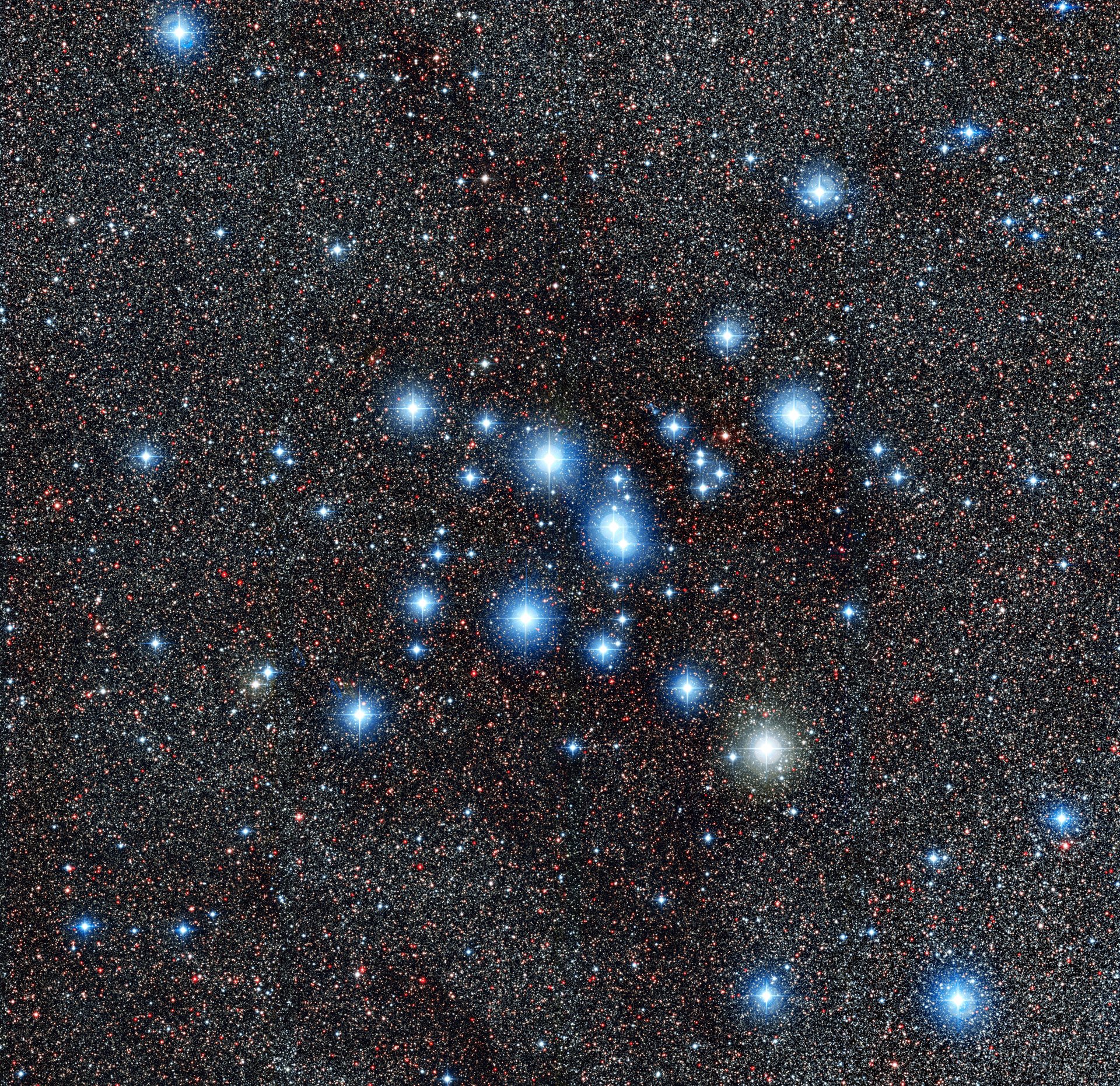
    This new image from the Wide Field Imager on the MPG/ESO 2.2-meter telescope at ESO’s La Silla Observatory in Chile, shows the bright star cluster Messier 7, also known as NGC 6475. Easily spotted by the naked eye in the direction of the tail of the constellation of Scorpius (The Scorpion), this cluster is one of the most prominent open clusters of stars in the sky and an important research target. Credit: ESO

    This newly released image of star cluster Messier 7 was taken by the Wide Field Imager on the MPG/ESO 2.2-meter telescope.

    A new image from ESO’s La Silla Observatory in Chile shows the bright star cluster Messier 7. Easily spotted with the naked eye close to the tail of the constellation of Scorpius, it is one of the most prominent open clusters of stars in the sky — making it an important astronomical research target.

    Messier 7, also known as NGC 6475, is a brilliant cluster of about 100 stars located some 800 light-years from Earth. In this new picture from the Wide Field Imager on the MPG/ESO 2.2-meter (7.2-foot) telescope it stands out against a very rich background of hundreds of thousands of fainter stars, in the direction of the center of the Milky Way.

    At about 200 million years old, Messier 7 is a typical middle-aged open cluster, spanning a region of space about 25 light-years across. As they age, the brightest stars in the picture — a population of up to a tenth of the total stars in the cluster — will violently explode as supernovae. Looking further into the future, the remaining faint stars, which are much more numerous, will slowly drift apart until they become no longer recognizable as a cluster.

    Open star clusters like Messier 7 are groups of stars born at almost the same time and place, from large cosmic clouds of gas and dust in their host galaxy. These groups of stars are of great interest to scientists, because the stars in them have about the same age and chemical composition. This makes them invaluable for studying stellar structure and evolution.

    An interesting feature in this image is that, although densely populated with stars, the background is not uniform and is noticeably streaked with dust. This is most likely to be just a chance alignment of the cluster and the dust clouds. Although it is tempting to speculate that these dark shreds are the remnants of the cloud from which the cluster formed, the Milky Way will have made nearly one full rotation during the life of this star cluster, with a lot of reorganization of the stars and dust as a result. So the dust and gas from which Messier 7 formed, and the star cluster itself, will have gone their separate ways long ago.


    This video pan sequence gives a close-up view of one of the brightest star clusters in the sky. This image from the Wide Field Imager on the MPG/ESO 2.2-meter telescope at ESO’s La Silla Observatory in Chile, shows Messier 7, also known as NGC 6475. Easily spotted by the naked eye in the direction of the tail of the constellation Scorpius (The Scorpion), this cluster is one of the most prominent open clusters of stars in the sky and is an important research target. Credit: ESO. Music: movetwo

    The first to mention this star cluster was the mathematician and astronomer Claudius Ptolemy, as early as 130 AD, who described it as a “nebula following the sting of Scorpius”, an accurate description given that, to the naked eye, it appears as a diffuse luminous patch against the bright background of the Milky Way. In his honor, Messier 7 is sometimes called Ptolemy’s Cluster. In 1764 Charles Messier included it as the seventh entry in his Messier catalog. Later, in the 19th century, John Herschel described the appearance of this object as seen through a telescope as a “coarsely scattered cluster of stars” — which sums it up perfectly.

    Never miss a breakthrough: Join the SciTechDaily newsletter.
    Follow us on Google and Google News.

    Astronomy European Southern Observatory
    Share. Facebook Twitter Pinterest LinkedIn Email Reddit

    Related Articles

    Supermassive Black Holes on a Collision Course: Closest Pair of Supermassive Black Holes to Earth Ever Discovered

    Black Hole Discovered Lurking in Star Cluster Outside Our Galaxy

    Discovery in a Galaxy Over 12 Billion Light-Years Away – Reveals How Element Found in Our Bones Is Forged in the Universe

    Strange 160 Mile-Long “Dog-Bone” Asteroid Kleopatra Captured in Detailed Images

    Astronomers Find Small Rocky Planet – Just Half the Mass of Venus

    First Clear Detection of a Moon-Forming Disc Around a Planet Outside Our Solar System

    Mystery Solved: Astronomers Unravel the Puzzle of Betelgeuse’s “Great Dimming”

    Stunning Galactic Fireworks: New ESO Images Reveal Spectacular Features of Nearby Galaxies

    Astronomers Were Puzzled by “Great Dimming” of Betelgeuse – Now the Mystery Is Solved

    Leave A Reply Cancel Reply

    • Facebook
    • Twitter
    • Pinterest
    • YouTube

    Don't Miss a Discovery

    Subscribe for the Latest in Science & Tech!

    Trending News

    Your Blood Pressure Reading Could Be Wrong Because of One Simple Mistake

    Astronomers Stunned by Ancient Galaxy With No Spin

    Physicists May Be on the Verge of Discovering “New Physics” at CERN

    Scientists Solve 320-Million-Year Mystery of Reptile Skin Armor

    Scientists Say This Daily Walking Habit May Be the Secret to Keeping Weight Off After Dieting

    New Therapy Rewires the Brain To Restore Joy in Depression Patients

    Giant Squid Detected off Western Australia in Stunning Deep-Sea Discovery

    Popular Sugar-Free Sweetener Linked to Liver Disease, Study Warns

    Follow SciTechDaily
    • Facebook
    • Twitter
    • YouTube
    • Pinterest
    • Newsletter
    • RSS
    SciTech News
    • Biology News
    • Chemistry News
    • Earth News
    • Health News
    • Physics News
    • Science News
    • Space News
    • Technology News
    Recent Posts
    • Eating One Egg a Day Could Cut Alzheimer’s Risk by 27%
    • Hidden Warm Water Beneath Antarctica Could Rapidly Raise Global Sea Levels
    • Scientists Revive Ancient Chemistry Trick To Engineer Next-Generation Glass
    • Scientists Use AI To Supercharge Ultrafast Laser Simulations by More Than 250x
    • Scientists Just Found a Surprising Way To Destroy “Forever Chemicals”
    Copyright © 1998 - 2026 SciTechDaily. All Rights Reserved.
    • Science News
    • About
    • Contact
    • Editorial Board
    • Privacy Policy
    • Terms of Use

    Type above and press Enter to search. Press Esc to cancel.