
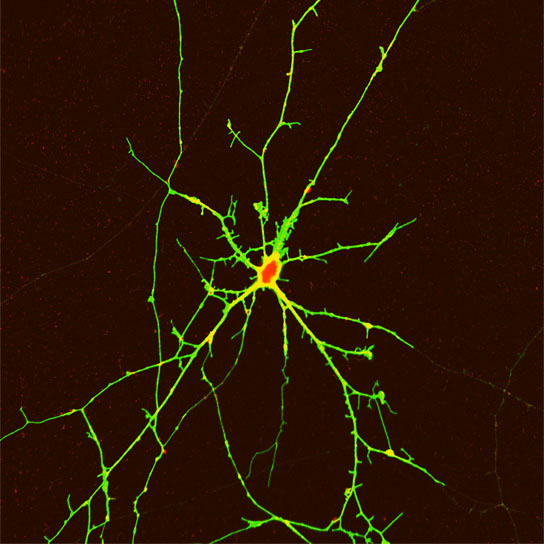
A new study showed that locomotion could be restored in mice with a Huntington’s-like condition by using GABA neurons forged from human embryonic stem cells. The study shows that the cells integrated into the brain, projected to the right target and effectively reestablished the broken communication network, restoring motor function.
Huntington’s disease, the debilitating congenital neurological disorder that progressively robs patients of muscle coordination and cognitive ability, is a condition without effective treatment, a slow death sentence.
But if researchers can build on new research reported this week (March 16, 2012) in the journal Cell Stem Cell, a special type of brain cell forged from stem cells could help restore the muscle coordination deficits that cause the uncontrollable spasms characteristic of the disease.
“This is really something unexpected,” says Su-Chun Zhang, a University of Wisconsin-Madison neuroscientist and the senior author of the new study, which showed that locomotion could be restored in mice with a Huntington’s-like condition.
Zhang is an expert at making different types of brain cells from human embryonic or induced pluripotent stem cells. In the new study, his group focused on what are known as GABA neurons, cells whose degradation is responsible for disruption of a key neural circuit and loss of motor function in Huntington’s patients. GABA neurons, Zhang explains, produce a key neurotransmitter, a chemical that helps underpin the communication network in the brain that coordinates movement.
In the laboratory, Zhang and his colleagues at the UW-Madison Waisman Center have learned how to make large amounts of GABA neurons from human embryonic stem cells, which they sought to test in a mouse model of Huntington’s disease. The goal of the study, Zhang notes, was simply to see if the cells would safely integrate into the mouse brain. To their astonishment, the cells not only integrated but also project to the right target and effectively re-established the broken communication network, restoring motor function.
The results of the study were surprising, Zhang explains, because GABA neurons reside in one part of the brain, the basal ganglia, which plays a key role in voluntary motor coordination. But the GABA neurons exert their influence at a distance on cells in the midbrain through the circuit fueled by the GABA neuron chemical neurotransmitter.
“This circuitry is essential for motor coordination,” Zhang says, “and it is what is broken in Huntington patients. The GABA neurons exert their influence at a distance through this circuit. Their cell targets are far away.”
That the transplanted cells could effectively reestablish the circuit was completely unexpected: “Many in the field feel that successful cell transplants would be impossible because it would require rebuilding the circuitry. But what we’ve shown is that the GABA neurons can remake the circuitry and produce the right neurotransmitter.”
The implications of the new study are important not only because they suggest it may one day be possible to use cell therapy to treat Huntington’s, but also because it suggests the adult brain may be more malleable than previously believed.
The adult brain, notes Zhang, is considered by neuroscientists to be stable, and not easily susceptible to therapies that seek to correct things like the broken circuits at the root of conditions like Huntington’s. For a therapy to work, it has to be engineered so that only cells of interest are affected. “The brain is wired in such a precise way that if a neuron projects the wrong way, it could be chaotic.”
Zhang stresses that while the new research is promising, working up from the mouse model to human patients will take much time and effort. But for a disease that now has no effective treatment, the work could become the next best hope for those with Huntington’s.
Reference: “Human Embryonic Stem Cell-Derived GABA Neurons Correct Locomotion Deficits in Quinolinic Acid-Lesioned Mice” by Lixiang Ma, Baoyang Hu, Yan Liu, Scott Christopher Vermilyea, Huisheng Liu, Lu Gao, Yan Sun, Xiaoqing Zhang and Su-Chun Zhang, 16 March 2012, Cell Stem Cell.
DOI: 10.1016/j.stem.2012.01.021
The new study was funded by the U.S. National Institutes of Health and the Chinese Ministry of Science and Technology.
Never miss a breakthrough: Join the SciTechDaily newsletter.
Follow us on Google and Google News.
1 Comment
GOOOOOOD