
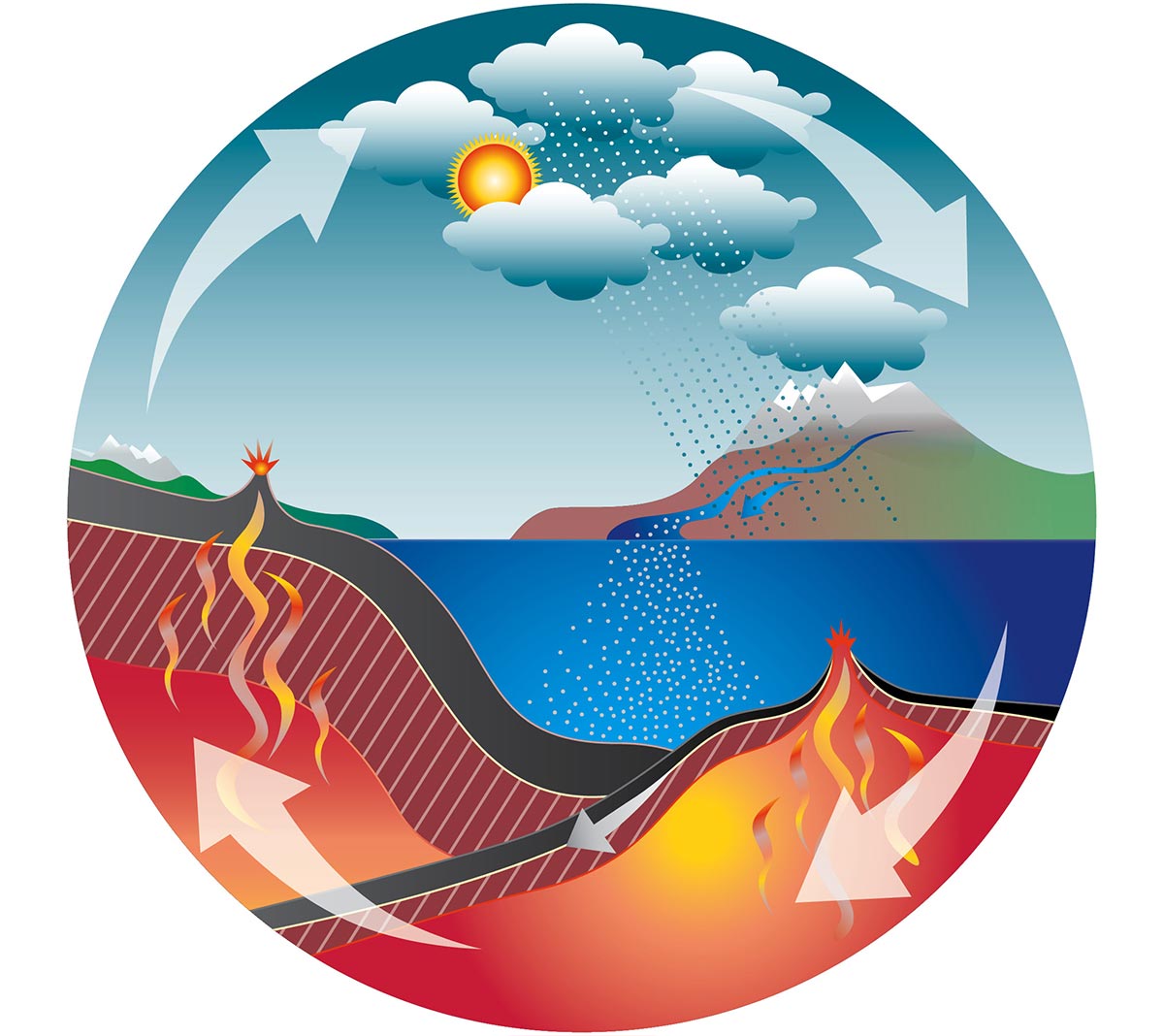
The weathering of silicate rocks plays an important role to keep the climate on Earth clement. Scientists led by the University of Bern and the Swiss National Center of Competence in Research (NCCR) PlanetS, investigated the general principles of this process. Their results could influence how we interpret the signals from distant worlds – including such that may hint towards life.
The conditions on Earth are ideal for life. Most places on our planet are neither too hot nor too cold and offer liquid water. These and other requirements for life, however, delicately depend on the right composition of the atmosphere. Too little or too much of certain gases — like carbon dioxide — and Earth could become a ball of ice or turn into a pressure cooker. When scientists look for potentially habitable planets, a key component is therefore their atmosphere.
Sometimes, that atmosphere is primitive and largely consists of the gases that were around when the planet formed — as is the case for Jupiter and Saturn. On terrestrial planets like Mars, Venus, or Earth, however, such primitive atmospheres are lost. Instead, their remaining atmospheres are strongly influenced by surface geochemistry. Processes like the weathering of rocks alter the composition of the atmosphere and thereby influence the habitability of the planet.

How exactly this works, especially under conditions very different from those on Earth, is what a team of scientists, led by Kaustubh Hakim of the Centre for Space and Habitability (CSH) at the University of Bern and the NCCR PlanetS, investigated. Their results were published on March 11, 2021, in The Planetary Science Journal.
Conditions Are Decisive
“We want to understand how the chemical reactions between the atmosphere and the surface of planets change the composition of the atmosphere. On Earth, this process — the weathering of silicate rocks assisted by water — helps to maintain a temperate climate over long periods of time,” Hakim explains. “When the concentration of CO2 increases, temperatures also rise because of its greenhouse effect. Higher temperatures lead to more intense rainfall. Silicate weathering rates increase, which in turn reduce the CO2 concentration and subsequently lower the temperature,” says the researcher.
However, it need not necessarily work the same way on other planets. Using computer simulations, the team tested how different conditions affect the weathering process. For example, they found that even in very arid climates, weathering can be more intense than on Earth if the chemical reactions occur sufficiently quickly. Rock types, too, influence the process and can lead to very different weathering rates according to Hakim. The team also found that at temperatures of around 70°C, contrary to popular theory, silicate weathering rates can decrease with rising temperatures. “This shows that for planets with very different conditions than on Earth, weathering could play very different roles,” Hakim says.
Implications for Habitability and Life Detection
If astronomers ever find a habitable world, it will likely be in what they call the habitable zone. This zone is the area around a star, where the dose of radiation would allow water to be liquid. In the solar system, this zone roughly lies between Mars and Venus.

“Geochemistry has a profound impact on the habitability of planets in the habitable zone,” study co-author and professor of astronomy and planetary sciences at the University of Bern and member of the NCCR PlanetS, Kevin Heng, points out. As the team’s results indicate, increasing temperatures could reduce weathering and its balancing effect on other planets. What would potentially be a habitable world could turn out to be a hellish greenhouse instead.
As Heng further explains, understanding geochemical processes under different conditions is not only important to estimate the potential for life, but also for its detection. “Unless we have some idea of the results of geochemical processes under varying conditions, we will not be able to tell whether bio-signatures — possible hints of life like the Phosphine that was found on Venus last year — indeed come from biological activity,” the researcher concludes.
Reference: “Lithologic Controls on Silicate Weathering Regimes of Temperate Planets” by Kaustubh Hakim, Dan J. Bower, Meng Tian, Russell Deitrick, Pierre Auclair-Desrotour, Daniel Kitzmann, Caroline Dorn, Klaus Mezger and Kevin Heng, 11 March 2021, The Planetary Science Journal.
DOI: 10.3847/PSJ/abe1b8
Center for Space and Habitability (CSH)
The mission of the Center for Space and Habitability (CSH) is to foster dialogue and interactions between the various scientific disciplines interested in the formation, detection and characterization of other worlds within and beyond the Solar System, the search for life elsewhere in the Universe, and its implications for disciplines outside of the sciences. The members, affiliates and collaborators include astronomers, astrophysicists and astrochemists, atmospheric, climate and planetary scientists, geologists and geophysicists, biochemists and philosophers. The CSH is home to the CSH and Bernoulli Fellowships, which host young, dynamic and talented researchers from all over the world to conduct independent research. It actively run a series of programs to stimulate interdisciplinary research within the University of Bern including collaborations and/or open dialogue with Medicine, Philosophy and Theology. The CSH has an active tie to the Centre for Exoplanets & Habitability of the University of Warwick. It is active in implementing gender equality measures and public outreach.
Bernese Space Exploration: With the World’s Elite Since the First Moon Landing
When the second man, “Buzz” Aldrin, stepped out of the lunar module on July 21, 1969, the first task he did was to set up the Bernese Solar Wind Composition experiment (SWC) also known as the “solar wind sail” by planting it in the ground of the moon, even before the American flag. This experiment, which was planned and the results analyzed by Prof. Dr. Johannes Geiss and his team from the Physics Institute of the University of Bern, was the first great highlight in the history of Bernese space exploration.
Ever since Bernese space exploration has been among the world’s elite. The numbers are impressive: 25 times were instruments flown into the upper atmosphere and ionosphere using rockets (1967-1993), 9 times into the stratosphere with balloon flights (1991-2008), over 30 instruments were flown on space probes, and with CHEOPS the University of Bern shares responsibility with ESA for a whole mission.
The successful work of the Department of Space Research and Planetary Sciences (WP) from the Physics Institute of the University of Bern was consolidated by the foundation of a university competence center, the Center for Space and Habitability (CSH). The Swiss National Fund also awarded the University of Bern the National Center of Competence in Research (NCCR) PlanetS, which it manages together with the University of Geneva.
Never miss a breakthrough: Join the SciTechDaily newsletter.
Follow us on Google and Google News.
5 Comments
Life is a chemical reaction controlled by electronic processors. It occurs due to the accidental placement of atoms, single crystals and molecules in electronic circuits. It exists on all planets near ALL stars, where the temperature for a certain period was greater than 0 C and less than +100 C. In the solar system on the satellites of gas giants, then moved to Phaeton, Mars, Earth, and, over time, along with the oceans and atmosphere of the Earth, will fly to Venus, when and in a spiral orbit away from the Sun and cool.
Theoretically, the possibility of the existence of quark life, for which the planets are stars, and the stars – black holes in the center of galaxies. They are 1000 times hotter, stronger, faster and smarter than us. Perhaps we sometimes see their satellites near the sun.
“The conditions on Earth are ideal for life.”
More properly, that should be “life as we know it.”
“Too little or too much of certain gases — like carbon dioxide — and Earth could become a ball of ice or turn into a pressure cooker.”
First rule of advocacy journalism: Never miss a chance to demonize carbon dioxide.
Yet, a methane atmosphere would be much worse. How about sulfur-based gasses as on Venus? How about a lack of oxygen? That would pretty much eliminate the possibility of advanced life as we know it. Why bring up carbon dioxide as the ‘poster child’ of bad gasses, if not to reinforce a meme about current political concerns, which is contested by no less than Dr. William Happer, and others with similar qualifications and experience?
Venus is the poster planet for too much carbon dioxide. It’s not so relevant to Earth as so much of our CO^2 is locked up in rocks.
From their abstract:
“We find that thermodynamic weathering rates of a continental crust-like lithology are about one to two orders of magnitude lower than those of a lithology characteristic of the oceanic crust.”
This is no great surprise as it is a direct corollary of Bowen’s Reaction Series that predicts that minerals are most stable in the temperature-pressure regime in which they first crystallized. Mafic igneous minerals tend to be unstable to meta-stable, at best, when exposed to water and oxygen at surface temperatures and pressure. One almost never finds olivine in old sediments, instead having been converted to iron-bearing oxides and silicates.
It seems that there is a bit of ‘re-inventing the wheel’ mentality here — along with the help of computers to ‘prove’ what most good geologists already knew.
A common problem in science is the unstated, and often unexamined, assumptions. The authors of this study focus on three types of igneous rocks, commonly only found in modern mountain ranges, or in craton cores exposed by glaciers. They make no allowance for the relative scarcity of the peridotite stereotype.
In reality, most of the Earth is covered by saprolites and soils, containing minerals that are highly resistant to weathering. Further, the bedrock below these soils is commonly composed of limestones and shales. The shales are largely composed of microscopic grains of chemical and mechanical-weathering resistant minerals. Neither rock type is considered in their analysis. They mention, but specifically exclude, limestones because of their slow weathering. They don’t take into consideration the well-known differences in the ratio of mechanical to chemical weathering that results from the altitude of the exposed bedrock.
The result is something that looks very sciency with all the jargon and chemical formulas. However, I can’t help but wonder about the veracity of their conclusions, considering what I would consider to be design defects in their analysis.