
Adding polymers and fireproofing to a battery’s current collectors makes it lighter, safer and about 20% more efficient.
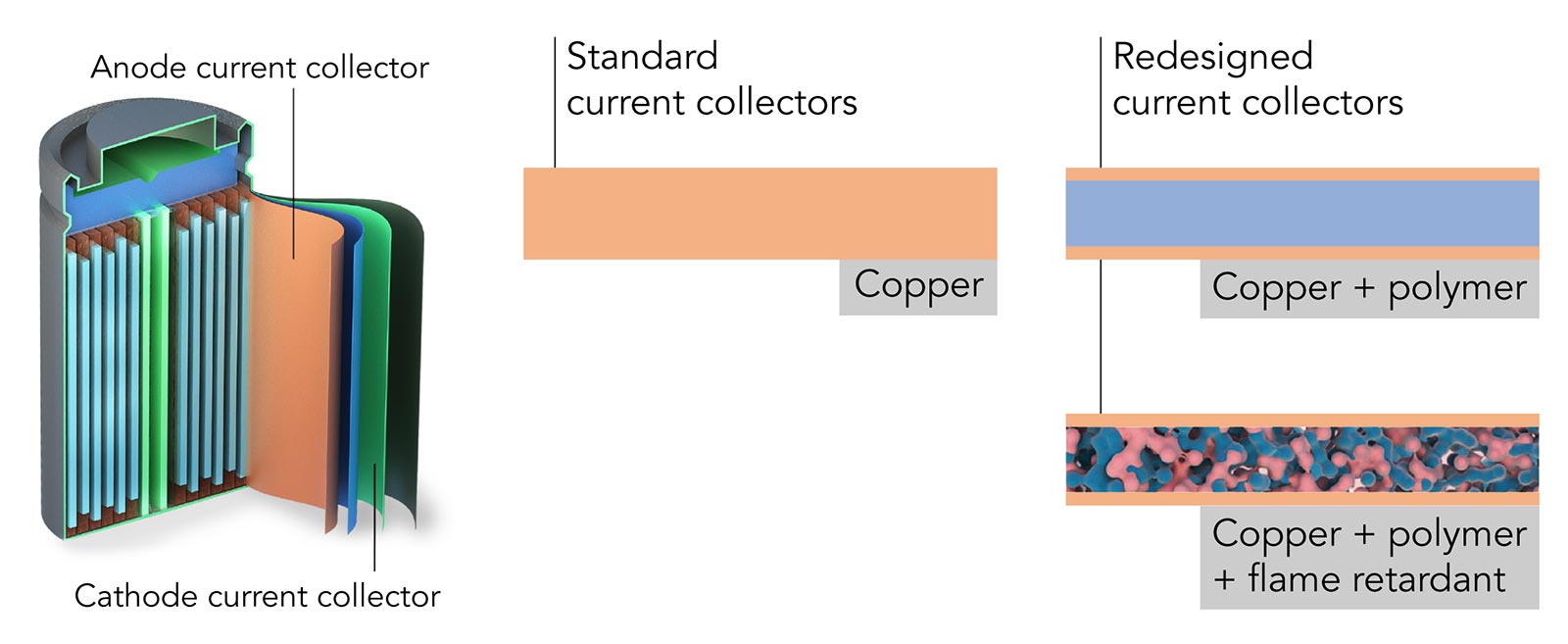
In an entirely new approach to making lithium-ion batteries lighter, safer, and more efficient, scientists at Stanford University and the Department of Energy’s SLAC National Accelerator Laboratory have re-engineered one of the heaviest battery components – sheets of copper or aluminum foil known as current collectors – so they weigh 80% less and immediately quench any fires that flare up.
If adopted, the researchers said, this technology could address two major goals of battery research: extending the driving range of electric vehicles and reducing the danger that laptops, cell phones, and other devices will burst into flames. This is especially important when batteries are charged super-fast, creating more of the types of battery damage that can lead to fires.
The research team described their work in Nature Energy on October 15, 2020.
“The current collector has always been considered dead weight, and until now it hasn’t been successfully exploited to increase battery performance,” said Yi Cui, a professor at SLAC and Stanford and investigator with the Stanford Institute for Materials and Energy Sciences (SIMES) who led the research.
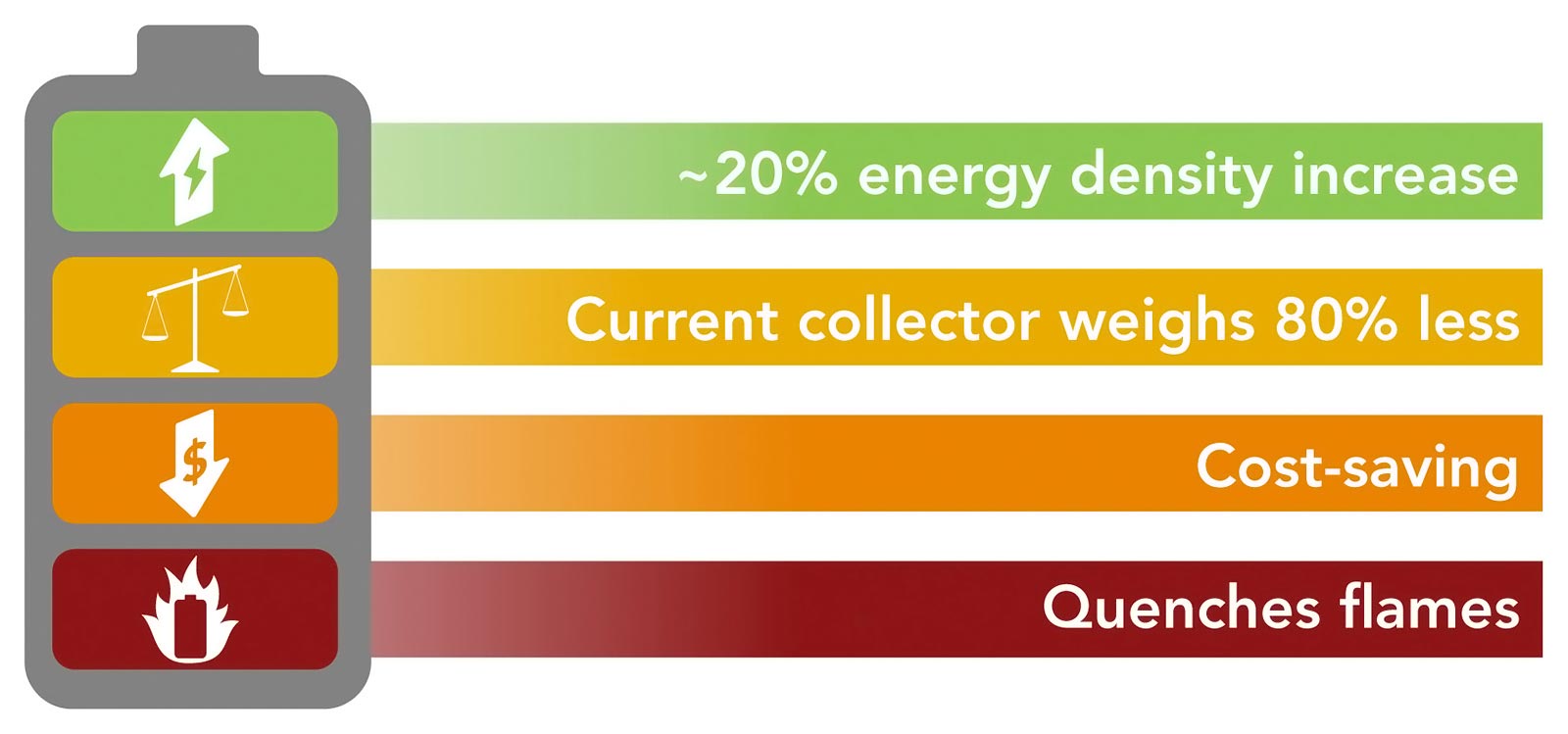
“But in our study, making the collector 80% lighter increased the energy density of lithium-ion batteries – how much energy they can store in a given weight – by 16-26%. That’s a big jump compared to the average 3% increase achieved in recent years.”
Desperately seeking weight loss
Whether they come in the form of cylinders or pouches, lithium-ion batteries have two current collectors, one for each electrode. They distribute current flowing in or out of the electrode, and account for 15% to as much as 50% of the weight of some high-power or ultrathin batteries. Shaving a battery’s weight is desirable in itself, enabling lighter devices and reducing the amount of weight electric vehicles have to lug around; storing more energy per given weight allows both devices and EVs to go longer between charges.
Reducing battery weight and flammability could also have a big impact on recycling by making the transportation of recycled batteries less expensive, Cui said.
Researchers in the battery industry have been trying to reduce the weight of current collectors by making them thinner or more porous, but these attempts have had unwanted side effects, such as making batteries more fragile or chemically unstable or requiring more electrolyte, which raises the cost, said Yusheng Ye, a postdoctoral researcher in Cui’s lab who carried out the experiments with visiting scholar Lien-Yang Chou.
As far as the safety issue, he said, “People have also tried adding fire retardant to the battery electrolyte, which is the flammable part, but you can only add so much before it becomes viscous and no longer conducts ions well.”

Designing a polymer-foil sandwich
After brainstorming the problem, Cui, Ye, and graduate student Yayuan Liu designed experiments for making and testing current collectors based on a lightweight polymer called polyimide, which resists fire and stands up to the high temperatures created by fast battery charging. A fire retardant – triphenyl phosphate, or TPP – was embedded in the polymer, which was then coated on both surfaces with an ultrathin layer of copper. The copper would not only do its usual job of distributing current, but also protect the polymer and its fire retardant.
Those changes reduced the weight of the current collector by 80% compared to today’s versions, Ye said, which translates to an energy density increase of 16-26% in various types of batteries, and it conducts current just as well as regular collectors with no degradation.
When exposed to an open flame from a lighter, pouch batteries made with today’s commercial current collectors caught fire and burned vigorously until all the electrolyte burned away, Ye said. But in batteries with the new flame-retardant collectors, the fire never really got going, producing very weak flames that went out within a few seconds, and did not flare up again even when the scientists tried to relight it.
One of the big advantages of this approach, Cui said, is that the new collector should be easy to manufacture and also cheaper, because it replaces some of the copper with an inexpensive polymer. So scaling it up for commercial production, he said, “should be very doable.” The researchers have applied for a patent through Stanford, and Cui said they will be contacting battery manufacturers to explore the possibilities.
Reference: “Ultralight and fire-extinguishing current collectors for high-energy and high-safety lithium-ion batteries” by Yusheng Ye, Lien-Yang Chou, Yayuan Liu, Hansen Wang, Hiang Kwee Lee, Wenxiao Huang, Jiayu Wan, Kai Liu, Guangmin Zhou, Yufei Yang, Ankun Yang, Xin Xiao, Xin Gao, David Thomas Boyle, Hao Chen, Wenbo Zhang, Sang Cheol Kim and Yi Cui, 15 October 2020, Nature Energy.
DOI: 10.1038/s41560-020-00702-8
This work was supported by the DOE’s Office of Energy Efficiency and Renewable Energy, Vehicle Technologies Office under the eXtreme Fast Charge Cell Evaluation of Lithium-ion Batteries (XCEL) program.
Never miss a breakthrough: Join the SciTechDaily newsletter.
Follow us on Google and Google News.