
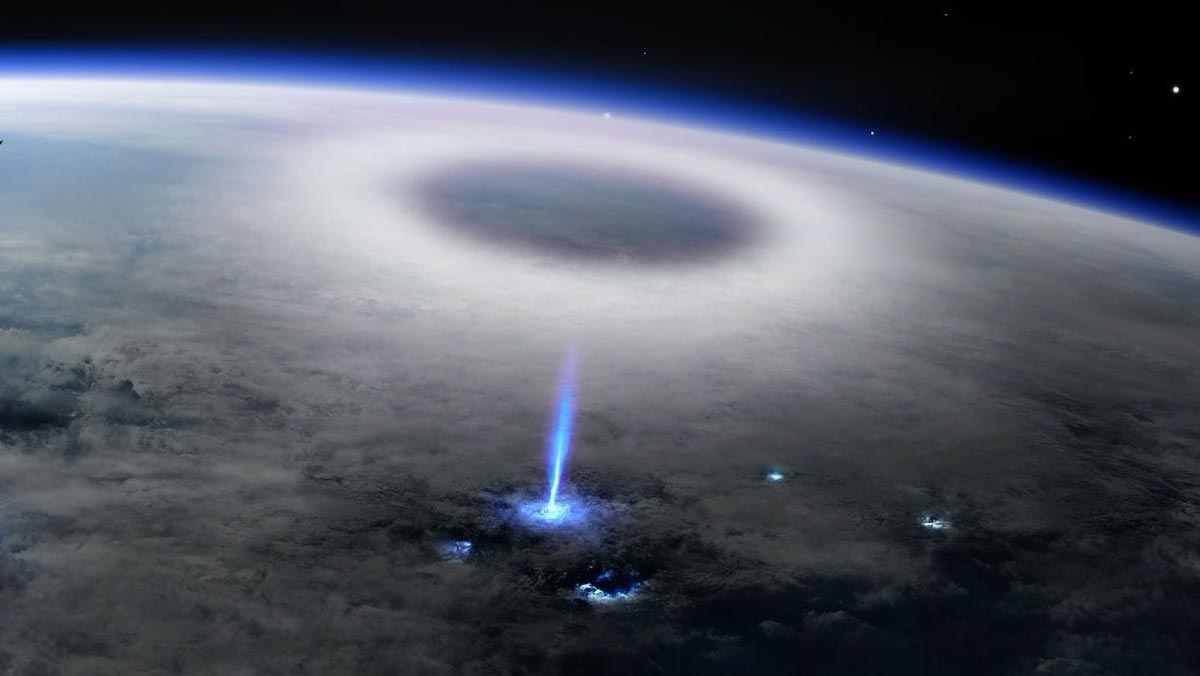
Researchers from USTC have uncovered how convection intensity drives corona discharges at thunderstorm cloud tops.
A research team from the University of Science and Technology of China (USTC), led by Professors Jiuhou Lei and Baoyou Zhu, along with Associate Professor Feifan Liu, has made substantial progress in uncovering the mechanisms driving corona discharges at the tops of thunderstorm clouds—a phenomenon crucial to Earth’s atmospheric chemistry.
Their findings, published in the prestigious journal Nature Communications on August 26, introduce a new conceptual model that could reshape our understanding of these high-altitude electrical discharges.
Corona discharges, often visible as blue flashes near the tops of thunderstorms, play a crucial role in transferring energy and materials from the troposphere to the stratosphere. These discharges, especially narrow bipolar events (NBEs), affect the levels of greenhouse gases like nitrogen oxides and ozone in the stratosphere, influencing Earth’s radiation balance.
Narrow Bipolar Events (NBEs) are a type of intense, high-energy lightning discharge characterized by extremely short-duration electromagnetic pulses. They are distinct from typical lightning strikes due to their narrow temporal width, often lasting only a few microseconds. NBEs occur at high altitudes in thunderstorms and are associated with strong electric fields.
NBEs are classified into two types: positive NBEs, which originate from the thunderstorm’s upper positive charge layer, and negative NBEs, which come from the lower negative charge layer. They are considered the most powerful natural radio wave sources in Earth’s atmosphere due to their intense electric fields and high-frequency radiation.
Researchers study NBEs to better understand lightning initiation, thunderstorm dynamics, and atmospheric electricity.
Challenges in Understanding Corona Discharges
Scientists once thought cloud-top discharges resulted from charge imbalances caused by conventional lightning. However, observing these events has been challenging due to cloud cover and Rayleigh scattering, leaving their exact triggers unclear and sparking ongoing scientific interest.
Using an advanced ground-based lightning detection system, the research team studied NBEs during a typhoon along the Chinese coastline. They discovered a strong polarity competition between different types of NBEs at the tops of clouds. Positive NBEs mainly occurred during the convective uplift phase at the cloud’s overshooting top, while negative NBEs were more common during the convective downdraft phase, typically linked to cirrus plumes in the lower stratosphere.
These observations led to a new model proposing that the strength of convection determines the altitude of charged cloud layers, which in turn controls cloud-top discharges. This breakthrough improves understanding of how cloud-top discharges work and their impact on stratospheric chemistry, paving the way for further research on thunderstorms’ role in atmospheric processes.
Reference: “Polarity transitions of narrow bipolar events in thundercloud tops reaching the lower stratosphere” by Feifan Liu, Torsten Neubert, Olivier Chanrion, Gaopeng Lu, Ting Wu, Fanchao Lyu, Weitao Lyu, Christoph Köhn, Dongshuai Li, Baoyou Zhu and Jiuhou Lei, 26 August 2024, Nature Communications.
DOI: 10.1038/s41467-024-51705-y
Never miss a breakthrough: Join the SciTechDaily newsletter.
Follow us on Google and Google News.