
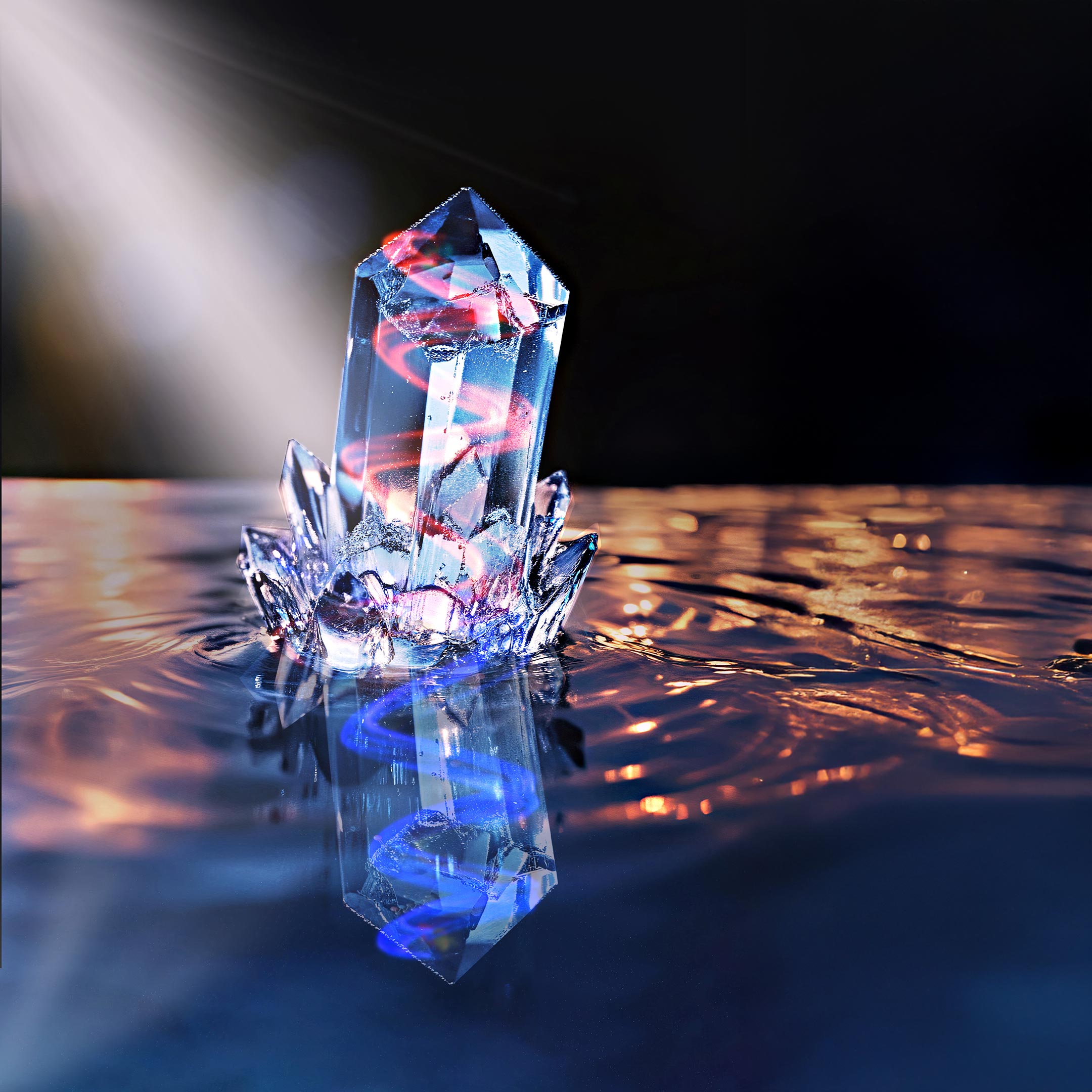
Researchers have discovered a method to induce chirality in non-chiral materials using terahertz light.
This groundbreaking technique, which involves manipulating crystal lattice structures on ultrafast timescales, could revolutionize applications in ultrafast memory devices and optoelectronics, highlighting a significant advancement in the dynamic control of material properties.
Breakthrough in Chirality Induction
Scientists from the University of Oxford and the Max Planck Institute for the Structure and Dynamics of Matter (MPSD) have discovered that terahertz light can induce chirality in a crystal that is naturally non-chiral. This breakthrough allows the crystal to take on either a left- or right-handed form on demand. Their findings, published on January 23 in Science, open new possibilities for studying complex materials and their dynamic behaviors.
Chirality is a key property of matter that plays a crucial role in biological, chemical, and physical processes. It describes objects that cannot be perfectly aligned with their mirror images, similar to how our left and right hands are different. In chiral crystals, the way atoms are arranged gives the material a distinct ‘handedness,’ which can significantly impact properties such as how the crystal interacts with light and electricity.
New Possibilities in Material Science
Chiral solids, for example, offer exciting opportunities for catalysis, sensing, and optical devices by enabling unique interactions with chiral molecules and polarised light. These properties are established when the material is grown, that is, the left- and right-handed enantiomers cannot be converted into one another without melting and recrystallization.
Until now, inducing chirality using light had never been demonstrated, but it follows directly from a set of theoretical predictions made by co-author Professor Paolo G Radaelli, Department of Physics, Oxford, in 2018. A collaboration between Oxford (Professor Radaelli) and the Max Planck Society (Professor Cavalleri) led to a series of state-of-the-art experiments to test this theory.
Ultrafast Chirality Induction Achieved
In the new study, the Oxford-Hamburg team proved the prediction and succeeded in inducing chirality in a non-chiral material (boron phosphate, BPO4) on ultrafast timescales, using terahertz light.
Lead researcher Professor Andrea Cavalleri, Oxford and MPSD, said: “This discovery opens up new possibilities for the dynamical control of matter at the atomic level. We are excited to see the potential applications of this technology and how it can be used to create unique functionalities. The ability to induce chirality in non-chiral materials could lead to new applications in ultrafast memory devices or even more sophisticated optoelectronic platforms.”
Advancements and Potential Risks
Zhiyang Zeng is a graduate student on the Oxford-Max Planck graduate training program in quantum materials, jointly supervised by Professors Radaelli and Cavalleri, and is the lead author on the paper: “We exploit a mechanism termed nonlinear phononics. By exciting a specific terahertz frequency vibrational mode, which displaces the crystal lattice along the coordinates of other modes in the material, we created a chiral state that survives for several picoseconds.”
Co-author Dr. Michael Först, MPSD, continued: “Notably, by rotating the polarization of the terahertz light by 90 degrees, we could selectively induce either a left- or right-handed chiral structure.”
Professor Radaelli commented: “This approach has huge potential. We have already demonstrated the magnetic analog of this effect, using light to generate magnetism in a non-magnetic material. We are currently attempting to “switch on” other properties, such as ferroelectricity, on ultra-fast timescales.”
Although concerns have been raised that the ability to generate chiral molecules presents potential risks to life, in this case no permanently chiral molecule is created. Instead, crystals are induced to be right- or left-handed for an extremely short time – typically a trillionth of a second.
Reference: “Photo-induced chirality in a nonchiral crystal” by Z. Zeng, M. Först, M. Fechner, M. Buzzi, E. B. Amuah, C. Putzke, P. J. W. Moll, D. Prabhakaran, P. G. Radaelli and A. Cavalleri, 23 January 2025, Science.
DOI: 10.1126/science.adr4713
This work received financial support from the Deutsche Forschungsgemeinschaft via the Cluster of Excellence ‘CUI: Advanced Imaging of Matter’. The MPSD is a member of the Center for Free-Electron Laser Science (CFEL), a joint enterprise with DESY and the University of Hamburg.
Never miss a breakthrough: Join the SciTechDaily newsletter.
Follow us on Google and Google News.
9 Comments
These properties are established when the material is grown, that is, the left- and right-handed enantiomers cannot be converted into one another without melting and recrystallization.
VERY GOOD!
Topological vortices and anti-vortices form Möbius strips, which represents one of the most significant entanglement configurations of vortex rings. As the background of various material interactions and movements, space exhibits isotropic physical characteristics. It may form various forms of spacetime vortices through topological phase transitions. Hence, vortex phenomena are ubiquitous in cosmic space, from vortices of quantum particles and living cells to tornados and black holes.
What one researcher see or touch about an elephant will be different, and what different researchers see or touch will be even more different. It is a scientific phenomenon, not the essence of nature. Scientific research guided by correct theories can enable researchers to think more.
According to the Topological Vortex Theory (TVT), spins create everything, spins shape the world. There are substantial distinctions between Topological Vortex Theory (TVT) and traditional physical theories. Grounded in the inviscid and absolutely incompressible spaces, TVT introduces the concept of topological phase transitions and employs topological principles to elucidate the formation and evolution of matter in the universe, as well as the impact of interactions between topological vortices and anti-vortices on spacetime dynamics and thermodynamics.
Within TVT, low-dimensional spacetime matter serves as the foundation for high-dimensional spacetime matter, and the hierarchical structure of matter and its interaction mechanisms challenge conventional macroscopic and microscopic interpretations. The conflict between Quantum Physics and Classical Physics can be attributed to their differing focuses: Quantum Physics emphasizes low-dimensional spacetime matter, whereas Classical Physics centers on high-dimensional spacetime matter.
Subatomic particles in the quantum world often defy the familiar rules of the physical world. The fact repeatedly suggests that the familiar rules of the physical world are pseudoscience. In the familiar rules of the physical world, two sets of cobalt-60 can form the mirror image of each other by rotating in opposite directions, and should receive the Nobel Prize for physics.
Please witness the grand performance of some so-called peer review publications (including PRL, PNAS, Nature, Science, etc.). https://scitechdaily.com/microscope-spacecrafts-most-precise-test-of-key-component-of-the-theory-of-general-relativity/#comment-854286. Some so-called academic publications (including PRL, PNAS, Nature, Science, etc.) are addicted to their own small circles and have deviated from science for a long time.
If the researchers are truly interested in science, please read: The Application of Inviscid and Absolutely Incompressible Spaces in Engineering Simulation (https://scitechdaily.com/microscope-spacecrafts-most-precise-test-of-key-component-of-the-theory-of-general-relativity/#comment-870077).
In the topological vortex architecture, the distinction between science and pseudoscience becomes evident. Topological Vortex Theory (TVT) can play a crucial role in elucidating the foundations of physics, establishing its principles, and combating pseudoscience. TVT may encounter significant opposition and resistance from traditional peer review publications. The field of physics faces an ongoing challenge in maintaining scientific rigor and integrity in the face of pervasive pseudoscientific claims. Fighting against rampant pseudoscience, physics still has a long way to go.
Under the topological vortex architecture, science and pseudoscience are clear at a glance. Topological Vortex Theory (TVT) can play a crucial role in elucidating the foundations of physics, establishing its principles, and combating pseudoscience. Therefore, TVT has been strongly opposed and boycotted by traditional so-called peer review publications (such as PRL, PNAS, Nature, Science, etc.). These so-called peer review publications hardly know what is dirty and ugly.
The field of physics faces an ongoing challenge in maintaining scientific rigor and integrity in the face of pervasive pseudoscientific claims. Fighting against rampant pseudoscience, physics still has a long way to go.
You are correct Sir. The money is the “science” not actual information. Its a shame.
Thank you for your valuable feedback. The popularization of science will be significantly enriched by your active engagement and contributions.
“Terahertz light” is an oxymoron. Light is most commonly defined as being EM radiation with a wavelength between 400 and 700 nanometers, whereas terahertz EM radiation corresponds to wavelengths from 3 mm down to 30 μm.
Yes you are correct in a way, that its just the problem of measurement accuracy. But as the field of quantum is proceeding, the accuracy will also be more precise. Light (photon) is not actually limited to any scale, if we consider the quantum topology. The infinity we cant measure so we need to have a scale, we can measure in our realm. But even at terahertz scale: its quite improvement to 1/0 even without multiple bits as with the speed (ghz CPU vs. thz CPU). We are using modest 8/0 system first in our project which can then be expanded into more logical states than 8 but its not but only quantum simulation device as it runs on normal 1/0 devices and is not at first even photonic device.
I’m sorry, but mainstream physics has what is called the electromagnetic spectrum, where by convention, there is agreement that names are assigned to regions of the spectrum so that the names can be used as a sort of ‘shorthand’ for EM radiation that has similar characteristics, such as being focusable with a lens, or being able to penetrate materials that are opaque to conventional light.
It is NOT just a problem of measurement accuracy. It is a definitional problem.
Did Kamala Harris write your ‘word salad?’
VERY GOOD!
This is the helplessness of physics being severely constrained by pseudoscientific theories today.
Hello, we also “bend crystals” in our skyrmion-balanced photonic quantum computer. Its opensource publication, feel free to investigate: https://elaraawaken.wordpress.com/2024/09/06/update-6-9-2024-quantum-ai-vector-data-crystal-computer/