
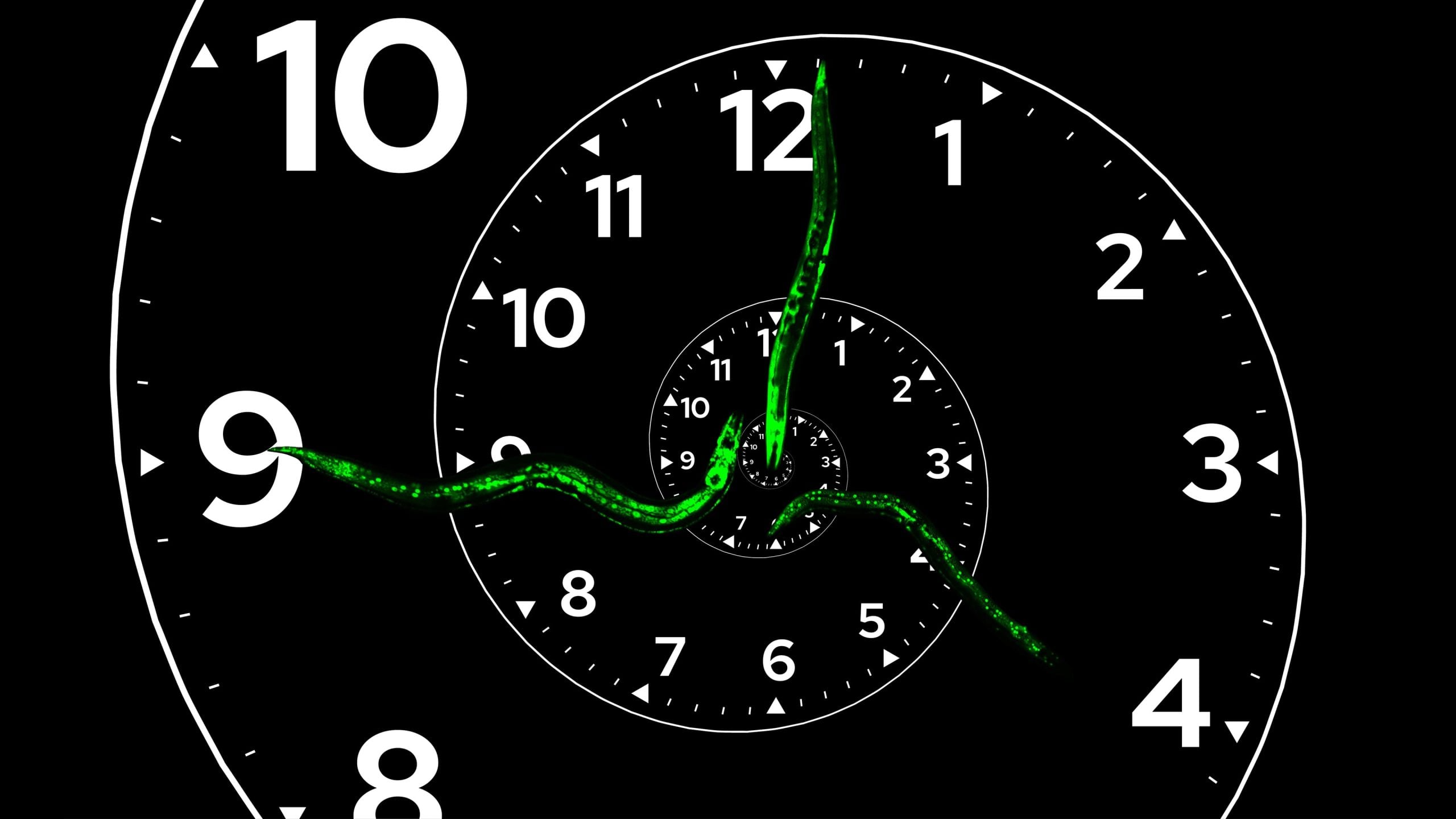
A newly discovered genetic clock acts as the body’s developmental timekeeper, coordinating the bursts of gene activity needed for growth.
Scientists found that when this clock breaks down, development comes to a halt.
Think about a train sitting at a station. Passengers have boarded, conductors are checking tickets, and everything is ready to go. But if the engineer’s watch never signals departure, the doors stay open, the whistle never blows, and the train never leaves the platform.
A similar problem can occur inside living organisms when developmental timing goes wrong. Instead of delaying a trip, a breakdown in the body’s internal schedule can prevent normal growth and maturation.
Researchers at Cold Spring Harbor Laboratory (CSHL) have now identified what appears to be a master developmental clock in the tiny worm C. elegans. The discovery helps explain how cells know exactly when to activate key genetic programs during growth and development.
A Master Clock for Development
Previous work by CSHL Professor Christopher Hammell and his colleagues showed that development in C. elegans is driven by bursts, or pulses, of gene activity. What remained unclear was how those pulses were timed with such precision.
The new study reveals that two proteins already known to scientists, MYRF-1 and LIN-42, form a feedback circuit that acts as a central developmental clock. Together, they determine when each pulse of gene expression begins and how long it lasts.
According to the researchers, this is the first example of a biological clock designed to run through a finite sequence of events rather than repeating continuously.
“This is the central clock for all cells in the worm,” Hammell explains. “It’s responsible for coordinating a finite series of sequential pulses of gene expression that must occur only once, and in order, for proper developmental progression. It’s like a ratchet. It turns genes on and off multiple times during development, but ultimately, it’s only going in one direction.”
How MYRF-1 and LIN-42 Keep Growth Moving
To uncover how the system works, the team combined traditional molecular biology experiments with DNA sequencing, protein sequencing, and the artificial intelligence tool AlphaFold.
Their findings showed that MYRF-1 plays several critical roles during development. The protein helps launch each new wave of gene activity and is also required for the checkpoint that marks the end of every developmental stage.
Once a gene expression pulse begins, MYRF-1 activates LIN-42. LIN-42 then regulates how strong the pulse becomes and how long it continues.
When researchers blocked MYRF-1, the entire developmental process broke down, demonstrating how essential the protein is for keeping growth on track.
“We’ve never seen anything like this before,” Hammell says. “MYRF-1 is part of this master regulatory clock for all cells, but it’s also acting as a key maker and the master key for each stage of growth. Without the right key for each stage, development hits a wall and can’t progress.”
New Questions About Cellular Communication
The research team also included CSHL Director of Research Leemor Joshua-Tor. Scientists are now investigating how MYRF-1 and LIN-42 physically interact and whether individual cellular clocks communicate with one another during development.
Understanding how these timing systems stay coordinated could provide important insights into cellular growth, differentiation, and developmental progression.
“The MYRF-1/LIN-42 circuit runs in all cells,” Hammell says. “And every one of these independent cellular clocks appears to be in sync when you watch normal development. But are they communicating with each other? We’ve never thought deeply about that question before.”
Potential Clues to Developmental Disorders
Answering that question could eventually help scientists better understand developmental disorders and genetic diseases. By revealing how the body’s developmental clocks stay synchronized, the work may offer new clues about what happens when those systems fail.
Just as a train cannot leave the station without the right signal, healthy development depends on precise timing. Researchers now believe they have identified one of the key mechanisms that keeps that process moving forward.
Reference: “A molecular timer couples organism-wide temporal identity to developmental checkpoints” by Peipei Wu, Jing Wang, Brett Pryor, Isabella Valentino, David F. Ritter, Kaiser Loel, Olya Yarychkivska, Shai Shaham, Justin Kinney, Sevinc Ercan, Leemor Joshua-Tor and Christopher M. Hammell, 6 May 2026, Proceedings of the National Academy of Sciences.
DOI: 10.1073/pnas.2606846123
Never miss a breakthrough: Join the SciTechDaily newsletter.
Follow us on Google and Google News.