
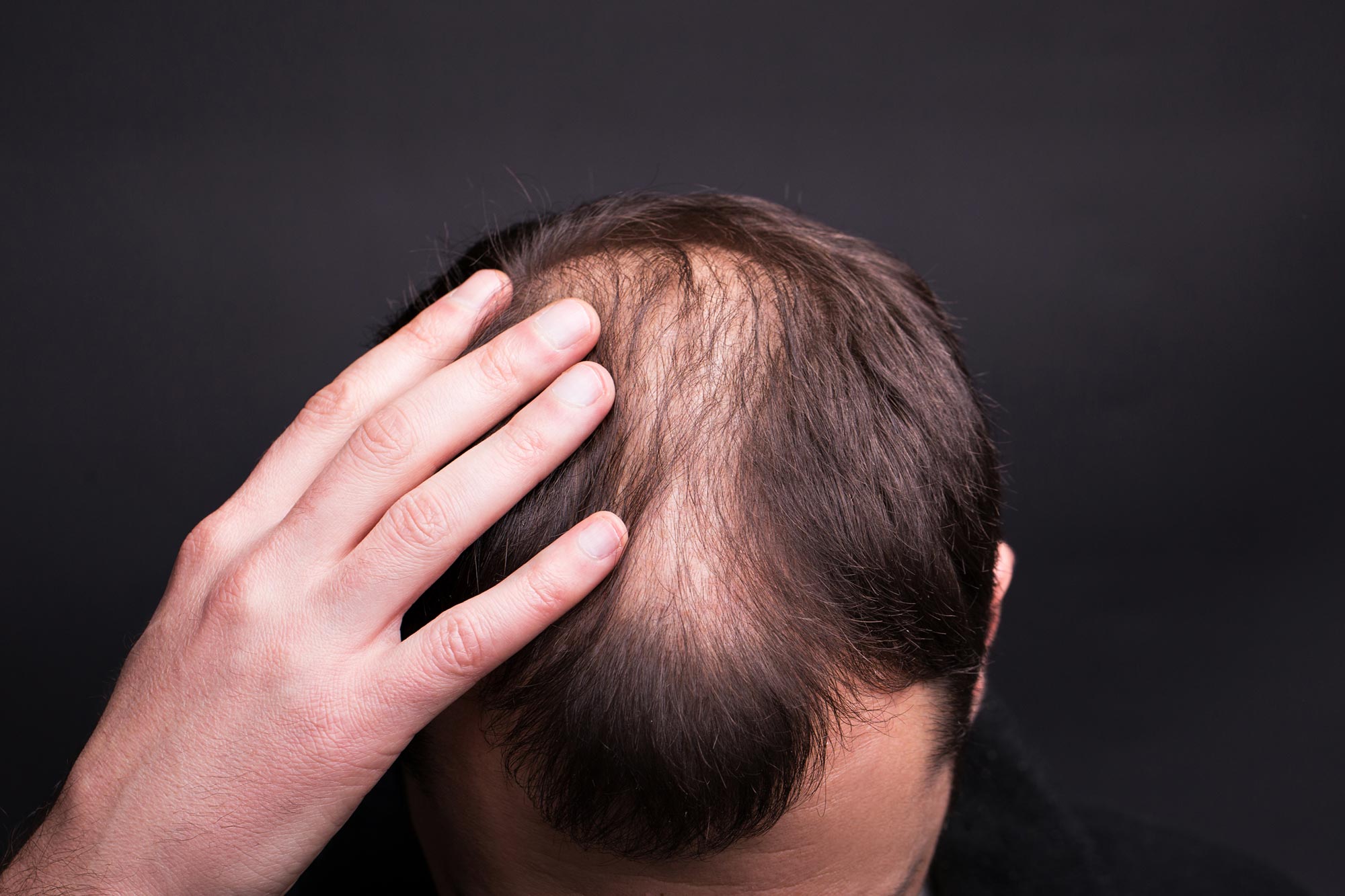
Hair thinning reported with Ozempic-like drugs may not be explained by rapid weight loss alone, as a new genetic study points to the GLP-1 pathway itself.
Hair thinning reported by people taking drugs such as Ozempic, Wegovy, and Zepbound has often been attributed to the rapid weight loss these medications can produce. A new genetic study suggests there may be another factor involved, at least for men already predisposed to the most common form of inherited hair loss.
Researchers at NYU Langone Health found that greater activity of the GLP1R gene, which increases levels of receptors for the hormone glucagon-like peptide-1, or GLP-1, was associated with an additional 7% risk of androgenetic alopecia in genetically susceptible men. Androgenetic alopecia is the common inherited pattern of hair loss that typically affects the front and top of the scalp.
The study does not directly show that taking a GLP-1 drug causes hair loss. Instead, researchers used genetic differences that naturally produce higher levels of GLP-1 receptor proteins as an indicator of increased GLP-1 activity. These are the same receptors targeted by GLP-1 medications used to treat type 2 diabetes and obesity by helping regulate blood sugar and suppress appetite.
That approach allowed the researchers to investigate whether the biological pathway targeted by GLP-1 drugs might itself be connected to hair loss.
Genetics point beyond rapid weight loss
Both men and women taking GLP-1 medications have reported thinning hair. Until now, researchers have largely attributed the shedding to the rapid weight loss caused by the drugs. Hair growth often resumes several months after a person’s weight stabilizes, but a possible genetic connection between GLP-1 activity and hair loss had remained uncertain.
“Our study provides the first genetic link between GLP-1 use and an increased risk of male- pattern hair loss from androgenetic alopecia, an association long suspected but until now not shown scientifically,” said study senior investigator Lynn Petukhova, PhD, an assistant professor in the Ronald O. Perelman Department of Dermatology and the Department of Population Health at NYU Grossman School of Medicine.
The study, published online September 3 in the Journal of Investigative Dermatology, compared genetic signals associated with higher GLP-1 receptor levels with genetic signals found in men with androgenetic alopecia.
Other hair-loss risks did not explain it
The researchers then tested whether other known or suspected contributors to hair loss could account for the relationship. They adjusted for hypertension, which is thought to reduce blood flow to the scalp and potentially harm hair follicle growth. The additional 7% risk remained unchanged.
They also examined insulin resistance, a cause of type 2 diabetes, and lower testosterone levels. Neither explained away the association.
The overlap in the genetic signals, the researchers say, suggests that GLP-1 activity and male-pattern hair loss may be biologically connected rather than the reported shedding being explained only by rapid weight loss.
The evidence is limited to men
The analysis drew on large, publicly available genetic databases. The eQTLGen database included 31,684 mostly White men and women, while a database from the Complex Traits Genetics group included 205,327 mostly White men.
Because male-pattern hair loss has been studied more extensively than hair loss in women, the researchers could only analyze a possible causal relationship in men. The largely White study populations also mean the findings may not apply equally to people from other genetic backgrounds.
Further research is needed to determine exactly how GLP-1 activity might weaken hair follicle growth and whether the same genetic relationship exists in women. Petukhova plans to investigate both questions.
If future experiments confirm the connection, the researchers say it could eventually help identify people who are more vulnerable to hair loss before they begin treatment.
“Our findings suggest that, if future experiments prove successful, some men, and possibly women too, could be screened and benchmarked for their risk of hair loss before being prescribed GLP-1 medications,” said Dr. Petukhova. “We could also envision these findings leading to some GLP-1 users being prescribed combination treatments to prevent hair loss, such as minoxidil or some other drug.”
Those possibilities remain prospective. The current findings identify a genetic connection for researchers to investigate further, rather than establishing a screening test or showing that preventive hair-loss treatments should accompany GLP-1 prescriptions.
GLP-1 use continues to grow
The question could become increasingly relevant as use of GLP-1 medications grows. Surveys cited by the researchers estimate that 12% of Americans have used the drugs solely for weight loss, including one in five women ages 50 to 64. Prescriptions have more than tripled since Ozempic was approved by the Food and Drug Administration in 2020, according to the source.
Androgenetic alopecia is also extremely common. It is estimated to affect about half of White American men over age 50 and nearly as many White American women over 50, particularly those who are postmenopausal.
For people who experience thinning hair while taking GLP-1 drugs, the new findings suggest that rapid weight loss may not be the only factor worth investigating. Genetics and the GLP-1 pathway itself may also help explain why some people are more susceptible than others.
Reference: “A causal effect of increased GLP1R expression on male-pattern hair loss is suggested by 2-sample Mendelian randomization” by Ravi Ramessur, Archie Spindler, Derek Maas, Mary Casagrande, Poppy A. Gould, Atlas Khan, Jerry Shapiro, Kristen I. Lo Sicco and Lynn Petukhova, 3 September 2026, Journal of Investigative Dermatology.
DOI: 10.1016/j.jid.2026.07.024
Funding support for this study was provided by National Institutes of Health grants R01AR080796 and K01AR075111.
Never miss a breakthrough: Join the SciTechDaily newsletter.
Follow us on Google and Google News.