
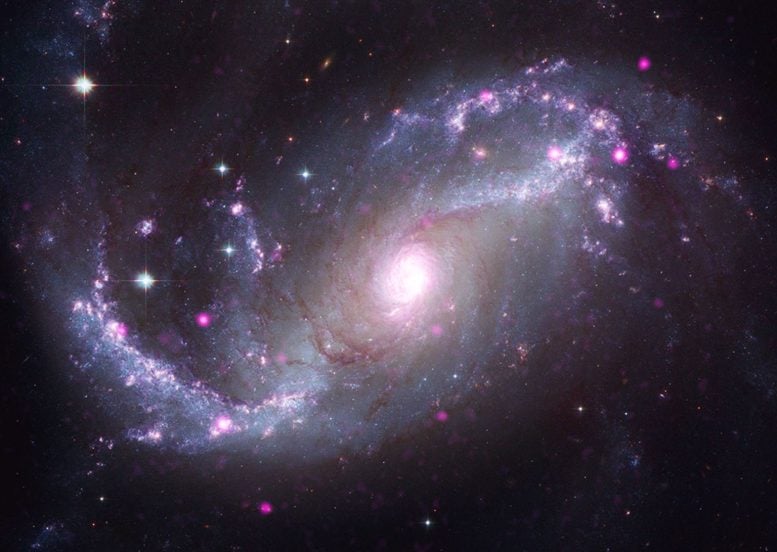
Galaxies can be peaceful star factories or cosmic wrecking grounds, torn apart by collisions and blasted by colossal black hole jets.
A new collection of 16 images from NASA’s Chandra X-ray Observatory captures galaxies in radically different stages of their lives. The gallery combines decades of Chandra observations with data from NASA’s James Webb and Hubble Space Telescopes, IXPE (Imaging X-ray Polarimetry Explorer), Neil Gehrels Swift Observatory, NuSTAR (Nuclear Spectroscopic Telescope Array), and other observatories on Earth and in space.
Astronomers broadly classify galaxies as spiral, elliptical, or irregular. Spirals such as the Milky Way have arms extending from their centers, while ellipticals generally contain older stars and often bear the imprint of past mergers. Irregular galaxies have no single defining structure and can reflect collisions, intense star formation, or other disruptive events.
Why Astronomers Observe X-Rays
Visible light shows stars and dust, but X-rays reveal some of the most violent activity inside galaxies. Chandra can detect gas heated to millions of degrees, compact stellar remnants, debris from exploded stars, and material energized by growing supermassive black holes.
These phenomena help shape galaxies and spread chemical elements into space. Exploding stars and powerful outflows distribute material that can eventually become part of new stars, planets, atmospheres, and living organisms.
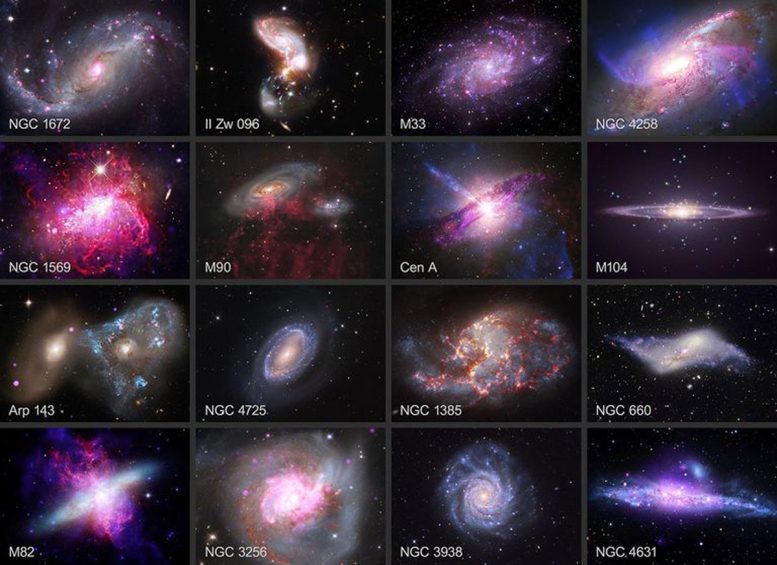
Combining X-rays with infrared, optical, and other observations allows astronomers to examine the same galaxy in several complementary ways. Each wavelength highlights different structures, producing a more complete picture of how galaxies form, interact, and change over cosmic time.
Studying distant galaxies also gives astronomers valuable context for understanding the Milky Way. Because researchers cannot observe our galaxy from the outside, neighboring systems provide useful comparisons and possible clues to its past and future.
Spiral Galaxies Seen From Different Angles
Face-on galaxies such as Messier 33 and NGC 3938 give astronomers a largely unobstructed view of their spiral arms. These structures contain energetic stellar pairs, regions of active star formation, and the remains of powerful cosmic explosions.
NGC 1672 and NGC 1385 belong to a different class known as barred spirals. Their elongated central structures contain stars, gas, and dust that can channel material toward the inner galaxy, supplying the raw ingredients for new bursts of star formation.
NGC 4725 shows another way that stars can begin forming. Evidence suggests that an earlier encounter with another galaxy disturbed its material and helped trigger new stellar growth.
Edge-on views reveal features that are harder to see when looking directly at a galaxy’s face. NGC 4631 (the Whale Galaxy) and Messier 82 (the Cigar Galaxy) display enormous halos and superwinds of million-degree gas. Repeated stellar explosions have driven this material thousands of light-years into intergalactic space, carrying newly produced elements with it.
Black Holes That Reshape Galaxies
A supermassive black hole can become an active galactic nucleus when it consumes surrounding material. Although the black hole itself emits no light, the matter falling toward it can become intensely hot and release radiation, outbursts, and narrow jets powerful enough to affect the wider galaxy.
In Centaurus A, Chandra and IXPE reveal a jet of high-energy particles extending tens of thousands of light-years from the galactic center. The observations help researchers examine how particles are accelerated near one of the most extreme environments in the universe.
The central black hole in Messier 106 produces jets that heat nearby gas and create unusual spiral structures. Unlike ordinary spiral arms dominated by stars, these features are shaped largely by energy released from the galaxy’s active core.
The Sombrero Galaxy (Messier 104) contains a supermassive black hole within an immense central bulge of stars. Around its prominent dust lanes, Chandra maps a diffuse halo of million-degree gas and a population of hot stellar remnants.
Collisions, Rings, and Stripped Galaxies
Several images capture galaxies undergoing dramatic gravitational upheaval. In Arp 143, a direct collision generated an expanding ring resembling a cosmic bullseye and sent waves of star formation through the system.
NGC 3256 and the dust-shrouded starburst II Zw 096 are caught in violent mergers. Such collisions were more common in the early universe, when galaxies were closer together, and they can compress gas, accelerate star formation, and transform the structures of the galaxies involved.
These mergers also provide a rough preview of the Milky Way’s distant future encounter with Andromeda. Although individual stars are unlikely to collide because of the enormous distances between them, gravity will profoundly rearrange both galaxies.
NGC 1569 serves as a nearby laboratory for investigating the powerful starbursts that helped shape young galaxies. NGC 660 has an unusual “polar ring,” with stars and gas orbiting over the galaxy’s poles, likely preserving evidence of a past gravitational interaction.
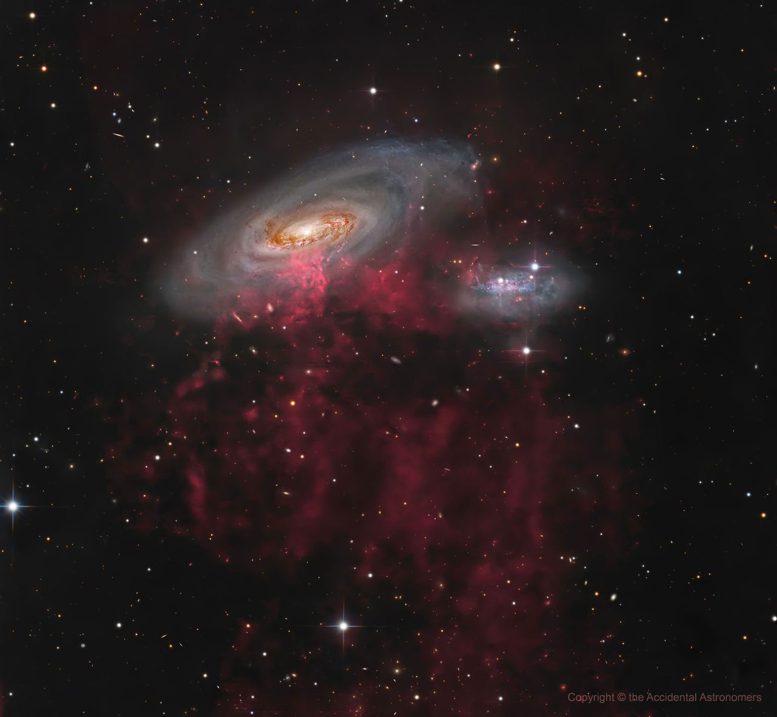
Messier 90 is experiencing a different kind of transformation as it travels through the Virgo Cluster. Pressure from the surrounding environment is violently removing its star-forming gas, gradually depriving the galaxy of the material needed to produce future generations of stars.
Never miss a breakthrough: Join the SciTechDaily newsletter.
Follow us on Google and Google News.