
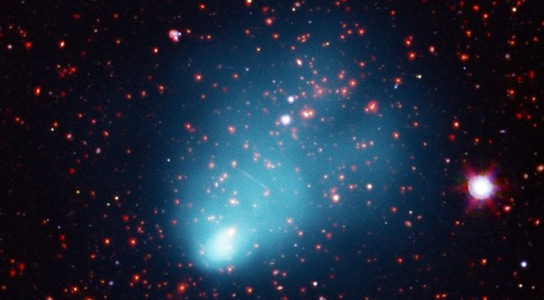
The largest galaxy cluster in the distant universe has been found and nicknamed “El Gordo,” which is much easier to say than the official name of ACT-CL J0102-4915. This massive galaxy cluster was discovered with help from the Sunyaev-Zeldovich effect, and is located over seven billion light years from Earth.
An exceptional galaxy cluster, the largest seen in the distant universe, has been found using NASA’s Chandra X-ray Observatory and the National Science Foundation-funded Atacama Cosmology Telescope (ACT) in Chile.
Officially known as ACT-CL J0102-4915, the galaxy cluster has been nicknamed “El Gordo” (“the big one” or “the fat one” in Spanish) by the researchers who discovered it. The name, in a nod to the Chilean connection, describes just one of the remarkable qualities of the cluster, which is located more than seven billion light-years from Earth. This large distance means that it is being observed at a young age.
“This cluster is the most massive, the hottest, and gives off the most X-rays of any known cluster at this distance or beyond,” said Felipe Menanteau of Rutgers University in New Brunswick, N.J., who led the study.
Galaxy clusters, the largest objects in the universe that are held together by gravity, form through the merger of smaller groups or sub-clusters of galaxies. Because the formation process depends on the amount of dark matter and dark energy in the universe, clusters can be used to study these mysterious phenomena.
Dark matter is material that can be inferred to exist through its gravitational effects, but does not emit and absorb detectable amounts of light. Dark energy is a hypothetical form of energy that permeates all space and exerts a negative pressure that causes the universe to expand at an ever-increasing rate.
“Gigantic galaxy clusters like this are just what we were aiming to find,” said team member Jack Hughes, also of Rutgers. “We want to see if we understand how these extreme objects form using the best models of cosmology that are currently available.”
Although a cluster of El Gordo’s size and distance is extremely rare, it is likely that its formation can be understood in terms of the standard Big Bang model of cosmology. In this model, the universe is composed predominantly of dark matter and dark energy, and began with a Big Bang about 13.7 billion years ago.
The team of scientists found El Gordo using ACT thanks to the Sunyaev-Zeldovich effect. In this phenomenon, photons in the cosmic microwave background interact with electrons in the hot gas that pervades these enormous galaxy clusters. The photons acquire energy from this interaction, which distorts the signal from the microwave background in the direction of the clusters. The magnitude of this distortion depends on the density and temperature of the hot electrons and the physical size of the cluster.
X-ray data from Chandra and the European Southern Observatory’s Very Large Telescope, an 8-meter optical observatory in Chile, show that El Gordo is, in fact, the site of two galaxy clusters running into one another at several million miles per hour. This and other characteristics make El Gordo akin to the well-known object called the Bullet Cluster, which is located almost 4 billion light-years closer to Earth.
As with the Bullet Cluster, there is evidence that normal matter, mainly composed of hot, X-ray bright gas, has been wrenched apart from the dark matter in El Gordo. The hot gas in each cluster was slowed down by the collision, but the dark matter was not.
“This is the first time we’ve found a system like the Bullet Cluster at such a large distance,” said Cristobal Sifon of Pontificia Universidad de Catolica de Chile (PUC) in Santiago. “It’s like the expression says: if you want to understand where you’re going, you have to know where you’ve been.”
These results on El Gordo are being announced at the 219th meeting of the American Astronomical Society in Austin, Texas. A paper describing these results has been accepted for publication in The Astrophysical Journal.
NASA’s Marshall Space Flight Center in Huntsville, Alabama, manages the Chandra program for NASA’s Science Mission Directorate in Washington. The Smithsonian Astrophysical Observatory controls Chandra’s science and flight operations from Cambridge, Mass.
Never miss a breakthrough: Join the SciTechDaily newsletter.
Follow us on Google and Google News.