
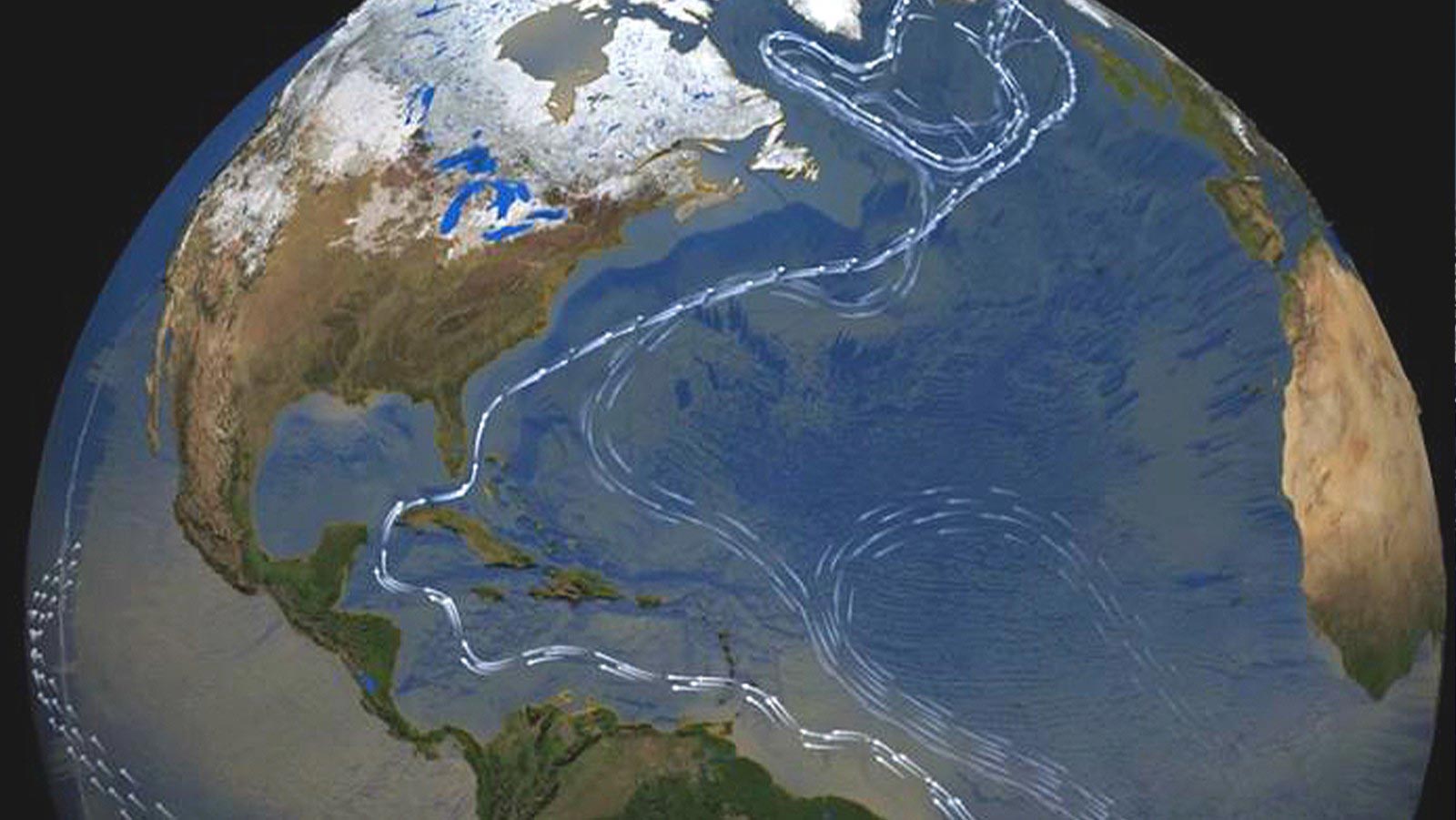
Rapid warming could cause a major Atlantic Ocean current system to collapse, even at temperatures it could withstand under slower warming.
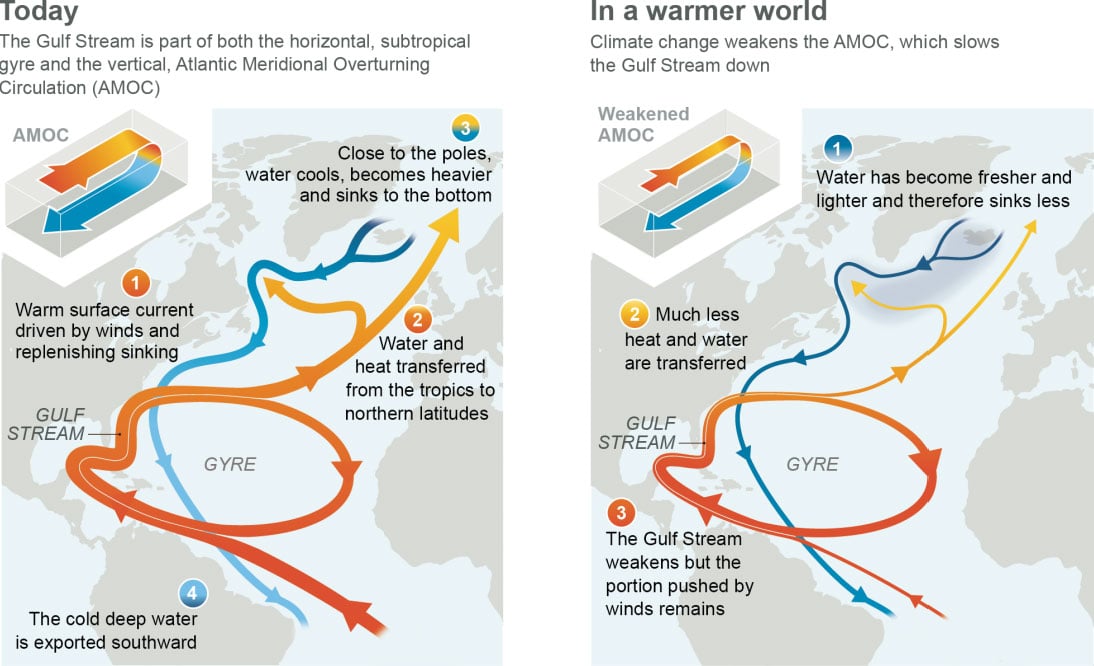
The Atlantic Meridional Overturning Circulation, or AMOC, carries warm water from the tropics northward, redistributing heat around the planet and helping keep Western Europe relatively mild. New research suggests that warming could push this system of ocean currents toward collapse if temperatures rise faster than the ocean can adjust.
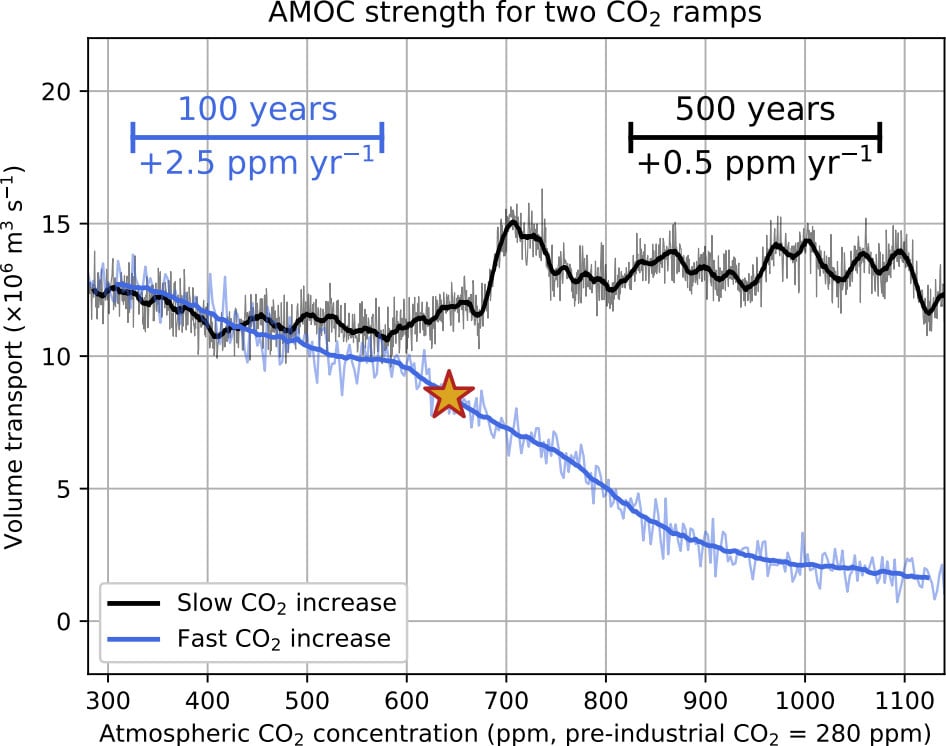
In climate simulations by Utrecht University researchers, the AMOC remained stable even at 5°C (9°F) of global warming when temperatures climbed slowly. With faster warming, it collapsed at around 2°C (3.6°F). The study, published in Nature Climate Change, shows why the pace of warming matters alongside the eventual temperature.
When warming outpaces the ocean
An AMOC collapse would mean a shift from today’s strong circulation to a much weaker state within decades. Scientists have long suspected that rising temperatures or an increasing flow of meltwater from polar regions could push the system past a tipping point. The new work examines how much time the ocean has to respond before reaching that point.
“Under slow warming, the entire ocean, from the surface down to its deepest layers, has time to gradually reorganize and adapt to the changing conditions,” says co-author Henk Dijkstra, a professor of dynamical oceanography. “Under faster warming, the ocean simply can’t keep up.”
To test the effect of warming speed, the team at Utrecht’s Institute for Marine and Atmospheric Research ran a climate model twice. In one simulation, the concentration of atmospheric carbon dioxide, or CO2, increased by 0.5 parts per million each year. In the other, it rose five times as quickly, at 2.5 parts per million annually, comparable to today’s rate.
“We deliberately looked at a scenario that is much slower than what we’re experiencing today,” explains co-author Reyk Börner. “That allowed us to isolate the effect of the warming rate alone, independent of how warm it eventually gets.”
Why AMOC tipping estimates differ
The team’s 2024 study of meltwater in the North Atlantic examined whether meltwater alone could destabilize the AMOC, leaving global warming and its pace out of the simulations. Adding enough meltwater did push the circulation past a critical threshold. Scientists had long suspected this mechanism, but the study was the first to demonstrate it in a modern, complex climate model. Reaching the threshold required an unrealistically large amount of meltwater, suggesting that meltwater on its own is unlikely to destabilize today’s AMOC.
The researchers then examined how the circulation would respond to different global warming scenarios. Under both intermediate- and high-emission scenarios, the simulations projected that the AMOC would reach a tipping point around 2060. Warming at that point was approximately 2.5°C (4.5°F), below the roughly 4°C (7.2°F) previously thought necessary for collapse.
The new study offers an explanation for why estimated temperature thresholds differ across climate models and emissions scenarios. Although the researchers identified a critical threshold for meltwater, their latest findings suggest there is no equivalent universal temperature limit.
“Our results show there is not necessarily a fixed temperature beyond which the AMOC inevitably collapses,” says lead author René van Westen. “The stability of the circulation depends on how fast the climate is changing.”
Slower warming could reduce collapse risk
The team estimates a critical warming rate of around 0.3°C (0.54°F) per decade, a pace the world is already approaching. Their findings suggest that slowing the rise in temperature could lower the near-term risk of an AMOC collapse.
Much climate policy, including the Paris Agreement, focuses on limiting how high temperatures eventually climb. Some proposed pathways allow an “overshoot,” in which warming temporarily exceeds a chosen limit, on the assumption that future technology could bring temperatures back down. For the AMOC, the research suggests that how quickly temperatures rise during that overshoot also matters.
Van Westen compares the challenge to driving a car. “If you’re driving toward a wall, it makes sense to steer around it. To do that, you need to brake; otherwise, you fly off the road. When it comes to global warming, the world is still pressing extra hard on the accelerator right now.”
Reference: “Failure to track a stable AMOC state under rapid climate change” by René M. van Westen, Reyk Börner and Henk A. Dijkstra, 13 August 2026, Nature Climate Change.
DOI: 10.1038/s41558-026-02730-w
Never miss a breakthrough: Join the SciTechDaily newsletter.
Follow us on Google and Google News.
1 Comment
All very well but it’s not stated what that actually means to the weather we could expect.