
A study suggests that increasing SORLA protein levels could help treat Alzheimer’s disease and other disorders involving tau protein.
Increasing SORLA, a protein with a protective role in the brain, helped mice withstand damage from tau tangles, the toxic protein clumps associated with Alzheimer’s disease. The findings suggest that boosting SORLA could offer a way to treat Alzheimer’s and other disorders involving tau, although that possibility remains a goal for future research.
Tau normally helps nerve cells hold their shape by stabilizing tiny internal filaments called microtubules. It performs this structural job throughout the brain and nervous system. But when tau clumps together inside nerve cells, the resulting tangles are linked to cognitive impairment and cell death. Diseases involving these tangles are known as tauopathies.
Scientists at Sanford Burnham Prebys investigated how changing the amount of SORLA, short for sorting-related receptor with A-type repeats, affected this damage. Their study, published in Science Advances, examined both the protection provided by extra SORLA and the consequences of its absence.
Extra SORLA limits damage in mice
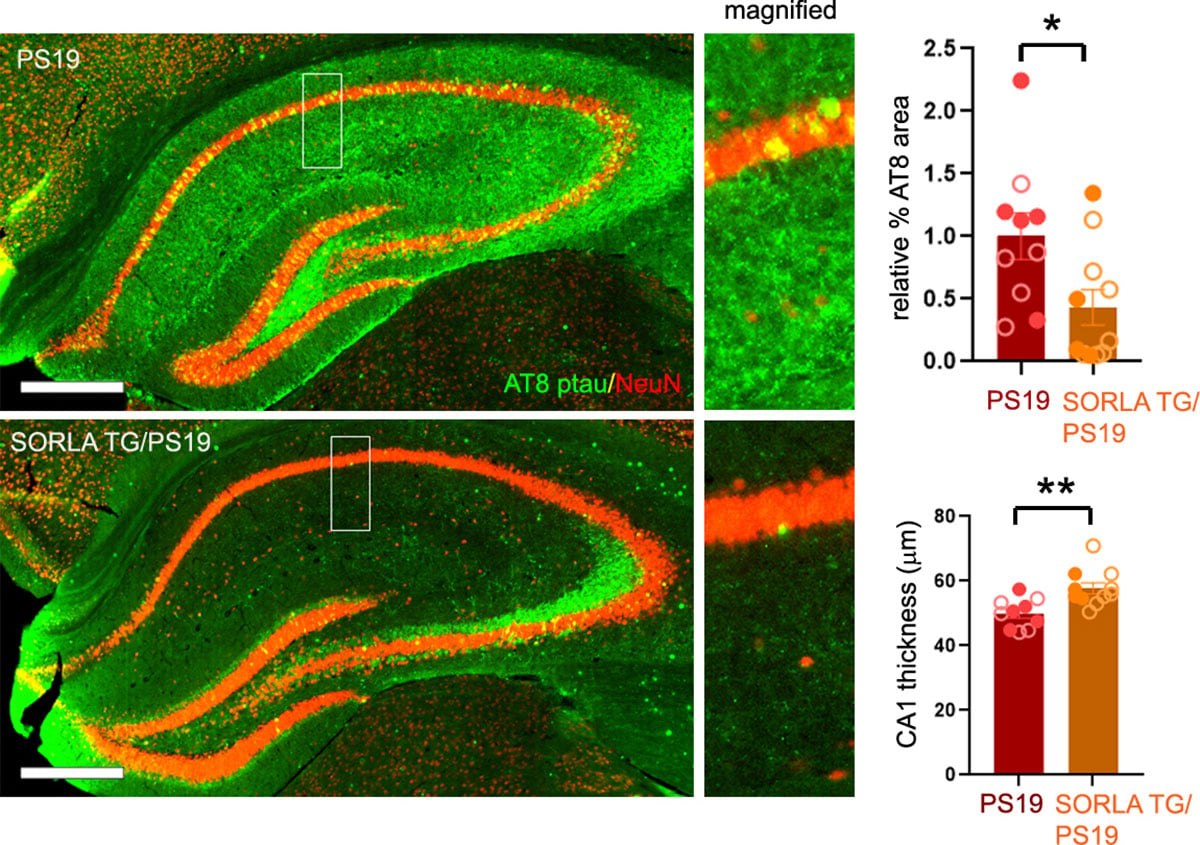
The team first bred mice that produced extra human SORLA with mice that developed tau tangles, brain shrinkage, and cognitive deficits. To investigate what happens without the protein, they also tested mice genetically modified to lack Sorl1, the gene that carries the instructions for making SORLA. Some people have mutations that disable this gene, making the comparison relevant to human disease.
“When you upregulate SORLA, you can suppress the negative effects found in tauopathies,” said Huijie Huang, PhD, a staff scientist in the Huang lab at Sanford Burnham Prebys and the study’s lead author.
“We found there was less brain atrophy and less tau accumulation, which was very exciting to see.”

The mice unable to make SORLA revealed the other side of that protective relationship.
“The opposite turned out to be true when we deleted the ability to produce SORLA proteins,” said Timothy Huang, PhD, an assistant professor in the Center for Neurologic Diseases at Sanford Burnham Prebys and the study’s senior and corresponding author. “A lack of SORLA exacerbated the harmful effects observed in tauopathies.”
SORLA’s protection extends beyond amyloid beta
SORLA had already attracted researchers’ attention because of its effects on amyloid beta, another protein that builds up in Alzheimer’s disease.
“In the last 15 or 20 years, considerable data has come out from our lab and other groups showing that SORLA can suppress one of the hallmarks of Alzheimer’s disease—amyloid-beta generation and accumulation,” said Timothy Huang.
“Very little was known, however, about whether SORLA affected the tau tangles reflected on the other side of the coin in Alzheimer’s disease.”

The new experiments found that extra SORLA reduced several processes associated with tau damage. One was hyperphosphorylation, in which too many chemical groups called phosphate groups become attached to tau. Another was the ability of misshapen tau to act as seeds that draw in more tau and encourage clumps to grow.
The benefits also reached the connections between nerve cells. Extra SORLA helped preserve synapses, the junctions through which neurons communicate, along with synaptic plasticity, the brain’s ability to adjust those connections.
To investigate the cellular changes behind these effects, the researchers combined techniques that measured protein levels and gene expression, or which genetic instructions cells were using. They also mapped the locations of RNA and proteins within brain tissue. RNA helps cells use genetic instructions to make proteins.
These analyses showed that extra SORLA prevented disease-related changes in protein production at synapses. It also suppressed other processes associated with worsening tauopathy, including disease-related patterns of gene activity in glial cells. These cells support and protect neurons, suggesting that SORLA’s effects extend beyond nerve cells themselves.
Could drugs calm overactive glial cells?
The findings in mice without SORLA pointed to a possible treatment approach involving glial cells.
“One particularly notable finding that we can build on is the upregulation of a member of the plexin-B family of receptors in the absence of SORLA,” said Huijie Huang.
Receptors are proteins that receive cellular signals. The increased levels of this plexin-B receptor drew interest because drugs that target the receptor family could potentially be repurposed.
“There are unique drugs that can target this class of receptors that we may be able to apply to tau-related dementia disorders,” said Timothy Huang. “One potential future direction is to repurpose these drugs to target overactivation of glial cells and perhaps reverse some of the phenotypes in tauopathies”
The researchers also plan to examine how individual cell types respond when SORLA levels rise or fall. They intend to graft human neurons or glial cells into mouse brains and study the effects of different SORLA mutations.
“Mouse cells and human cells are different,” said Timothy Huang. “Because we’re looking at human disease, it’s more informative if we can observe the modulation and dysfunction of SORLA in the context of a human cell inside of a diseased brain environment.”
Reference: “SORLA up-regulation suppresses pathological effects in aged tauopathy mouse brain” by Huijie Huang, Christina Huan Shi, Wenqi Yang, Juan C. Piña-Crespo, Jay Bhatnagar, Julian Curatolo, Rabi Murad, Palak Shah, Alex Campos, Alexandra Houser, Rebecca A. Porritt, Giau Van Vo, Qiang Xiao, Tongmei Zhang, Shengjie Feng, Kevin Y. Yip and Timothy Y. Huang, 17 July 2026, Science Advances.
DOI: 10.1126/sciadv.aed6825
The study was supported by the National Institutes of Health, National Cancer Institute and National Institute on Aging.
Never miss a breakthrough: Join the SciTechDaily newsletter.
Follow us on Google and Google News.