
Close Menu
    Facebook X (Twitter) Instagram
    SciTechDaily
    • Biology
    • Chemistry
    • Earth
    • Health
    • Physics
    • Science
    • Space
    • Technology
    Facebook X (Twitter) Pinterest YouTube RSS
    SciTechDaily
    Home»Health»This Simple Brainwave Test Can Spot Alzheimer’s Years Early
    Health

    This Simple Brainwave Test Can Spot Alzheimer’s Years Early

    By University of BathSeptember 20, 2025No Comments4 Mins Read
    Facebook Twitter Pinterest Telegram LinkedIn WhatsApp Email Reddit
    Share
    Facebook Twitter LinkedIn Pinterest Telegram Email Reddit
    Brain Wave Activity EEG Signals
    A three-minute brainwave scan called Fastball EEG can uncover memory decline linked to Alzheimer’s years early, offering a cheap, home-based way to spot the disease when treatment works best. Credit: Shutterstock

    Researchers from the University of Bath and the University of Bristol have, for the first time, successfully tested Fastball EEG technology in patients’ homes.

    A noninvasive brainwave test created at the University of Bath has proven capable of detecting early signs of memory decline associated with Alzheimer’s disease long before conventional diagnosis is usually possible.

    Details of the research, published in Brain Communications by scientists from the University of Bath and the University of Bristol, show that the Fastball EEG test can reliably spot memory difficulties in individuals with Mild Cognitive Impairment (MCI), a condition that often precedes Alzheimer’s. The test takes just three minutes, passively recording brain activity while participants view a rapid sequence of images. This work builds on a 2021 study in which the same team first showed the method’s sensitivity to memory impairment caused by Alzheimer’s.

    Upclose Shot of John Stennard
    John Stennard, a healthy volunteer, taking the Fastball test in his home. Credit: BRACE Dementia Research

    Expanding access beyond clinics

    For the first time, the researchers also demonstrated that the Fastball EEG can be carried out successfully in people’s homes, removing the need for a clinical setting. According to the team, this advancement paves the way for broader screening and ongoing monitoring with affordable, easy-to-use technology.

    The development of Alzheimer’s drugs such as donanemab and lecanemab makes early detection even more critical, as these treatments are most effective during the disease’s initial stages. Yet in England, estimates suggest that around one in three people with dementia remain undiagnosed, which delays not only treatment but also access to support and research opportunities aimed at addressing the condition.

    The study was led by Dr. George Stothart, a cognitive neuroscientist in the Department of Psychology at the University of Bath. He said:

    “We’re missing the first 10 to 20 years of Alzheimer’s with current diagnostic tools. Fastball offers a way to change that – detecting memory decline far earlier and more objectively, using a quick and passive test.”
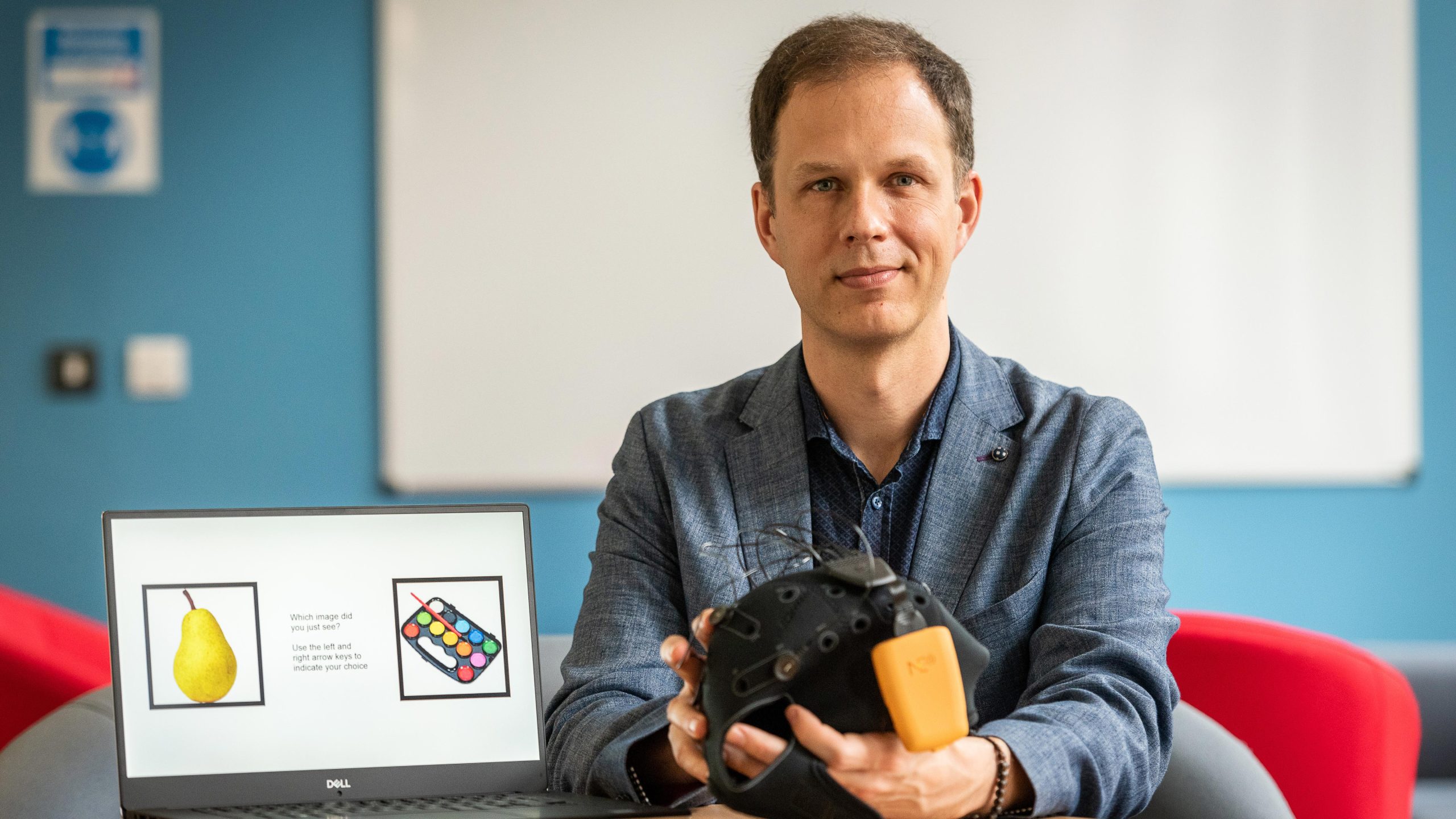
    George Stothart With the Fastball EEG System
    Dr. George Stothart from the University of Bath with the Fastball EEG system. Credit: University of Bath

    How the test works

    Fastball is a passive EEG test that monitors the brain’s automatic responses to images – without requiring participants to follow instructions or recall information. This makes it more objective and accessible than traditional memory tests.

    Researchers say Fastball could be scaled for use in GP surgeries, memory clinics, or at home – helping deliver earlier, more accurate diagnoses.

    Dr. Stothart added, “There’s an urgent need for accurate, practical tools to diagnose Alzheimer’s at scale. Fastball is cheap, portable, and works in real-world settings.”
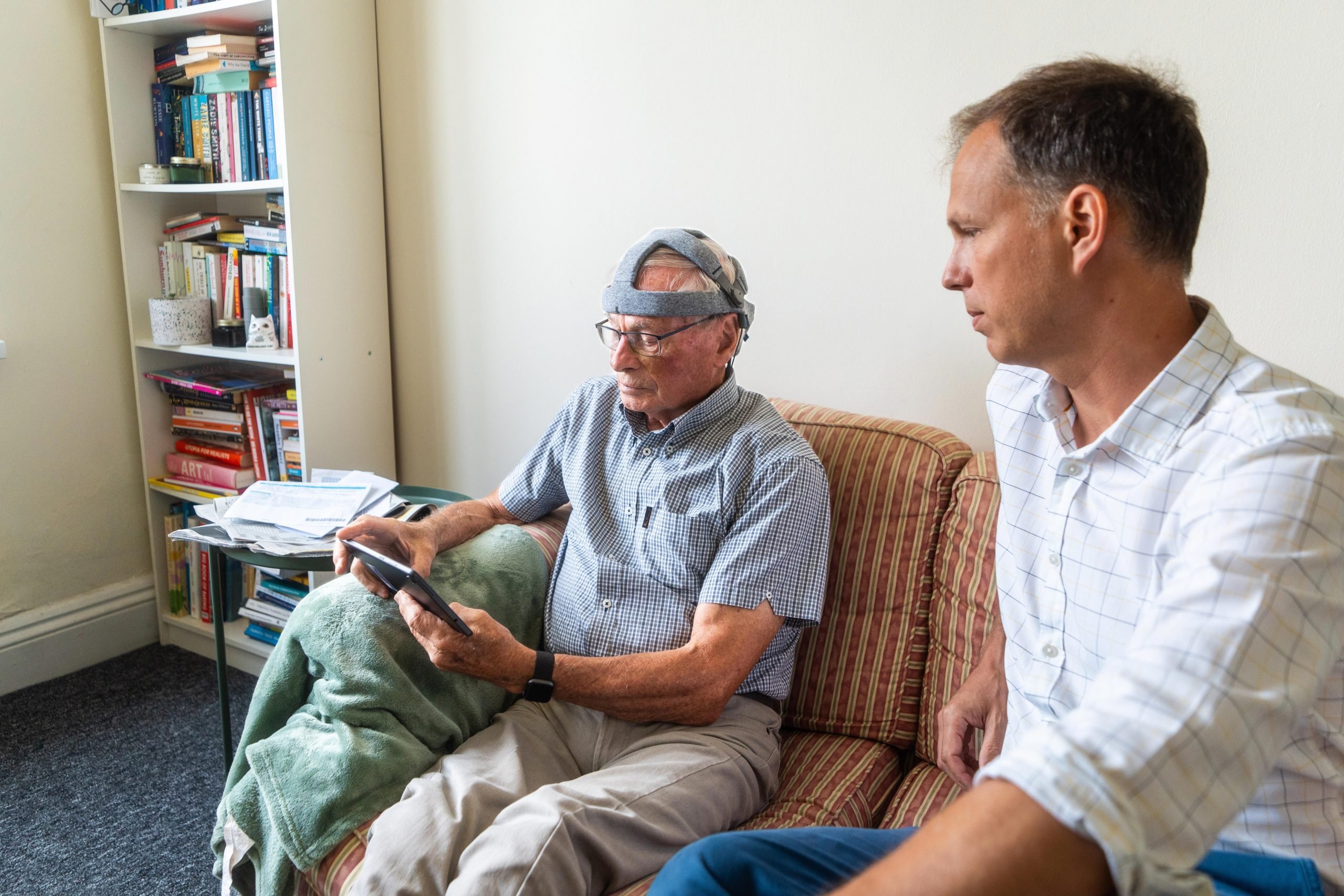
    Healthy Study Volunteer Taking the Fastball Test
    John Stennard, a healthy study volunteer taking the Fastball test in his home, with Dr. George Stohart from the University of Bath. Credit: BRACE Dementia Research

    Chris Wiliams, CEO of BRACE Dementia Research, said: “Fastball is an incredible tool that could offer anyone who, for whatever reason, cannot access a dementia diagnosis in a clinical setting. BRACE has been supporting the development of Fastball for several years, and we are excited to see what Dr. Stothart’s team will achieve over the next few years with ongoing support from the charity.”

    Reference: “A passive and objective measure of recognition memory in mild cognitive impairment using Fastball memory assessment” by George Stothart, Sophie Alderman, Oliver Hermann, Sam Creavin and Elizabeth J Coulthard, 1 September 2025, Brain Communications.
    DOI: 10.1093/braincomms/fcaf279

    The study was funded by the Academy of Medical Sciences and supported by dementia research charity BRACE.

    Reference: “Lecanemab in Early Alzheimer’s Disease” by Christopher H. van Dyck, Chad J. Swanson, Paul Aisen, Randall J. Bateman, Christopher Chen, Michelle Gee, Michio Kanekiyo, David Li, Larisa Reyderman, Sharon Cohen, Lutz Froelich, Sadao Katayama, Marwan Sabbagh, Bruno Vellas, David Watson, Shobha Dhadda, Michael Irizarry, Lynn D. Kramer and Takeshi Iwatsubo, 4 January 2023, New England Journal of Medicine.
    DOI: 10.1056/NEJMoa2212948

    Never miss a breakthrough: Join the SciTechDaily newsletter.
    Follow us on Google and Google News.

    Alzheimer's Disease Cognitive Science Dementia Neuroscience Popular University of Bath
    Share. Facebook Twitter Pinterest LinkedIn Email Reddit

    Related Articles

    Scientists Discover How Obesity May Trigger Alzheimer’s Disease

    19-Year Study Reveals the Surprising Truth About Sitting and Dementia

    Simple Brain Training Cuts Dementia Risk Decades Later, Study Finds

    A Simple Blood Test Could Predict Dementia Risk 25 Years Early

    Cannabis Compound Shows Promise in Fighting Alzheimer’s by Calming Brain Inflammation

    Scientists Uncover the Hidden Mechanism Behind FDA-Approved Alzheimer’s Drug

    Statins Used to Lower Cholesterol Linked to Doubled Risk of Developing Dementia

    Identifying “The Terrorist Inside My Husband’s Brain” – Living Brain Imaging Can Clearly Differentiate Between Types of Dementia

    Blocking HDAC2 Enzyme May Reverse Memory Loss Caused by Alzheimer’s Disease

    Leave A Reply Cancel Reply

    • Facebook
    • Twitter
    • Pinterest
    • YouTube

    Don't Miss a Discovery

    Subscribe for the Latest in Science & Tech!

    Trending News

    The Strange “Spacetime Crystal” That Can Suddenly Turn Into a Black Hole

    The Surprising Way Asteroids May Have Helped Life Begin on Earth

    Vast Hidden Structure Discovered Under Miles of Ice in East Antarctica

    A Surprising Discovery Suggests Autism Is Not One Condition

    New Alzheimer’s Discovery Could Change How Scientists Fight the Disease

    Yale Discovery Overturns Long-Held “Evolutionary Dead End” Theory

    UCLA Scientists Uncover a “Hidden Weakness” in Some of the World’s Deadliest Cancers

    Humpback Whale Stuns Scientists With 15,000 Kilometer Journey Across Oceans

    Follow SciTechDaily
    • Facebook
    • Twitter
    • YouTube
    • Pinterest
    • Newsletter
    • RSS
    SciTech News
    • Biology News
    • Chemistry News
    • Earth News
    • Health News
    • Physics News
    • Science News
    • Space News
    • Technology News
    Recent Posts
    • Meet the Artemis III Astronauts Preparing for NASA’s Boldest Moon Mission Yet
    • Scientists Develop a New Way To Measure Gravitational Waves in the Expanding Universe
    • MIT’s New Dual-Mode Rocket System Could Send Tiny Satellites to Mars
    • Scientists Discover a Biological Clock Unlike Anything Seen Before
    • This “Zombie” Sea Creature Keeps Growing After Being Cut Apart
    Copyright © 1998 - 2026 SciTechDaily. All Rights Reserved.
    • Science News
    • About
    • Contact
    • Editorial Board
    • Privacy Policy
    • Terms of Use

    Type above and press Enter to search. Press Esc to cancel.