
A rare mutation may keep a major Alzheimer’s risk gene from damaging the brain’s protective barrier.
About one in five people carries at least one copy of APOE ε4, the strongest common genetic risk factor for Alzheimer’s disease. Yet some carriers remain mentally sharp into their 80s. Columbia researchers previously identified a rare variant in the fibronectin gene (FN1) that may help explain their resilience.
Fibronectin helps support the structure of tissues, but too much of it can collect around the brain’s blood vessels in people with APOE ε4. The protective variant appears to limit that buildup. A new study in Nature Aging investigates why that matters and whether the process could offer a target for treatment.
“This new study takes us from a genetic clue to a disease mechanism,” says Caghan Kizil, the study’s corresponding author and professor of neurological sciences in the Department of Neurology and the Taub Institute for Research on Alzheimer’s Disease and the Aging Brain at Columbia University Vagelos College of Physicians and Surgeons.
“We knew that changes in fibronectin could protect against Alzheimer’s, but we didn’t know why excess fibronectin was harmful in the first place. This study gives us that detailed mechanism—and with it, ideas for how to reproduce that natural protection.”
How Fibronectin Weakens the Brain’s Barrier
The blood-brain barrier controls what moves between the bloodstream and the brain and helps clear harmful substances. The researchers suspected that excess fibronectin interferes with this protection.
They examined human brain tissue and cerebrospinal fluid, then used genetic analyses, detailed cell imaging, human stem-cell models, three-dimensional blood-vessel cultures, zebrafish, and mice to test what they found. The approaches pointed to the same pattern: APOE ε4 promotes fibronectin buildup around brain blood vessels.
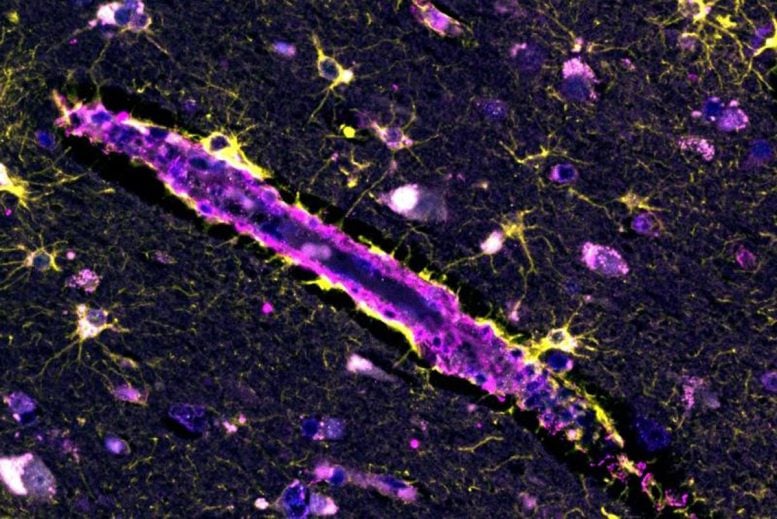
In mice carrying human APOE ε4, brain fibronectin levels were nearly twice those in mice carrying APOE ε3. The higher levels appeared alongside signs of a leaky barrier. To test whether fibronectin could cause the damage, the researchers increased it in astrocytes, cells that help maintain the barrier. That change alone made the barrier leak.
“The animal experiments allowed us to move beyond association,” says co-first author Prabesh Bhattarai, an associate research scientist in the lab of Caghan Kizil at Columbia University. “When we increased fibronectin in astroglia, the barrier became permeable. When we reduced fibronectin, barrier function improved.”
A Disrupted Conversation Between Cells
The team traced the damage to signals triggered by excess fibronectin. Those signals pass through integrins, proteins that help cells sense their surroundings, and an enzyme called focal adhesion kinase. They disrupt the activity of three growth factors, VEGF, HBEGF, and IGF1, that help astrocytes and blood-vessel cells work together to maintain the barrier.
“Single-cell analysis allowed us to examine this pathway in the different cells that maintain the brain’s blood vessels,” says co-first author Elanur Yilmaz, an associate research scientist in the Kizil lab. “We observed the same biological pattern across experimental models and human Alzheimer’s tissue, making the mechanism especially compelling.”
The human evidence reinforced the findings from experimental models. Higher fibronectin levels in brain tissue and cerebrospinal fluid were associated with inflamed astrocytes. Genetic and gene-regulation analyses also connected FN1 to vascular disease and changes in VEGFA, a growth factor important for healthy brain blood vessels.
“The convergence of these independent human datasets strengthens the case that fibronectin is part of the APOE ε4-related vascular disease process,” says Badri Vardarajan, associate professor of neurological science in the Department of Neurology, Gertrude H. Sergievsky Center, and Taub Institute, who collaborated on this discovery of the FN1 mutation.
Could Natural Protection Inspire a Treatment?
The findings suggest three possible approaches for people with APOE ε4: prevent excess fibronectin from accumulating, block the damaging signals it triggers, or restore the growth signals that keep the barrier healthy. The researchers are investigating these possibilities in laboratory experiments.
A treatment would need to leave fibronectin’s normal roles in tissue structure and repair intact. The study identifies a mechanism and potential targets, but it has not shown that targeting fibronectin can prevent or treat Alzheimer’s in people.
“By showing how fibronectin contributes to early vascular damage, this study gives us new therapeutic targets and potential ways to measure whether treatments are working,” says Richard Mayeux, chair of Columbia’s Department of Neurology and a collaborator on the project. “Clinically, it connects a major genetic risk factor for Alzheimer’s to an early disease process that may be possible to modify.”
Reference: “Fibronectin mediates APOE4-driven blood–brain barrier dysfunction in Alzheimer’s disease” by Prabesh Bhattarai, Elanur Yilmaz, Elif Öykü Cakir, Huseyin Tayran, Imdadul Haq, Dylan Murphy, Jonah Nadelmann Keller, Quentin Le Grand, Jacqueline O. Eschbach, Hilal Celikkaya, Mehmet I. Cosacak, Hande Yüceer Korkmaz, Annie J. Lee, Verena Haage, Yiyi Ma, Xue Wang, Nastasia Nelson, Weilin Lin, Yixin Zhang, Bengisu Turgutalp, Sherida M. de Leeuw, Ronak Patel, Dörthe Jülich, Özkan İş, Scott A. Holley, Philip L. De Jager, Uwe Freudenberg, Carsten Werner, Peter St George-Hyslop, Nilüfer Ertekin-Taner, Stéphanie Debette, Fanny M. Elahi, Elizabeth S. Fisher, Hemali Phatnani, Andrew F. Teich, Kate Tubbesing, Taylor Bertucci, Sally Temple, Tal Nuriel, Badri N. Vardarajan, Richard Mayeux and Caghan Kizil, 11 September 2026, Nature Aging.
DOI: 10.1038/s43587-026-01204-0
The work was supported by the NIH (grants R01AG067501, RF1AG066107, P30AG066462, and U54AG076040); a Schaefer Research Scholars Award; Taub Institute Grant for Emerging Research; Thompson Family Foundation Program for Accelerated Medicine Exploration in Alzheimer’s Disease and Related Disorders of the Nervous System; American Brain Foundation Cure-One-Cure-Many Award; Carol and Gene Ludwig Family Foundation; Toffler Scholar Program; National Institute on Aging and Department of Veterans Affairs (IK2CX002180); Chan Zuckerberg Initiative; and Rainwater Charitable Foundation.
Never miss a breakthrough: Join the SciTechDaily newsletter.
Follow us on Google and Google News.