
Researchers have uncovered a surprising cellular process that could reshape our understanding of brain regeneration and offer new possibilities for recovery from neurological damage.
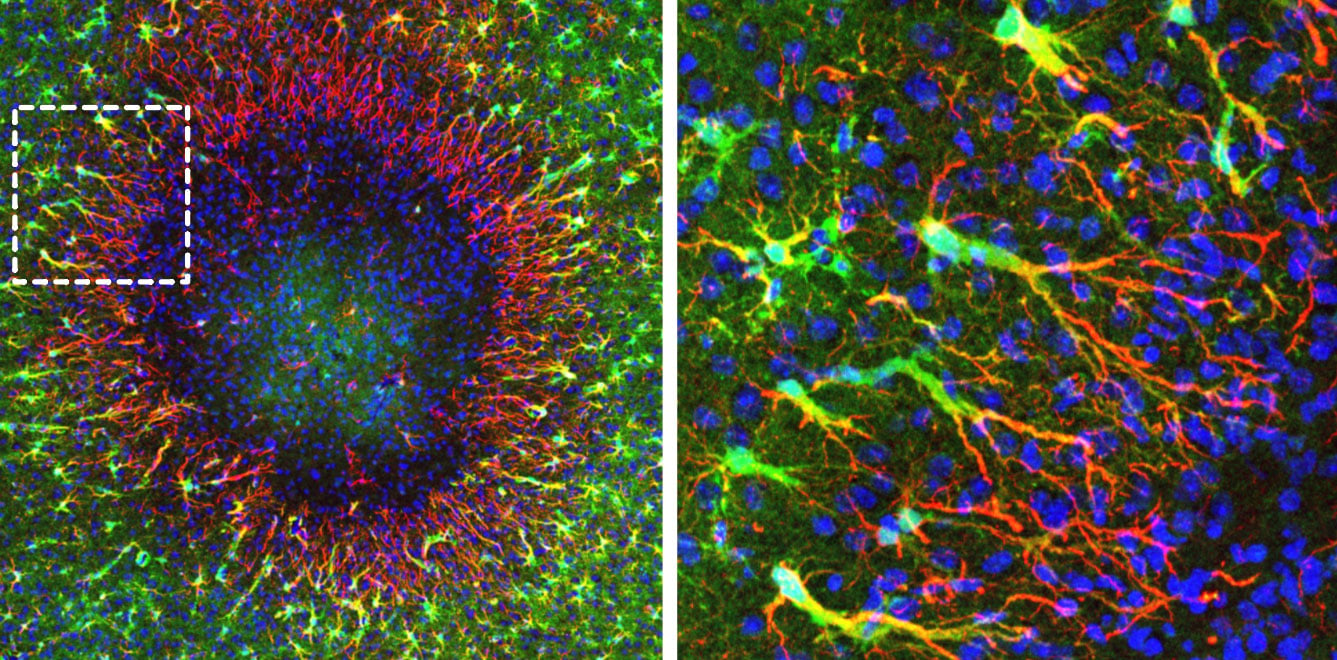
Scientists have discovered an unexpected way the adult brain may replace certain cells lost to injury or disease. In living mice, researchers observed specialized brain cells repairing damaged regions by transporting newly formed cell nuclei over long distances, revealing a regenerative process that was previously unknown.
The discovery challenges the long-held belief that the adult brain cannot fully replace lost astrocytes. These star-shaped glial cells support neurons by supplying nutrients, helping regulate blood flow, and maintaining healthy brain tissue. Astrocytes can be destroyed by brain injuries and autoimmune conditions, including the rare disorder neuromyelitis optica spectrum disorder, in which the body’s antibodies attack these essential cells.
Specialized Brain Cells Help Restore Damaged Tissue
A research team led by Bruno Weber at the University of Zurich (UZH) identified a specialized population of “regenerative” astrocytes in the brains of living mice. Located along the edges of damaged tissue, these cells help replace missing astrocytes and rebuild the networks that support surrounding neurons. The study’s co-lead authors were Marina Herwerth and Matthias Wyss from the university’s Institute of Pharmacology and Toxicology.
“The findings of our study reveal a previously unknown ability of the adult brain to repair itself. They point toward new ways of supporting recovery from ailments involving the loss of astrocytes,” Weber says.
An Unusual Mechanism for Brain Cell Regeneration
To investigate how this repair process works, the scientists monitored living mouse brains over several weeks using two-photon microscopy, an imaging technique that allows researchers to examine cells within living tissue. They also mapped gene activity across different brain regions to identify the astrocytes involved in regeneration.
The observations revealed that these cells do more than simply divide to produce replacements. Newly formed nuclei from daughter cells travel through the long, branching extensions of astrocytes toward areas where cells have been lost. As Weber explains, “they send the newly formed nuclei of their daughter cells gliding across long distances to repopulate the damaged area of the brain and knit the astrocyte network back together.”
New Molecular Targets Could Guide Future Treatments
By examining gene activity during regeneration, the researchers identified molecular changes associated with the repair process. These findings could eventually help scientists determine whether specific biological signals can be stimulated to promote astrocyte replacement after injuries or diseases that destroy these cells.
“We were able to identify numerous genes and signaling pathways that are temporarily activated during repair. They could serve as starting points in the future for influencing post-disease and -injury regeneration processes,” Weber stresses.
Reference: “Focal astrocyte loss reveals nuclear translocation during lesion repopulation” by Marina Herwerth, Matthias T. Wyss, Nicola B. Schmid, Anna Lasne, Jacqueline Condrau, Luca Ravotto, José María Mateos Melero, Andres Kaech, Gustav Bredell, Carolina Thomas, Rachel Kim, Petra Kukanja, Vladyslav L. Korobeynyk, Christine Stadelmann, Thomas Misgeld, Jeffrey L. Bennett, Sebastian Jessberger, Aiman S. Saab, Shane A. Liddelow and Bruno Weber, 23 July 2026, Nature Neuroscience.
DOI: 10.1038/s41593-026-02354-5
Never miss a breakthrough: Join the SciTechDaily newsletter.
Follow us on Google and Google News.