
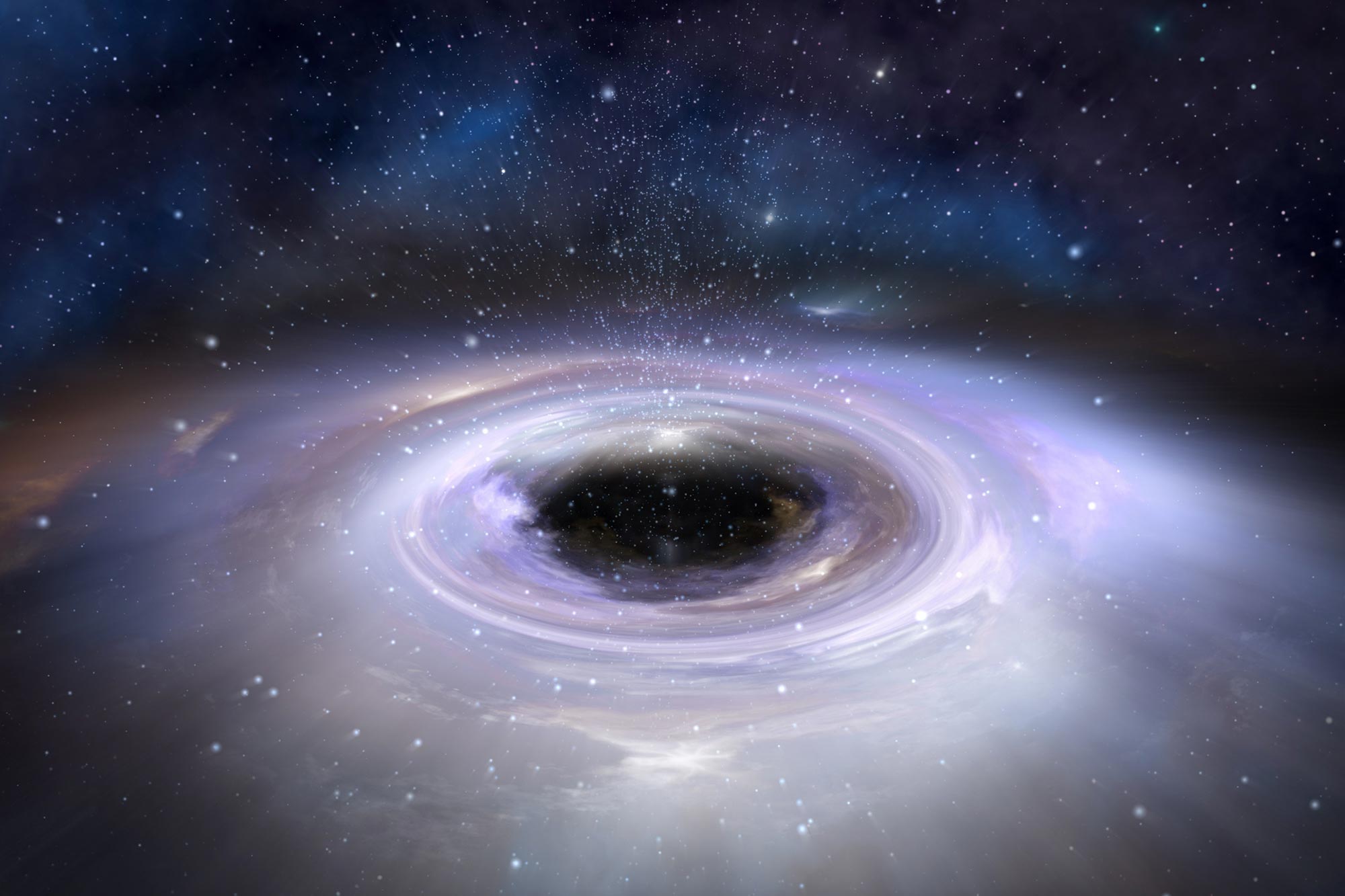
An unexpected gap in black hole masses may point to a hidden population born from stars that collapsed silently rather than exploded.
Some massive stars may end their lives without a supernova, collapsing directly into black holes instead of producing a brilliant explosion. A new Caltech-led study suggests that gravitational waves from colliding black holes may contain evidence of these silent stellar deaths, potentially explaining why certain black holes are far more common than others.
Using observations from the LIGO–Virgo–KAGRA gravitational-wave network, researchers analyzed 257 black hole mergers recorded over the past decade. They found a pronounced concentration of black holes with masses around 10 times that of the Sun, accounting for roughly three-quarters of the merger sample. Black holes between 12 and 16 solar masses, however, were unexpectedly scarce.
An Unexpected Gap in Black Hole Masses
The researchers also examined how rapidly the black holes spin, a property influenced by the processes that formed them. Black holes near 10 solar masses had a narrower distribution of spin rates than the overall population. Combined with the unusual mass distribution, this suggests they may belong to a distinct group with a shared formation history.
“We see 10 solar-mass black holes merging all the time,” says Isaac Legred (PhD ’25), the study’s lead author and a postdoctoral researcher at the University of Illinois Urbana-Champaign who conducted the research at Caltech. “But why are, say, 14 solar-mass black holes so rare? The gap we see in the distribution of masses indicates there may be a special cocktail of internal physics that goes into forming the abundance of 10 solar-mass black holes.”
Could Massive Stars Collapse Without Exploding?
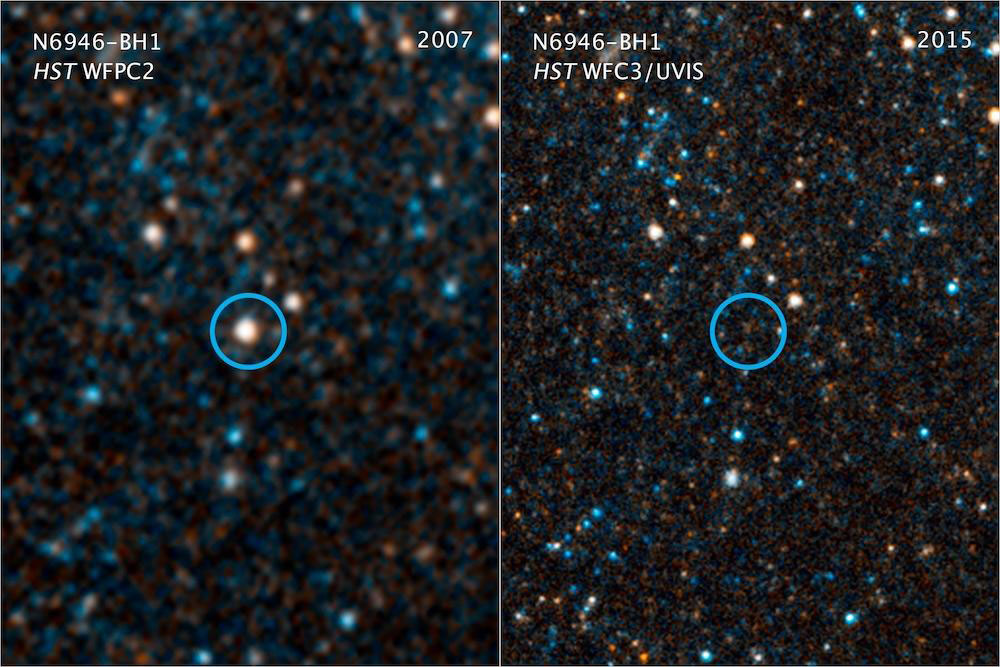
Massive stars typically end their lives when their cores collapse and trigger supernova explosions, ejecting much of their material into space. The remaining cores can become neutron stars or black holes. However, theoretical models predict that some massive stars may collapse directly into these compact objects without producing a bright supernova.
Such events, known as failed supernovae, have not yet been conclusively confirmed. Scientists have proposed that they could produce many of the black holes observed in merging binary systems, particularly those around 10 solar masses. In these systems, one or both black holes may have formed through a quiet stellar collapse rather than an explosive death.
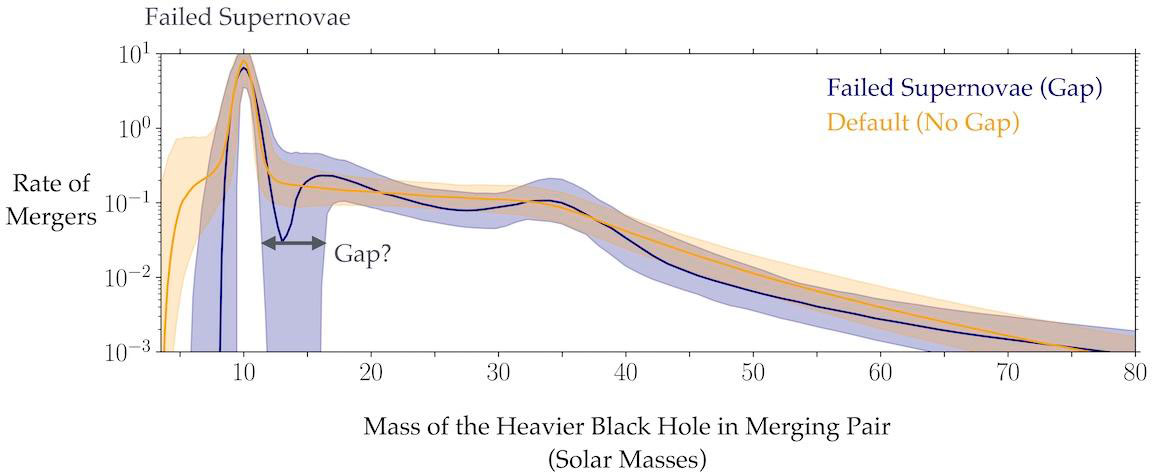
“A vast majority of the merging black holes in the universe are about 10 times the mass of our Sun,” says Katerina Chatziioannou, a Caltech physics professor and LIGO team member who led the research. “Our data are showing that this group of black holes may have a common origin—they may be a distinct subpopulation that failed to go supernova. These results represent a connection between the gravitational-wave data and underlying astrophysics we are trying to extract.”
Gravitational Waves Reveal Clues About Stellar Deaths
The National Science Foundation (NSF)-funded LIGO observatories in Louisiana and Washington made the first direct detection of gravitational waves from merging black holes in 2015. These ripples in spacetime carry information about the masses and spins of the objects that produced them. Together with Virgo in Italy and KAGRA in Japan, the network has now detected more than 300 black hole collisions.
The new study, published in Physical Review D, was led by Chatziioannou, with Legred as lead author and former Caltech researcher Jacob Golomb (PhD ’25), now at Asari AI, as a coauthor. Although the findings agree with theoretical predictions for failed supernovae, they do not directly establish that these events occurred.
“We can look up at the sky and try to study historical records of massive stars that failed to explode, but it’s challenging because they just vanish without exploding, leaving a dark patch of sky,” Legred says. “With this study, we show the gravitational-wave data are consistent with most binary black holes forming from a very special kind of failed supernova, but more research is needed. Black holes are born in some of the most extreme environments in the universe, so the prospect of better understanding their formation is very exciting.”
Reference: “Low-mass failed supernovae and the 10M⊙ peak in the merging black hole mass distribution” by Isaac Legred, Jacob Golomb and Katerina Chatziioannou, 10 November 2026, Physical Review D.
DOI: 10.1103/mnzq-w1b5
Funding: U.S. National Science Foundation, DOE/US Department of Energy, Simons Foundation
Never miss a breakthrough: Join the SciTechDaily newsletter.
Follow us on Google and Google News.