
Close Menu
    Facebook X (Twitter) Instagram
    SciTechDaily
    • Biology
    • Chemistry
    • Earth
    • Health
    • Physics
    • Science
    • Space
    • Technology
    Facebook X (Twitter) Pinterest YouTube RSS
    SciTechDaily
    Home»Space»Black Hole Collision May Have Exploded With Light
    Space

    Black Hole Collision May Have Exploded With Light

    By NASANovember 28, 20211 Comment2 Mins Read
    Facebook Twitter Pinterest Telegram LinkedIn WhatsApp Email Reddit
    Share
    Facebook Twitter LinkedIn Pinterest Telegram Email Reddit
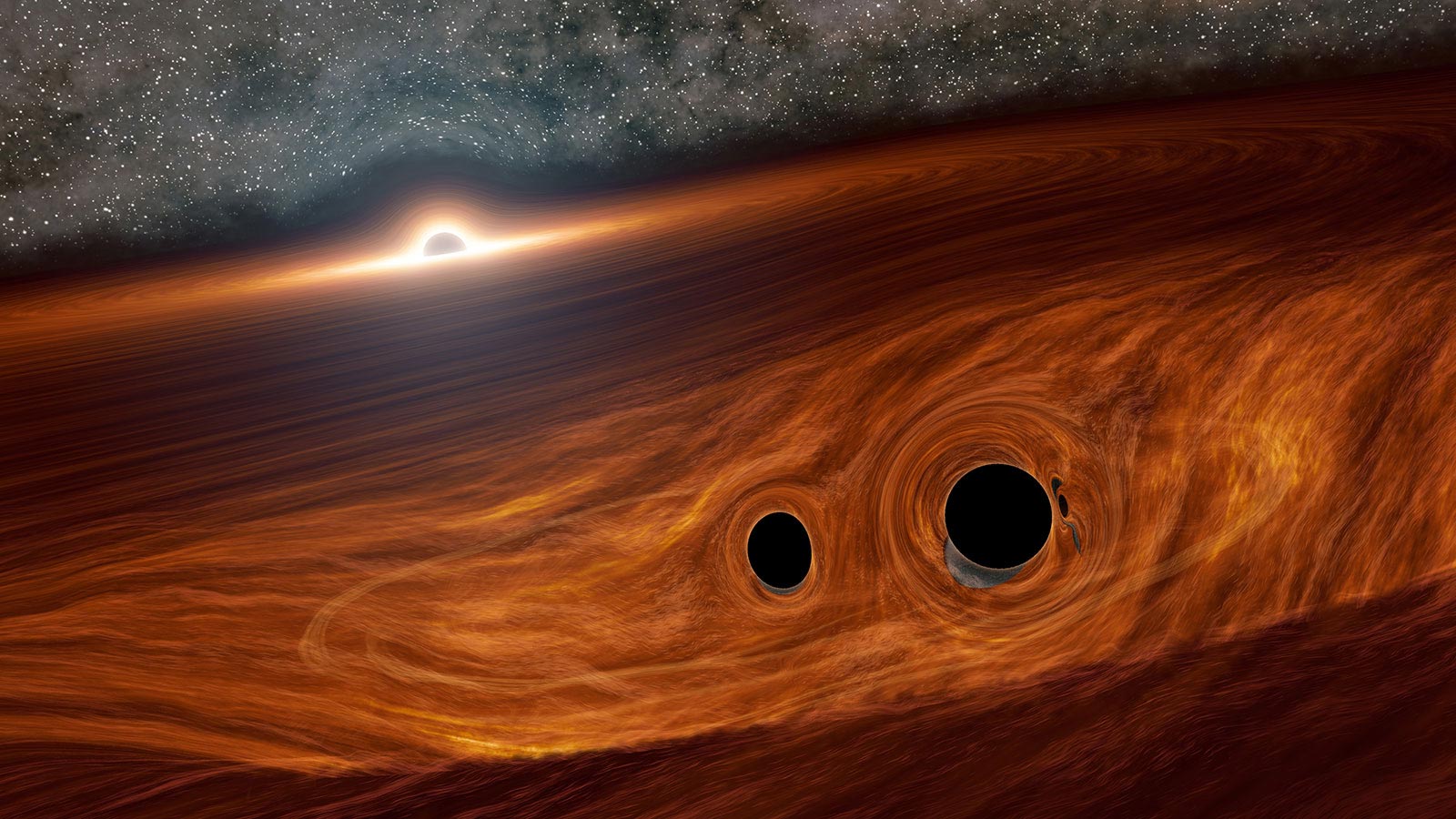
    Supermassive Black Hole Surrounded by Two Black Holes
    This artist’s concept shows a supermassive black hole surrounded by a disk of gas. Embedded in this disk are two smaller black holes that may have merged together to form a new black hole. Credit: Caltech/R. Hurt (IPAC)

    First Glimpse of Light from a Black Hole Merger

    In a first, astronomers may have seen light from the merger of two black holes, providing opportunities to learn about these mysterious dark objects.

    This artist’s concept shows a supermassive black hole surrounded by a disk of gas. Embedded in this disk are two smaller black holes that may have merged together to form a new black hole.

    When two black holes spiral around each other and ultimately collide, they send out gravitational waves — ripples in space and time that can be detected with extremely sensitive instruments on Earth. Since black holes and black hole mergers are completely dark, these events are invisible to telescopes and other light-detecting instruments used by astronomers. However, theorists have come up with ideas about how a black hole merger could produce a light signal by causing nearby material to radiate.

    Now, scientists using Caltech’s Zwicky Transient Facility (ZTF) located at Palomar Observatory near San Diego may have spotted what could be just such a scenario. If confirmed, it would be the first known light flare from a pair of colliding black holes.

    The merger was identified on May 21, 2019, by two gravitational wave detectors – the National Science Foundation’s Laser Interferometer Gravitational-wave Observatory, or LIGO, and the European Virgo detector – in an event called GW190521g. That detection allowed the ZTF scientists to look for light signals from the location where the gravitational wave signal originated. These gravitational wave detectors have also spotted mergers between dense cosmic objects called neutron stars, and astronomers have identified light emissions from those collisions.

    Never miss a breakthrough: Join the SciTechDaily newsletter.
    Follow us on Google and Google News.

    Astronomy Astrophysics Black Hole California Institute of Technology Gravitational Waves NASA
    Share. Facebook Twitter Pinterest LinkedIn Email Reddit

    Related Articles

    Cosmic Heavyweights Collide – LIGO Detects Largest, Fastest-Spinning Black Holes Yet

    NASA’s Planet Hunter’s Rare Glimpse at Two Black Holes in a Faraway Galaxy

    Colossal Black Holes Locked in an Epic Cosmic Dance at Heart of Galaxy

    “Echo Mapping” Light Bursts From Supermassive Black Holes in Faraway Galaxies to Measure Vast Cosmic Distances

    Lopsided “David and Goliath” Black Hole Merger With an Oddball Origin Story

    Massive “Bang” in LIGO and Virgo Gravitational-Wave Detectors: Fabric of Space-Time Shaken by Binary Black Hole Merger

    Quick ‘Bang’ Signals the Most Massive Gravitational-Wave Source Ever Detected

    Here’s What Happens When a Supermassive Black Hole Fails to Do Its Job [Video]

    Gravitational Waves Could Soon be Detectable by Existing Radio Telescopes

    1 Comment

    1. Torbjörn Larsson on November 30, 2021 5:21 am

      i found the arxiv preprint, but the model isn’t of a merger producing light but of it kicking the merged black hole through the galaxy supermassive black hole accretion disk to produce a light flare.

      “Nearby gas is accelerated around the BH, producing a shocked Bondi tail [e.g., 57–59] which both acts as a drag on the BH and accretes onto it. We approximate the Bondi-Hoyle-Lyttleton (BHL) luminosity …” [ https://arxiv.org/pdf/2006.14122.pdf ].

      They then predict a similar flare “when the kicked BBH re-encounters the disk on timescale … “.

      Reply
    Leave A Reply Cancel Reply

    • Facebook
    • Twitter
    • Pinterest
    • YouTube

    Don't Miss a Discovery

    Subscribe for the Latest in Science & Tech!

    Trending News

    Largest-Ever Study Finds Medicinal Cannabis Ineffective for Anxiety, Depression, PTSD

    250-Million-Year-Old Egg Solves One of Evolution’s Biggest Mysteries

    Living With Roommates Might Be Changing Your Gut Microbiome Without You Knowing

    Century-Old Cleaning Chemical Linked to 500% Increased Risk of Parkinson’s Disease

    What if Your Memories Never Happened? Physicists Take a New Look at the Boltzmann Brain Paradox

    One of the Universe’s Largest Stars May Be Getting Ready To Explode

    Scientists Discover Enzyme That Could Supercharge Ozempic-Like Weight Loss Drugs

    Popular Sweetener Linked to DNA Damage – “It’s Something You Should Not Be Eating”

    Follow SciTechDaily
    • Facebook
    • Twitter
    • YouTube
    • Pinterest
    • Newsletter
    • RSS
    SciTech News
    • Biology News
    • Chemistry News
    • Earth News
    • Health News
    • Physics News
    • Science News
    • Space News
    • Technology News
    Recent Posts
    • Challenging the Narrative: New Study Shows U.S. Life Expectancy Is Rising Across All States
    • Mystery Illness Kills 5 in Burundi As Doctors Scramble for Answers
    • Bone-Strengthening Discovery Could Reverse Osteoporosis
    • The Most Elusive Number in Physics Just Got Even More Mysterious
    • Scientists Uncover Hidden Trigger Behind Stem Cell Aging
    Copyright © 1998 - 2026 SciTechDaily. All Rights Reserved.
    • Science News
    • About
    • Contact
    • Editorial Board
    • Privacy Policy
    • Terms of Use

    Type above and press Enter to search. Press Esc to cancel.