
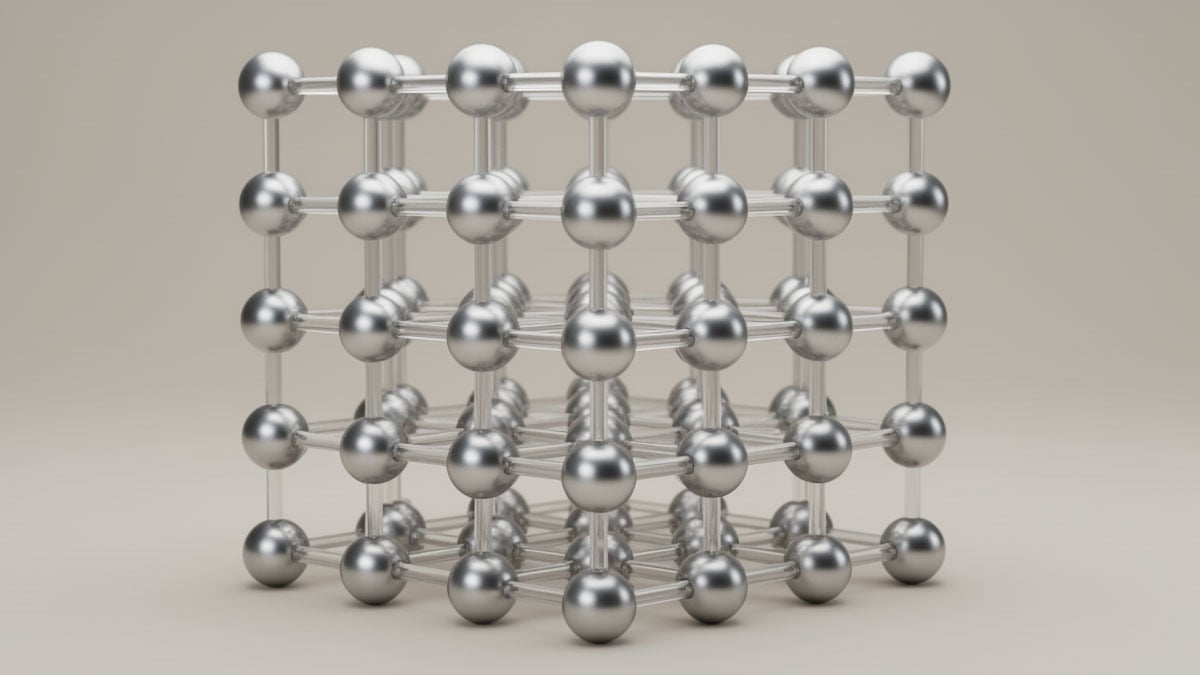
Researchers have discovered a previously unknown crystal structure of silver that exhibits unusually high chemical reactivity.
Silver can take on an extraordinarily rare atomic structure that makes it far more chemically reactive than its familiar form. Researchers at Hokkaido University have discovered a previously unknown crystal arrangement in which silver atoms form a simple cubic pattern, a structure previously documented in only one other element.
The findings, published in Nano Letters, emerged when scientists used an electron beam to break down silver iodide and observed the resulting silver crystals at the atomic scale. Unlike ordinary silver, the newly formed crystals began converting into silver oxide within approximately 100 seconds, demonstrating how dramatically atomic arrangement can influence a material’s chemical behavior.
An Exceptionally Rare Arrangement of Silver Atoms
Most silver crystallizes in a structure known as face-centered cubic, in which atoms occupy the eight corners and the center of each face of a repeating cube. This tightly packed arrangement is also found in common metals such as gold, copper, and aluminum.
The newly discovered silver instead formed a simple cubic structure, with atoms occupying only the corners of each repeating cube. This arrangement is exceptionally uncommon in pure elements. Before this discovery, the only known elemental example was radioactive polonium, whose simple cubic structure was identified in 1966.
“It was surprising to find that such a low-density structure could form in a pure metal crystal,” says first author Dr. Masaya Sakakibara. “We expected silver nanoparticles to form when silver iodide decomposes under electron beam irradiation, but we didn’t expect them to adopt a simple cubic structure.”
Watching an Unusual Crystal Form in Real Time
The researchers created and examined the silver using a transmission electron microscope (TEM), which employs electrons with wavelengths shorter than those of visible light to resolve structures down to individual atoms. The electron beam served two purposes: it triggered the decomposition of silver iodide and allowed the scientists to watch the resulting silver atoms organize into crystals.
The nanoscale conditions were essential to the discovery. At dimensions of just a few billionths of a meter, materials can temporarily adopt crystal structures that would be unstable in larger samples. Such arrangements can produce physical and chemical properties that differ substantially from those of the same element in its conventional form.
A More Reactive Form of Silver
Experiments conducted under high vacuum revealed a striking difference between the two silver structures. Conventional face-centered cubic silver remained stable, while the simple cubic crystals gradually oxidized, forming silver oxide. The rapid transformation provided direct evidence of the new structure’s unusually high chemical reactivity.
“Within 100 seconds of its formation, it began to transform into silver oxide,” adds Sakakibara.
The researchers believe their technique could provide a way to discover other previously unknown crystal structures and investigate the properties they produce.
“This is a new approach to discovering previously unknown crystal structures, which could also help us develop materials with novel properties in the future,” says Professor Yuki Kimura, co-author of the study and head of the Low Temperature Nanomaterial Science Laboratory at Hokkaido University.
“Going forward, we will continue investigating the physical and chemical properties of simple cubic silver in greater detail and extend this approach to other elements and compounds.”
Reference: “Electron-Beam-Assisted Formation of Simple-Cubic Silver” by Masaya Sakakibara, Hiroki Nada, Yuji Kunisada, Tomoya Yamazaki and Yuki Kimura, 4 November 2026, Nano Letters.
DOI: 10.1021/acs.nanolett.6c03635
Never miss a breakthrough: Join the SciTechDaily newsletter.
Follow us on Google and Google News.