
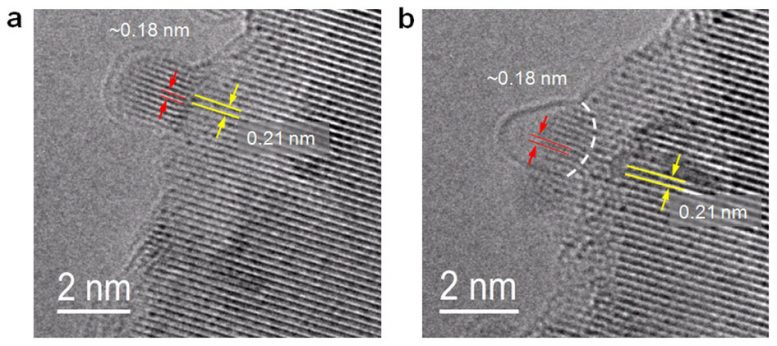
a, b, In situ HRTEM lattice images showing carbon cap formation on epitaxial Co nanoparticles formed from the CoxMg1−xO solid solution at 600°C in presence of 6.3 mbar CO in the TEM chamber. The lattice-mismatched epitaxial relationship between Co and MgO, as demonstrated in Fig. 2e, is also observed in both cases. Credit: Maoshuai He, et al., doi:10.1038/srep01460
A team of researchers has managed to control chirality in carbon nanotubes, achieving an epitaxial formation of Co nanoparticles by reducing a well-developed solid solution in CO.
An ultimate goal in the field of carbon nanotube research is to synthesize single-walled carbon nanotubes (SWNTs) with controlled chiralities. Twenty years after the discovery of SWNTs, scientists from Aalto University in Finland, A.M. Prokhorov General Physics Institute RAS in Russia, and the Center for Electron Nanoscopy of Technical University of Denmark (DTU) have managed to control chirality in carbon nanotubes during their chemical vapor deposition synthesis.
Carbon nanotube structure is defined by a pair of integers known as chiral indices (n,m), in other words, chirality.
Chirality defines the optical and electronic properties of carbon nanotubes, so controlling it is a key to exploiting their practical applications, says Professor Esko I. Kauppinen, the leader of the Nanomaterials Group in Aalto University School of Science.
Over the years, substantial progress has been made to develop various structure-controlled synthesis methods. However, precise control over the chiral structure of SWNTs has been largely hindered by a lack of practical means to direct the formation of the metal nanoparticle catalysts and their catalytic dynamics during tube growth.
We achieved an epitaxial formation of Co nanoparticles by reducing a well-developed solid solution in CO, reveals Maoshuai He, a postdoctoral researcher at Aalto University School of Chemical Technology.
For the first time, the new catalyst was employed for selective growth of SWNTs, adds senior staff scientist Hua Jiang from Aalto University School of Science.
By introducing the new catalysts into a conventional CVD reactor, the research team demonstrated preferential growth of semiconducting SWNTs (~90%) with an exceptionally high population of (6,5) tubes (53%) at 500 °C (932 °F). Furthermore, they also showed a shift of the chiral preference from (6,5) tubes at 500 °C to (7, 6) and (9, 4) nanotubes at 400 °C (752 °F).
These findings open new perspectives both for structural control of SWNTs and for elucidating their growth mechanisms, thus are important for the fundamental understanding of science behind nanotube growth, comments Professor Juha Lehtonen from Aalto University.
The research has been recently published in a new Nature Publishing Group journal Scientific Reports.
Reference: “Chiral-Selective Growth of Single-Walled Carbon Nanotubes on Lattice-Mismatched Epitaxial Cobalt Nanoparticles” by Maoshuai He, Hua Jiang, Bilu Liu, Pavel V. Fedotov, Alexander I. Chernov, Elena D. Obraztsova, Filippo Cavalca, Jakob B. Wagner, Thomas W. Hansen, Ilya V. Anoshkin, Ekaterina A. Obraztsova, Alexey V. Belkin, Emma Sairanen, Albert G. Nasibulin, Juha Lehtonen and Esko I. Kauppinen, 15 March 2013, Scientific Reports.
DOI: 10.1038/srep01460
This work is financially supported by the CNB-E project in Aalto University through the Multidisciplinary Institute of Digitalization and Energy (MIDE) program and the Aalto Energy Efficiency program project (MOPPI). This work made use of facilities at Nanomicroscopy Center of Aalto University in Finland and at the Center for Electron Nanoscopy at the Technical University in Denmark sponsored by the A.P. Moller and Chastine Mc-Kinney Moller Foundation.
Never miss a breakthrough: Join the SciTechDaily newsletter.
Follow us on Google and Google News.