

Scientists have uncovered subtle changes in the brain’s master clock and immune cells during early Alzheimer’s disease.
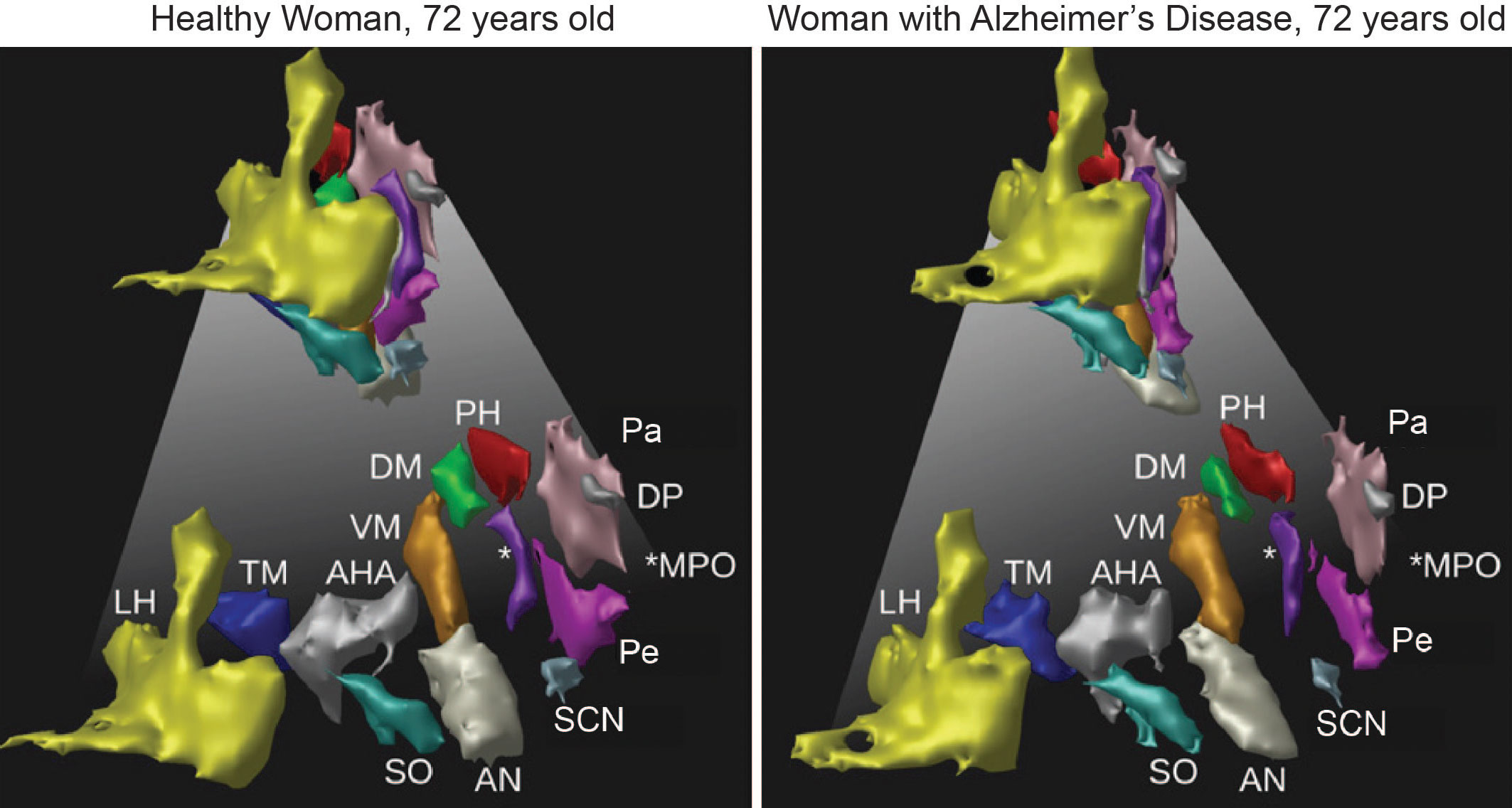
Sleep problems, changes in appetite, and disruptions to the body’s internal clock can appear in people with Alzheimer’s disease before significant memory loss develops. Scientists have now identified molecular changes in the hypothalamus, a small brain region that controls these functions, that could help explain some of the disease’s earliest symptoms.
The study, published November 18, 2026, in Nature, found altered activity in the brain’s clock neurons and immune cells during early Alzheimer’s. Researchers also discovered that different parts of the hypothalamus change in size with normal aging, even when the region’s overall volume remains relatively stable.
“Most of what we know about Alzheimer’s comes from the hippocampus and cortex, because that’s where memory is organized and lives,” said senior author Ashley Webb, PhD, associate professor at the Buck Institute for Research on Aging. “But patients and families often report disrupted sleep, a change in appetite, or different responses to stress alongside memory changes.”
“We wanted to look directly at the part of the brain that controls those functions, and to do it with enough resolution to see which cells are changing with age and in the disease.”
Alzheimer’s Disrupts the Brain’s Internal Clock
The hypothalamus regulates essential functions including body temperature, hunger, thirst, hormone release, and sleep. Its specialized regions, called nuclei, perform different tasks. The suprachiasmatic nucleus (SCN) serves as the body’s master clock, coordinating daily biological rhythms, while the arcuate nucleus helps regulate appetite and energy balance.
Researchers discovered altered signaling involving vasopressin, a hormone and neuropeptide involved in circadian regulation, in a prominent group of SCN neurons. These changes could help explain why sleep disturbances and irregular daily rhythms often accompany Alzheimer’s.
“Sleep and circadian problems are some of the earliest signs of Alzheimer’s, and circadian behavioral changes known as sundowning, occur later in the disease. But we’ve never had a good molecular explanation for why,” Webb said. “Seeing vasopressin signaling disrupted in the brain’s master clock, in people at early stages of the disease, gives us a concrete place to start.”
Immune Cells Show Early Signs of Alzheimer’s
The researchers also found extensive changes in microglia, the brain’s resident immune cells. These cells showed more altered genes than any other cell type examined. Computational analysis suggested a progression from a resting state toward the inflammatory, disease-associated state previously observed in other brain regions affected by Alzheimer’s.
“This finding suggests that the hypothalamus transitions to an inflammatory state early in Alzheimer’s disease, just like the brain regions involved in memory,” said Webb.
Among 254 identified neuronal subtypes, inhibitory (GABAergic) neurons showed particularly pronounced changes in neuropeptide and receptor signaling. Machine learning models could distinguish Alzheimer’s cells from healthy controls using gene activity patterns, with inflammation and circadian regulation emerging as major differences.
Brain Scans Reveal Uneven Changes With Aging
Using MRI scans from 458 living adults, the team measured 13 hypothalamic regions. Although the hypothalamus as a whole changed little in volume with age, individual regions behaved differently. The lateral hypothalamus shrank, while the SCN and several regions involved in metabolism and hormone regulation increased in size.
These patterns remained after accounting for Alzheimer’s status, suggesting they primarily reflect normal aging. Volume differences associated specifically with Alzheimer’s were not statistically significant.
“If you only measure the hypothalamus as a whole, it looks like nothing is happening,” Webb said. “When you zoom in, you see some regions shrinking and others growing. That tells us aging is reshaping this region in a very specific, structured way.”
The team also examined gene activity in approximately 614,000 individual hypothalamic cells, using tissue from seven people with mostly early-stage Alzheimer’s, seven age-matched controls, and published data from three younger individuals. The combined findings form HypoAD, a resource available to other researchers.
“No single method can answer this question,” said co-senior author Manu Goyal, MD, director of neuroimaging labs at Washington University School of Medicine in St. Louis, MO. “MRI can tell you what’s happening in living people but is limited in its resolution. Single-cell sequencing tells you what’s happening inside each cell type but requires actual tissue. The goal here was to put them side by side to let us see things that neither could show alone.”
What Could Explain the Changes in Brain Size?
The researchers found no clear evidence that total cell numbers had changed. Instead, increased activity in mTOR, a pathway that regulates cell growth, along with changes in surrounding tissue and inflammatory activity, could help explain why certain hypothalamic regions become larger. This explanation remains unconfirmed.
The study also has limitations. The postmortem Alzheimer’s and age-matched control groups included only 14 people, while imaging and cellular measurements came from different individuals. Because the research did not follow participants over time, it cannot establish whether the observed changes cause symptoms or result from the disease.
Could the Brain’s Clock Become a Treatment Target?
Future studies will investigate how these changes develop and whether protecting circadian rhythms and neuropeptide signaling could help manage symptoms or slow Alzheimer’s progression. The findings identify potential targets but do not establish that such interventions would work.
“This is a starting point, not the final word,” Webb said. “Our next step is to follow these changes over time and test whether protecting the brain’s clock, and neuropeptide signaling in particular, can slow the disease or help manage symptoms. If circadian disruption is one of the first things to go wrong, it may also be one of the first places we can intervene.”
Reference: “Hypothalamic volume and cell-type changes in ageing and Alzheimer’s disease” by Doudou Yu, Jürgen Germann, Ghulam Murtaza, Kaitlyn H. Hajdarovic, Kelsey R. Babcock, Shiva Kazempour Dehkordi, Alexander C. Jackson, Ivana Delalle, Miranda E. Orr, Habil Zare, Ritambhara Singh, Michael J. MacCoss, William Stafford Noble, Andrei G. Vlassenko, Manu S. Goyal and Ashley E. Webb, 18 November 2026, Nature.
DOI: 10.1038/s41586-026-11305-w
The work was supported by grants from the NIH/NIA: AG053503, AG057536, RF1 AG073210, R21 AG070527, AG078299, AG084624, R01 MH112739. AG078299, R01 AG068293, R01 AG068293, AG084624 and NIH/NIA F99/K00 award AG083292. Additional support came from the National Science Foundation, DBI 2213824. Support also came from the Blavatnik Family Graduate Fellowship in Biology and Medicine, the Carney Institute for Brain Science at Brown University, the Cure Alzheimer’s Fund, and the American Federation for Aging Research.
Never miss a breakthrough: Join the SciTechDaily newsletter.
Follow us on Google and Google News.