
Scientists have found a way to predict the heating requirements of future fusion machines, offering valuable insight into one of the biggest challenges of harnessing the energy that powers the Sun.
In 1982, scientists studying nuclear fusion discovered something unexpected. Once the heating power inside an experimental fusion machine reached a certain level, the fuel suddenly became much better at retaining heat. This discovery offered a way to overcome one of the biggest challenges in fusion research. More than four decades later, predicting how much power is needed to trigger this change remains a difficult problem.
Nuclear fusion releases energy when light atomic nuclei combine, the same process that powers the Sun. Recreating this process on Earth requires heating a gas to extreme temperatures, turning it into plasma, a state of matter made up of electrically charged particles.
Machines called tokamaks use powerful magnetic fields to confine this plasma inside a doughnut-shaped chamber. However, keeping the plasma in place does not necessarily keep it hot. Turbulent motion within the plasma can carry heat away, making it difficult to maintain the conditions needed for fusion.
The elusive threshold for better confinement
The phenomenon discovered in 1982 occurs when heating power crosses a critical threshold, causing turbulence near the outer edge of the plasma to drop sharply. Scientists call this the transition from low confinement (L-mode) to high confinement (H-mode), a state in which the plasma retains energy much more efficiently.
Achieving H-mode is essential for future fusion reactors. The difficulty is that the amount of heating power required depends on several factors, including how densely packed the plasma particles are and the direction of the magnetic field. Existing theories have struggled to explain both effects together.
Turbulence can suppress itself
In a study published in Physical Review Letters, researchers led by Brenno De Lucca, a doctoral assistant at EPFL’s Swiss Plasma Center (SPC), developed a theory that explains these effects within a single physical framework.
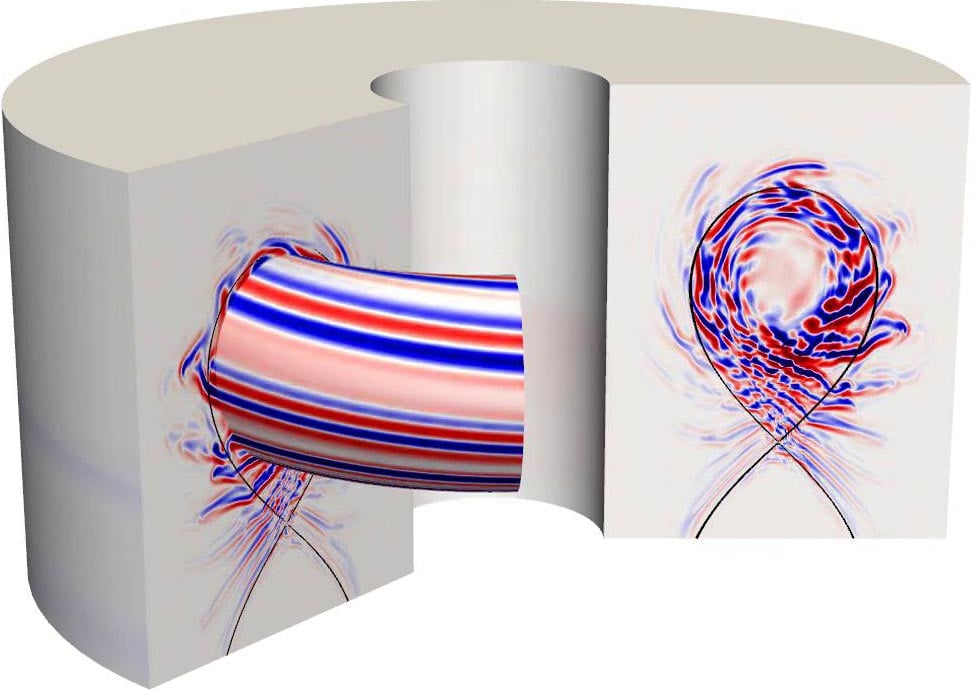
Using computer simulations, the researchers recreated the behavior of plasma inside a tokamak as heating power increased. They identified the physical processes responsible for the transition, developed a mathematical model to describe them, and compared its predictions with experimental measurements from existing tokamaks.
Their results showed that turbulence generates flows within the plasma that move at different speeds across its outer region. As neighboring layers move past one another at different speeds, they help disrupt the turbulent motion that created them in the first place. This reduces heat loss, allowing the plasma to retain more energy.
The researchers also found that the direction of the magnetic field, the movement of the plasma, and collisions between particles work together to make H-mode easier to reach in one magnetic field configuration than in the other.
Plasma density presents another complication. Increasing the density can reduce the amount of heating power needed in one range and increase it in another. The researchers derived equations describing these changes and other operating conditions, explaining why there is a particular density at which the heating requirement is lowest.
A tighter power margin for SPARC
The model could help researchers determine whether future fusion machines will have sufficient heating power to achieve H-mode. For ITER, the world’s largest international fusion project, currently under construction in France, the researchers predicted a minimum requirement of 43 megawatts, comfortably below its planned heating capacity of 73 megawatts.
The outlook is tighter for SPARC, a compact tokamak that uses powerful magnetic fields and is being developed by the U.S. company Commonwealth Fusion Systems. Its predicted minimum heating requirement is 26 megawatts, slightly above its planned capacity of 25 megawatts, leaving considerably less room for uncertainty.
Reference: “Theory for the Power Threshold of the L−H Transition in Tokamaks” by B. De Lucca, P. Ricci, B. Labit, D. Mancini, L. N. Stenger and Z. Tecchiolli, 13 November 2026, Physical Review Letters.
DOI: 10.1103/rw25-wy15
Funding: EUROfusion Consortium, European Union Euratom Research and Training Programme (Grant Agreement No. 101052200), Swiss State Secretariat for Education, Research and Innovation (SERI), Swiss National Science Foundation (SNSF), and Swiss National Supercomputing Center (CSCS)
Never miss a breakthrough: Join the SciTechDaily newsletter.
Follow us on Google and Google News.