
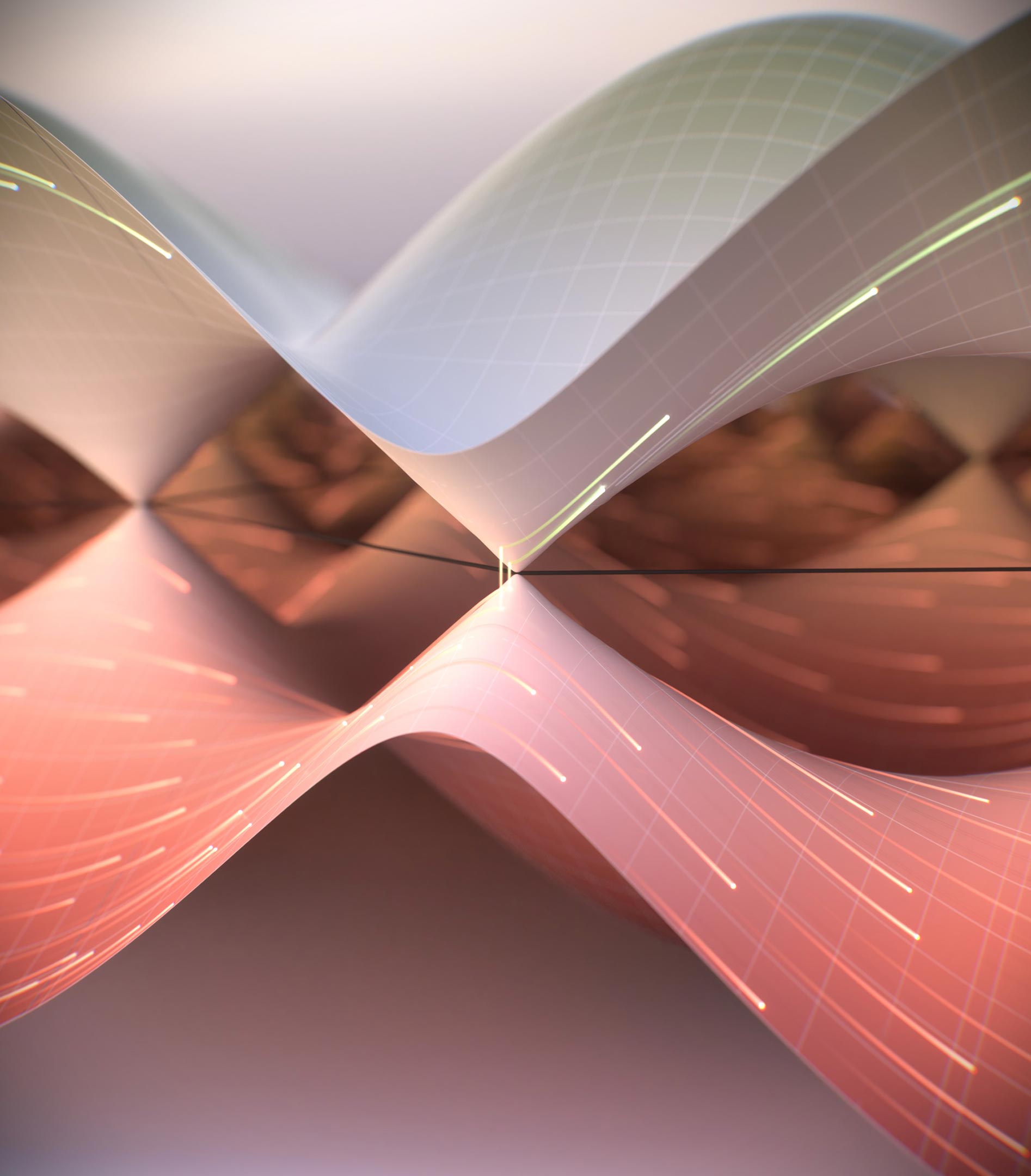
Experiments with graphene have revealed how remarkably effectively light can control electrons, offering a possible route toward a new generation of high-speed electronics.
Imagine riding an elevator whose floor indicator climbs from 1 to 2 to 3 before suddenly jumping to 20. You arrive at the twentieth floor without ever passing through the floors in between. In the quantum world, electrons can make a comparable leap in energy, and physicists have now found a way to watch it happen in slow motion.
Researchers from the University of Regensburg, Philipps-Universität Marburg, and Forschungszentrum Jülich combined laser technology with electron microscopy to capture this unusual behavior in graphene, a material made of atomically thin layers of carbon. Their findings, published in Nature, could help lay the groundwork for future high-speed electronics that use light to control the movement of electrons.
Speed determines the quantum leap
In semiconductors and related materials, electrons can occupy only certain ranges of energy, known as energy bands. Separating these bands are gaps containing energies that electrons are not allowed to occupy. Electrons normally remain within their respective bands, though under certain conditions, they can jump from one band to another without occupying the forbidden energies in between. Physicists call this process a Landau-Zener-Majorana transition.
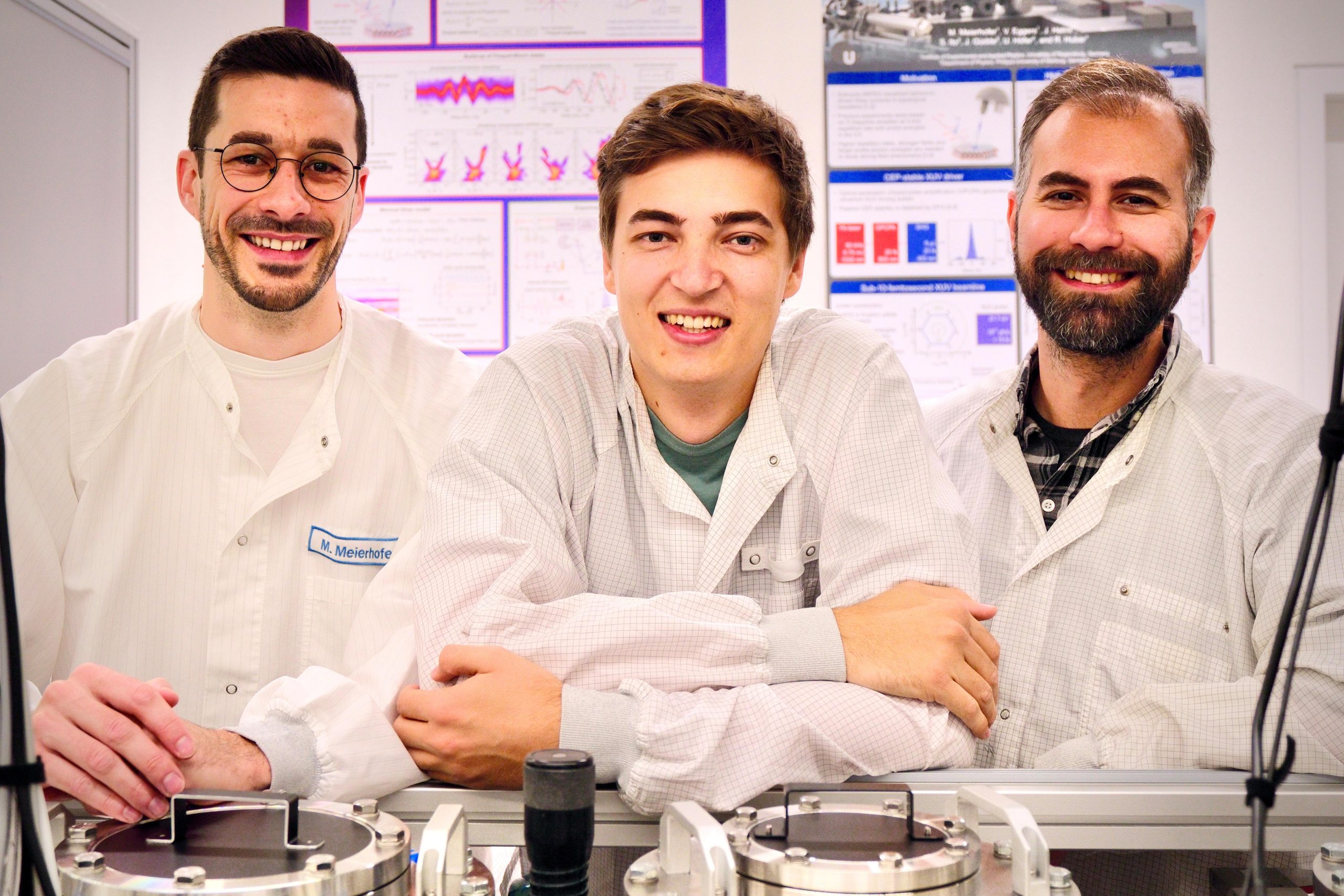
The researchers used the electric field of an intense light pulse to accelerate electrons in graphene, observing how they switched between energy bands as they moved. Under these conditions, the probability of electrons crossing the gap through a quantum process known as tunneling reached as high as 100 percent.
Even when energy states are well separated, electrons can have a high probability of making the jump. What matters is how quickly they approach the energy gap. This makes the process fundamentally different from conventional quantum tunneling, in which a particle passes through an energy barrier in space.
Capturing electrons in slow motion
Capturing these fleeting transitions required the researchers to observe large numbers of electrons simultaneously.
“If you want to know who has won a race, you have watch all participants,” explains Vincent Eggers, first author of the study. “Likewise, we must observe as many electrons as possible at one time to catch those that undergo a quantum mechanical transition while moving.”
To do this, the team used an instrument called a photoemission momentum microscope. Rather than producing magnified pictures of objects, the microscope measures the energies and states of motion of electrons, creating a map of how they are distributed. The challenge was combining these measurements with powerful, rapidly oscillating light fields that could drive electrons in a controlled manner.
“Our team worked on this experiment for many years. Now, we can track electrons moving across the entire energy landscape of a solid in real time,” says Rupert Huber.
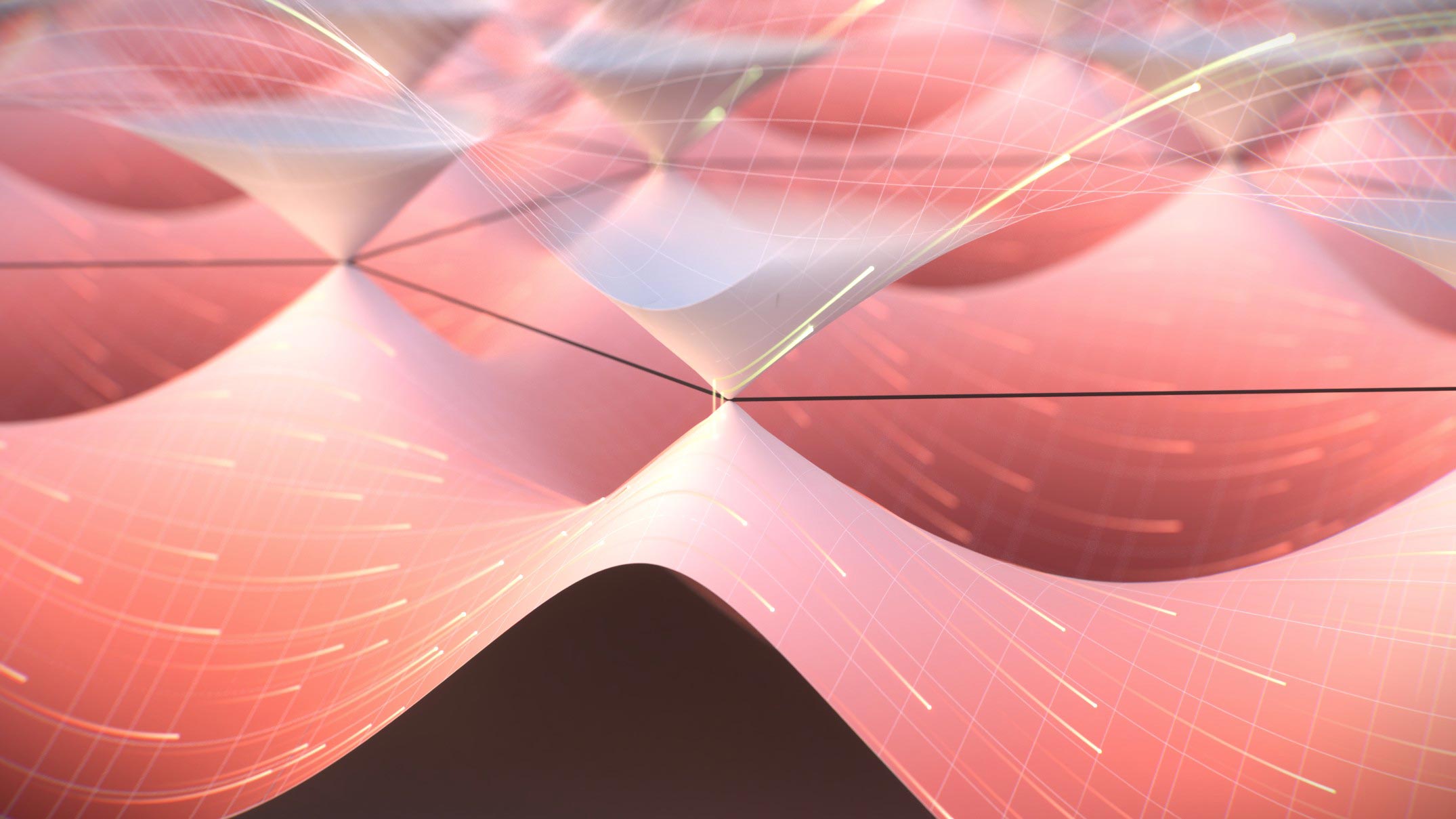
The experiment also depended on exceptionally pure graphene samples specially produced at Forschungszentrum Jülich.
Ulrich Höfer, Huber’s research partner and one of the pioneers of ultrafast electron spectroscopy, recalls, “Being able to observe such a fundamental quantum mechanical process during our first measurement campaign was a very special moment for us—it was also made possible by the samples we used.”
“These precision experiments require material that is nearly perfect at the atomic level. This ensures that impurities do not obscure the delicate quantum dynamics of the electrons. Another important factor for the study was the use of “rotated” graphene, a specialty from Jülich, which allows the quantum dynamics to emerge particularly clearly,” emphasizes Stefan Tautz from Forschungszentrum Jülich.
Toward electronics controlled by light
Beyond capturing quantum transitions, the new technique allows researchers to investigate what prevents electrons from moving in a controlled way. The graphene experiments already revealed how interactions with the crystal lattice, the repeating arrangement of atoms within the material, disrupt the initially orderly motion of electrons.
Understanding these disturbances could become increasingly important as researchers explore technologies that use the extremely rapid oscillations of light to control electrons directly, rather than relying solely on electrical voltages.
“Our experiment opens a panoramic window into the quantum world. Now, we can follow in real time how electrons move through the energy landscape of a material. And this is just the beginning. Our method can be applied to many other quantum materials, opening up completely new possibilities for controlling their electronic properties selectively with light,” says Giacomo Inzani from the University of Regensburg.
Reference: “Subcycle videography of Landau–Zener–Majorana transitions in graphene” by V. Eggers, G. Inzani, M. Meierhofer, L. Münster, J. Helml, R. Wallauer, S. Zajusch, S. Ito, L. Machtl, H. Yin, C. Kumpf, F. C. Bocquet, C. Bao, J. Güdde, F. S. Tautz, R. Huber and U. Höfer, 28 October 2026, Nature.
DOI: 10.1038/s41586-026-11214-y
This work is supported by the Deutsche Forschungsgemeinschaft (DFG, German Research Foundation) through SFB 1083, project-ID 223848855, SFB 1277, project-ID 314695032, research grant HO 2295/9, research grant HU1598/8, GRK 2905, project-ID 502572516, DFG major instrumentation INST 89/520, project ID 445487514 and by the European Research Council (ERC) Synergy Grant, project-ID 101071259.
Never miss a breakthrough: Join the SciTechDaily newsletter.
Follow us on Google and Google News.