
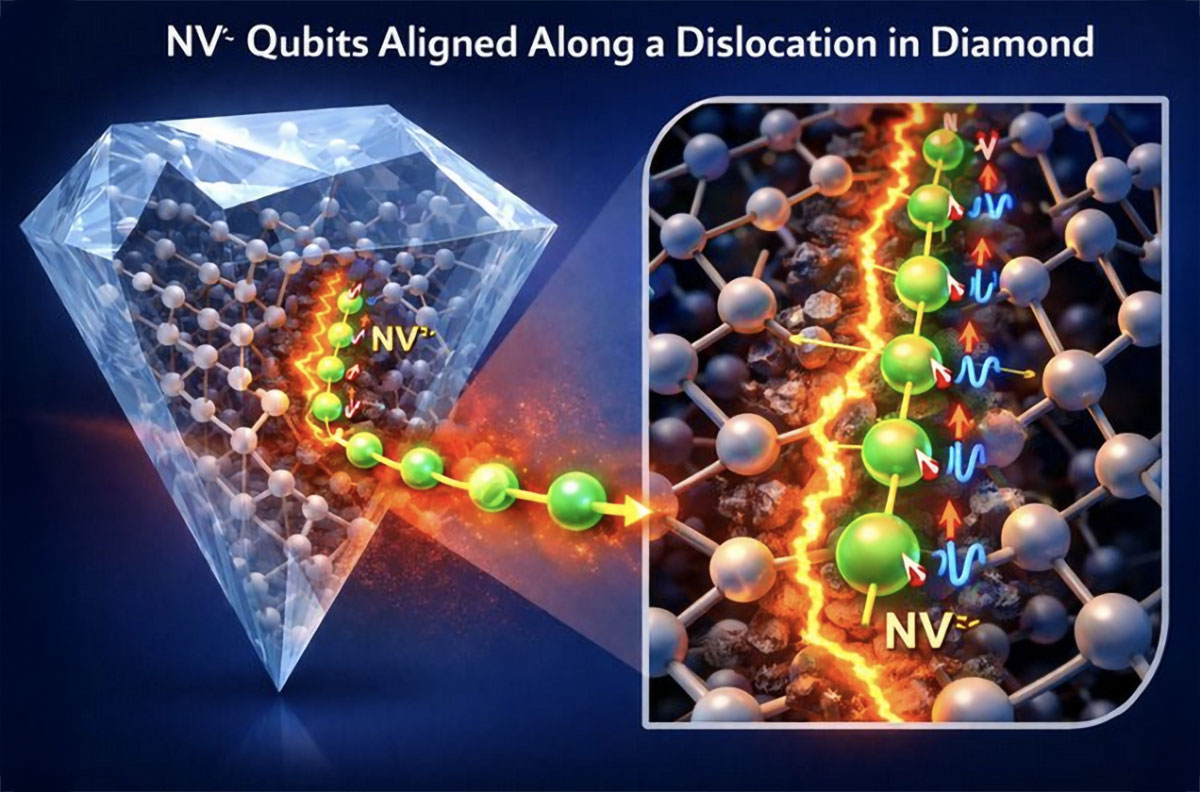
A new study suggests that crystal defects in diamond may hold the key to scalable quantum interconnects.
Connecting large numbers of quantum bits (qubits) into a working technology remains one of the biggest obstacles facing quantum computing. Qubits are extraordinarily sensitive, and even small disturbances can disrupt the quantum states that give these systems their power.
New theoretical research published in npj Computational Materials points to an unexpected solution: using defects inside crystals not as problems to eliminate, but as structural features that could help organize and link qubits at scale.
In the study, researchers show that crystal dislocations, which are extended line defects that run through a material, can act as natural gathering points for qubits. Rather than degrading quantum performance, these defects may provide a stable framework for building quantum connections.
The work suggests that dislocations could function as the backbone of future quantum devices, guiding qubits into orderly arrangements while preserving their fragile behavior.
The research team, led by Prof. Maryam Ghazisaeidi at The Ohio State University and Prof. Giulia Galli at the University of Chicago Pritzker School of Molecular Engineering (UChicago PME) and Chemistry Department, focused on nitrogen-vacancy (NV) centers in diamond.
These atomic-scale defects are among the most promising solid-state qubit platforms because they can be controlled and read out using light. Using detailed first-principles simulations, the researchers found that NV centers are naturally drawn toward dislocations in the crystal lattice. Once near these line defects, the qubits can maintain their quantum properties and, in some configurations, perform even better than they do in an otherwise perfect diamond.
“Because dislocations form quasi-one-dimensional (1D) structures extending through a crystal, they provide a natural scaffold for arranging qubits into ordered arrays,” said co-first author Cunzhi Zhang, a UChicago PME staff scientist in the Galli Group.
A Collaborative, Computation-Driven Effort
Supported by funding from the Air Force, the project combined expertise from UChicago and Ohio State across materials science, mechanical engineering, quantum information science, and high-performance computing.
The computational work relied on GPU-accelerated, massively parallel simulation tools developed through the Midwest Integrated Center for Computational Materials (MICCoM). MICCoM is a Department of Energy-funded computational materials science center based at Argonne National Laboratory and directed by Galli, and its software capabilities made it possible to model the complex behavior of quantum defects associated with dislocations in unprecedented detail.
“These unprecedented large-scale first-principles calculations made it possible to accurately model the complex quantum properties of defects at 1D dislocation cores,” said co-first author Victor Yu, staff scientist at Argonne National Laboratory and a MICCoM principal investigator.
The study revealed that many NV centers near dislocation cores remain stable in the desired charge and spin state and preserve a viable optical cycle, enabling optical initialization and readout of their spin states.
“Importantly, we predicted that specific NV configurations near dislocations exhibit significantly enhanced quantum coherence times compared to NV centers in pristine diamond,” Ghazisaeidi said.
This improvement arises from symmetry breaking near the dislocation, which creates specific states, called “clock transitions,” that protect the qubit from environmental magnetic noise.
Guiding Experiments and Future Devices
Beyond establishing stability and coherence, the work provided detailed predictions of optical and magnetic resonance signatures that can guide experimental identification of useful NV–dislocation configurations.
“While not all defect arrangements are suitable for quantum operations, the results show that a substantial fraction meet the requirements for qubit functionality,” said co-author Yu Jin, who was a graduate student at UChicago at the time of the research and now is a postdoctoral research fellow at the Flatiron Institute in New York.
Altogether, the findings of the study introduce a new paradigm for quantum device design: using dislocations not as defects to eliminate, but as quantum highways that can host and facilitate chains of interacting qubits. The approach opens a path toward scalable quantum interconnects in diamond and potentially other materials, offering a promising strategy for future solid-state quantum technologies.
Reference: “Towards dislocation-driven quantum interconnects” by Cunzhi Zhang, Victor Wen-zhe Yu, Yu Jin, Jonah Nagura, Sevim Polat Genlik, Maryam Ghazisaeidi and Giulia Galli, 9 January 2026, npj Computational Materials.
DOI: 10.1038/s41524-025-01945-3
Funding: This work was supported by the AFOSR Grant No. FA9550-23-1-0330.
Never miss a breakthrough: Join the SciTechDaily newsletter.
Follow us on Google and Google News.
2 Comments
A new study suggests that crystal defects in diamond may hold the key to scalable quantum interconnects.
VERY GOOD.
Please ask researchers to think deeply:
What exactly do you mean by scalable quantum interconnects?
Based on Topological Vortex Theory (TVT), quantum mechanics is not a theory about “particles” or “waves,” but the necessary mathematical expression of the spin dynamics of spacetime’s microscopic topological structure. The entire mathematical structure of quantum mechanics—including complex Hilbert space, non-commutative operators, unitary evolution, and even the measurement postulate—originates from the geometric constraints and topological invariants of a dynamic vortex network.
——Excerpted from https://zhuanlan.zhihu.com/p/1999506461873690092.
The value of scientific theory lies in revealing truth rather than maintaining dogma. In today’s physics, some so-called peer-reviewed publications — including the Proceedings of the National Academy of Sciences, Physical Review Letters, Science, Nature, and others—stubbornly insist on and promote the following:
1. Even though θ and τ particles exhibit differences in experiments, physics can claim they are the same particle. This is science.
2. Even though topological vortices and antivortices have identical structures and opposite rotational directions, physics can define their structures and directions as entirely different. This is science.
3. Even though two sets of cobalt-60 rotate in opposite directions and experiments reveal asymmetry, physics can still define them as mirror images of each other. This is science.
4. Even though vortex structures are ubiquitous—from cosmic accretion disks to particle spins—physics must insist that vortex structures do not exist and require verification. Only the particles that like God, Demonic, or Angelic are the most fundamental structures of the universe. This is science.
5. Even though everything occupies space and maintains its existence in time, physics must still debate and insist on whether space exists and whether time is a figment of the human mind. This is science.
6. Even though space, with its non-stick, incompressible, and isotropic characteristics, provides a solid foundation for the development of physics, physics must still insist that the ideal fluid properties of space do not exist. This is science.
and so on.
Contemporary physics and so-called peer-reviewed publications (including the Proceedings of the National Academy of Sciences, Physical Review Letters, Science, Nature, Science Bulletin, etc.) stubbornly believe that two sets of counter rotating cobalt-60 are two mirror images of each other, constructing a more shocking pseudoscientific theoretical framework in the history of science than the “geocentric model”. This pseudo scientific framework and system have seriously hindered scientific progress and social development.
These guys and the so-called peer-reviewed publications they manipulate no longer know what shame is:
Example 1
Two sets of cobalt-60 are manually rotated in opposite directions, and even without detection, people around the world know that they will not be symmetrical because these two objects are not mirror images of each other at all. However, a group of so-called physicists and so-called academic publications do not believe it. They conducted experiments and the results were indeed asymmetric, but they still firmly believed that these two objects were mirror images of each other, and the asymmetry was due to a violation of the previous natural laws (CP violation). In the history of science, there can never be a dirtier and uglier operation and explanation than this.
—— Excerpted from https://scitechdaily.com/what-happens-when-light-gains-extra-dimensions/#comment-947619.
Example 2
Please see how the so-called “mystery of θ – τ” is explained: θ and τ are completely identical in all measurable physical properties such as mass, lifetime, charge, spin, etc. However, experimental observations have shown that the θ meson decays into two π mesons, while the τ meson decays into three π mesons, making it difficult for physicists to explain why they are so similar. Physicist Martin Block proposed a highly challenging idea: θ and τ are the same particle, but in weak interactions, parity is not conserved. An easy to understand explanation is the following analogy:: There are two boxes of apples with identical weight, color, and taste. However, when one box is opened, there are two apples, while when the other box is opened, there are three apples. This confuses the old farmer who buys apples. He circled around the orchard and came up with a highly challenging idea: these two boxes of apples are not from the same tree, so they are the same.
—— Excerpted from https://scitechdaily.com/what-happens-when-light-gains-extra-dimensions/#comment-947686.
Any so-called evidence tainted by human intervention risks distorting our understanding and cognition of the intrinsic dynamics of natural laws.
—— Excerpted from https://zhuanlan.zhihu.com/p/1996561896279667777.