
Close Menu
    Facebook X (Twitter) Instagram
    SciTechDaily
    • Biology
    • Chemistry
    • Earth
    • Health
    • Physics
    • Science
    • Space
    • Technology
    Facebook X (Twitter) Pinterest YouTube RSS
    SciTechDaily
    Home»Space»Astronomers Discover the Sun Contains 55% More Silver Than Previously Thought
    Space

    Astronomers Discover the Sun Contains 55% More Silver Than Previously Thought

    By Uppsala UniversityNovember 27, 2026No Comments3 Mins Read
    Facebook Twitter Pinterest Telegram LinkedIn WhatsApp Email Reddit
    Share
    Facebook Twitter LinkedIn Pinterest Telegram Email Reddit
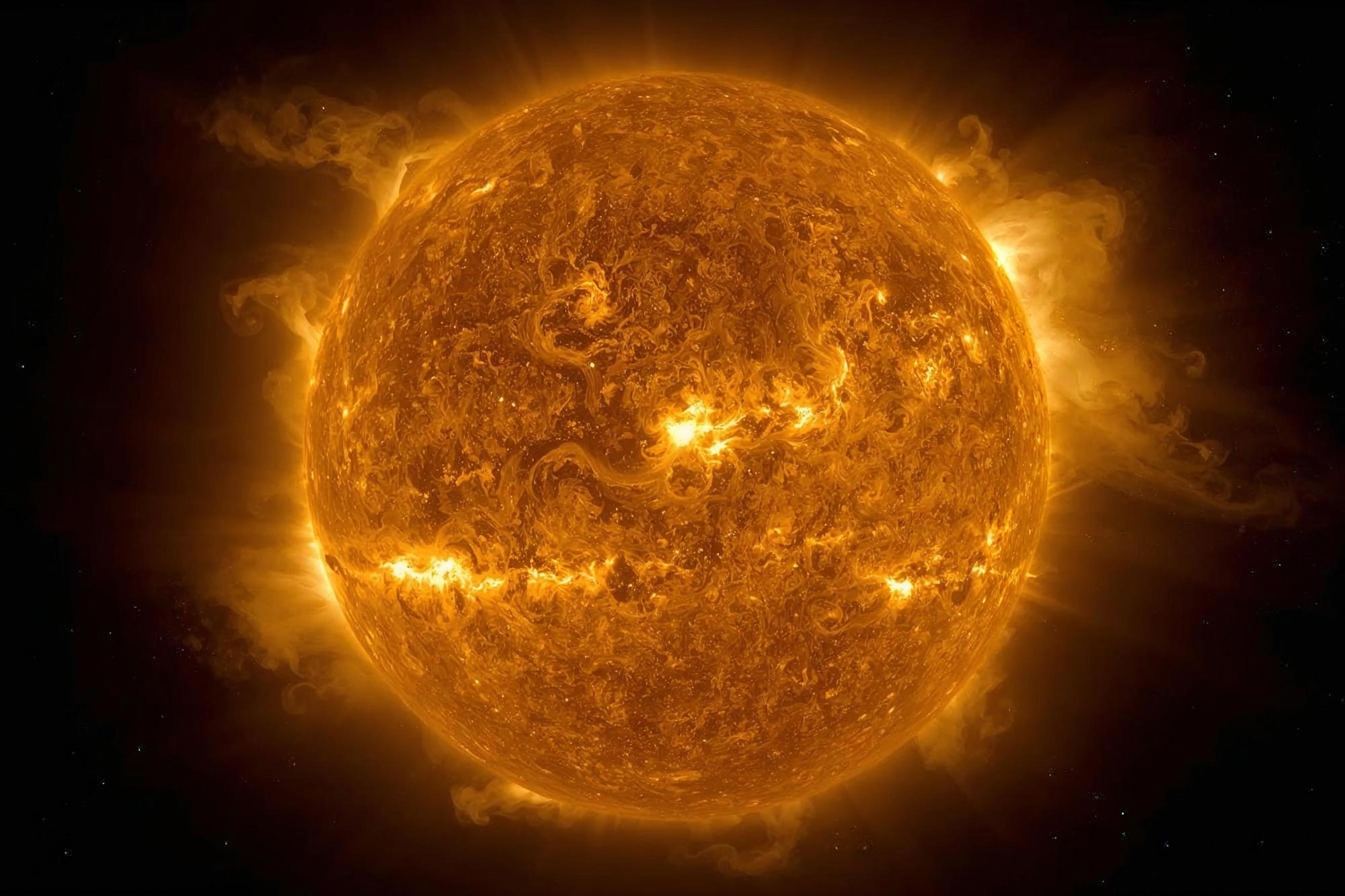
    Sun Surface Close Up Solar Flares
    The Sun’s chemical composition serves as a fundamental benchmark for understanding the formation and evolution of stars and planets. New research suggests that some of these measurements may need revising, with important implications for understanding how heavy elements spread throughout the galaxy. Credit: Shutterstock

    Some of the oldest rocks in the solar system hinted that astronomers were undercounting the Sun’s silver. A fresh look at sunlight suggests they were right.

    Researchers at Uppsala University estimate that silver is 55 percent more abundant in the Sun than previous calculations indicated.

    The revised estimate brings the Sun much closer to the silver abundance found in primitive meteorites. Both preserve material from the same cloud of gas and dust that gave rise to the solar system 4.6 billion years ago.

    How Sunlight Reveals Silver

    Silver atoms in the Sun’s atmosphere absorb light at specific wavelengths, leaving dark lines in the spectrum. The pattern identifies silver, but estimating how much is there requires a model that predicts how strongly those atoms absorb light.

    The team modeled the motion of the Sun’s outer layers and used more detailed calculations of how silver atoms interact with light and other particles. The model accounts for how radiation changes the energy states of silver atoms, which affects the strength of the lines astronomers use to measure the element’s abundance.
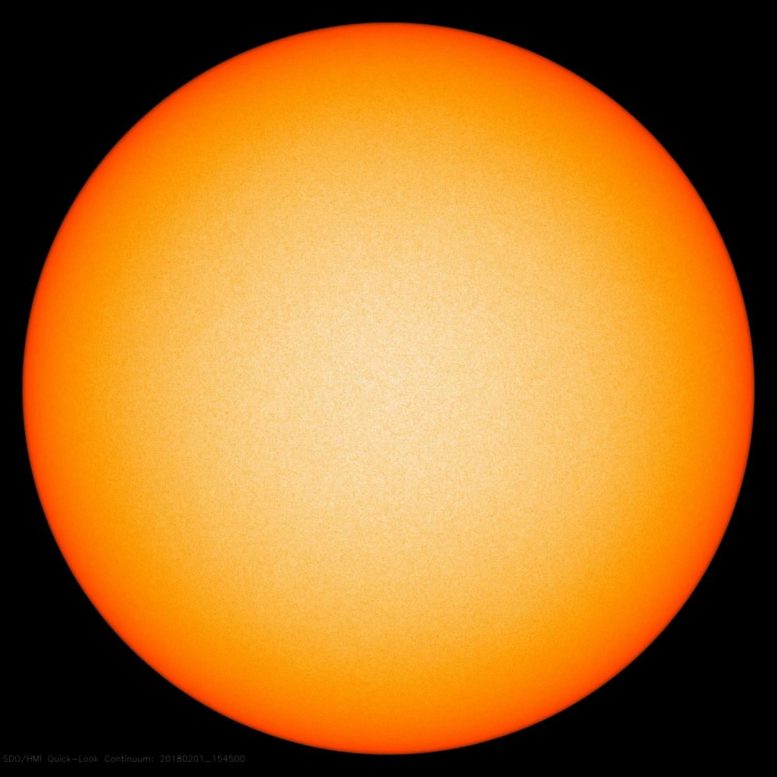
    Spotless Sun
    The optical wavelengths (what our eyes see) probe deeper layers of the Sun’s atmosphere, and our analysis is based on these layers. Credit: NASA/GSFC/Solar Dynamics Observatory

    “With our new model, we were able to interpret the spectral lines used to determine the solar silver abundance more accurately,” says Sema Caliskan, who conducted the research during her PhD studies at Uppsala University.

    Tracing Silver Across the Milky Way

    Hydrogen and helium make up nearly all of the Sun. Heavier elements such as carbon, iron, and silver account for just 1.5 percent of its mass. Many of these elements form inside stars or during stellar explosions, then become part of later generations of stars and planets. Measuring their abundance helps astronomers reconstruct how the Milky Way’s chemistry changed over time.
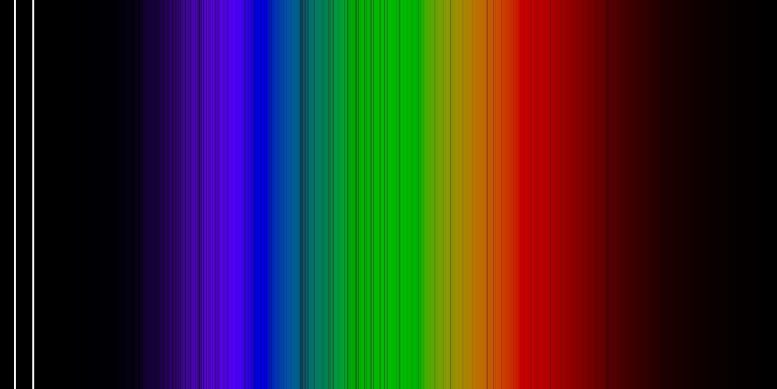
    The Solar Spectrum
    The solar spectrum. The two strongest silver lines, highlighted in white, lie in the ultraviolet region that is invisible to the human eye. Credit: Anish Amarsi

    “The new knowledge about the Sun’s composition is important for the understanding of other stars, planets, and cosmic material, because the Sun is one of astronomy’s key reference points,” says Caliskan.

    The team plans to apply the same method to other stars. “By studying the light of stars of different types and ages, we hope to understand where silver is formed in the universe, and how it has been distributed throughout the Milky Way over time,” says Caliskan.

    Reference: “Ag I model atom and the 3D non-LTE solar silver abundance” by S. Caliskan, A. M. Amarsi, P. Jönsson, N. Grevesse and B. K. Sahoo, 17 July 2026, Astronomy & Astrophysics.
    DOI: 10.1051/0004-6361/202659578

    This study was funded by the Swedish Research Counsil, KVA Kungliga vetenskapsakademien, and ANRF India.

    Never miss a breakthrough: Join the SciTechDaily newsletter.
    Follow us on Google and Google News.

    Astrophysics Planetary Science Star Sun Uppsala University
    Share. Facebook Twitter Pinterest LinkedIn Email Reddit

    Related Articles

    Cosmic Mystery Solved? New Evidence Shows Planets Influence Sun’s Magnetic Cycles

    Ancient Blue Crystals Reveal What the Early Sun Was Like

    Astronomers Discover a Giant Exoplanet and Four New Companion Stars

    Astronomers Discover a Probable Free-Floating Planet, CFBDSIR2149

    Giant Gap PDS 70’s Protoplanetary Disk May Indicate Multiple Planets

    New Study Revives Doubted Exoplanet Fomalhaut b

    NASA’s Kepler Mission Discovers Multiple Transiting Planets Orbiting Two Suns

    Vaporization Simulation of Earth Helps Explain the Atmospheres of Super-Earths

    New Light Shed on the Origins of Extreme Space Storms

    Leave A Reply Cancel Reply

    • Facebook
    • Twitter
    • Pinterest
    • YouTube

    Don't Miss a Discovery

    Subscribe for the Latest in Science & Tech!

    Trending News

    America’s Data Centers Have a Hidden Death Toll, MIT Researchers Warn

    Scientists Discover a Potential New Way To Treat Diabetes – No Insulin Required

    “This Star System Should Not Exist”: Astronomers Discover a Cosmic Mystery Just 28 Light-Years Away

    Scientists Discover the Human Ear May Work Very Differently Than We Thought

    A Metal Foam Designed for Armor Could Make Cars Dramatically Safer

    This Common Vitamin Deficiency Could Be Quietly Disrupting Your Sleep

    A 360-Year-Old Manuscript Reveals Galileo May Have Built a Telescope Far Ahead of Its Time

    Your Personality May Be Partly Written in Your DNA, Massive Study of 1 Million People Reveals

    Follow SciTechDaily
    • Facebook
    • Twitter
    • YouTube
    • Pinterest
    • Newsletter
    • RSS
    SciTech News
    • Biology News
    • Chemistry News
    • Earth News
    • Health News
    • Physics News
    • Science News
    • Space News
    • Technology News
    Recent Posts
    • Astronomers Discover the Sun Contains 55% More Silver Than Previously Thought
    • A Black Hole Smaller Than an Atom Could Trigger One of the Universe’s Most Violent Explosions
    • Scientists Develop a Powerful Two-in-One Treatment for Gum Disease
    • Scientists Discover a Unique Gut Microbe Signature in People Who Live to 100
    • Alzheimer’s Breakthrough? Experimental Nose Drops Restore Youthful Memory in Mice
    Copyright © 1998 - 2026 SciTechDaily. All Rights Reserved.
    • Science News
    • About
    • Contact
    • Editorial Board
    • Privacy Policy
    • Terms of Use

    Type above and press Enter to search. Press Esc to cancel.