
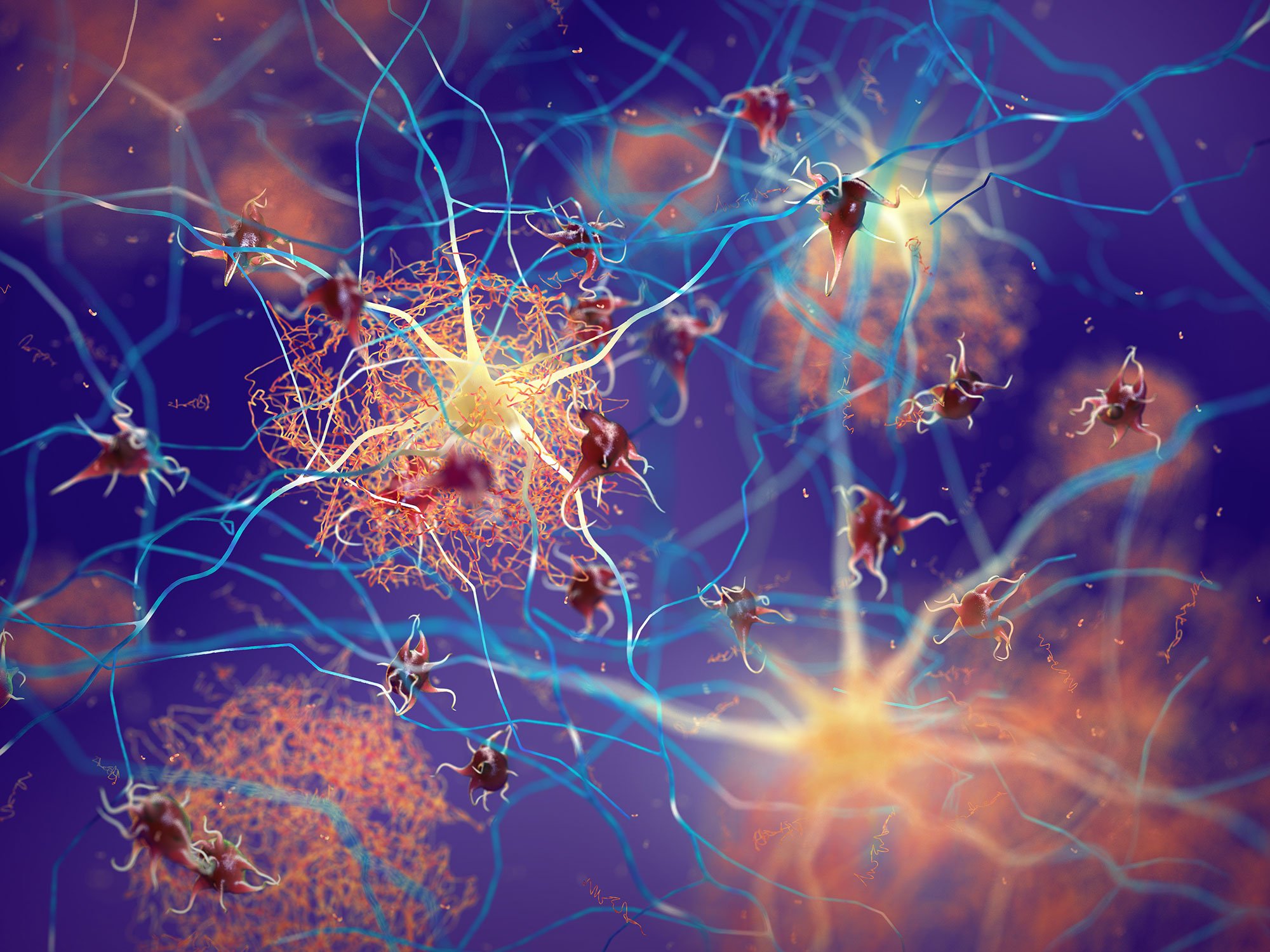
Removing a single protein reduced nerve damage in mice with an Alzheimer’s-like disease, offering a potential new direction for treating a disease that remains difficult to manage.
In the brains of people with Alzheimer’s disease, a protein called beta-amyloid accumulates in clumps known as plaques. The brain’s resident immune cells, called microglia, gather around these deposits and help break down the material. However, their response can also contribute to inflammation, and nerve endings surrounding the plaques can become damaged. Understanding how these processes interact could help scientists develop treatments that address more than the buildup of amyloid.
Researchers at Lund University in Sweden have identified a protein called galectin-3 that appears to connect these processes. The protein influences how microglia respond to amyloid plaques and directly alters the structure of the plaques themselves, potentially contributing to the damage they cause.
“This discovery provides new insights into the mechanisms of the disease and identifies galectin-3 as a potential future therapeutic target,” says Lluís Camprubí-Ferrer, one of the study’s lead authors and a postdoctoral researcher at Lund University.
Removing galectin-3 reduces nerve damage
The study was conducted using mice and human brain tissue in collaboration with the University of Seville and the Instituto de Biomedicina de Sevilla (IBiS) in Spain. When researchers removed galectin-3 from mice with an Alzheimer’s-like disease, the plaques became smaller and more tightly packed, and damage to surrounding nerve endings decreased significantly. The microglia also became less inflammatory and took on a more protective role.
“When we inactivated galectin-3, microglia transitioned from their harmful state to a state rich in the protective receptor TREM2, a protein that we know plays an important role in the brain’s immune defense and in the risk of Alzheimer’s disease,” says Lluís Camprubí-Ferrer.
A protein that reshapes amyloid plaques
The Lund researchers had previously been the first to demonstrate that galectin-3 levels increase in the brains of people with Alzheimer’s disease. Their earlier work also showed that removing the protein reduced brain inflammation. The new study helps explain how galectin-3 contributes to the disease by examining its direct interactions with beta-amyloid.
The researchers found that galectin-3 binds “with remarkable strength” to beta-amyloid and operates both inside and outside microglia. Within these immune cells, the protein is found in structures called lysosomes, which function as cellular recycling compartments, where it influences how amyloid is broken down and processed. Outside the cells, galectin-3 interferes with the growth of the protein fibers that make up plaques.
“No one has previously shown what galectin-3 does to the plaque itself. We have observed that the protein binds to long protein strands known as amyloid fibrils, blocking one of the steps by which they multiply and altering their shape. In cell experiments, the fibrils reshaped by galectin-3 went on to damage nerve cells,” explains Lluís Camprubí-Ferrer.
Targeting inflammation in Alzheimer’s treatment
While the mouse experiments established a cause-and-effect relationship, examinations of human brain tissue from nine individuals revealed a strong correlation. Clinical trials will be needed to determine whether blocking galectin-3 can benefit people with Alzheimer’s disease.

“This is important because current Alzheimer’s drugs target amyloid without helping to reduce inflammation in the brain. And galectin-3 is a protein that drugs can actually bind to,” says Lluís Camprubí-Ferrer.
“And the timing is right. Drugs containing antibodies that break down amyloid have reached patients, but their modest effect has drawn attention to the brain’s immune response. That is where we can now fill in the gaps,” says Tomas Deierborg, professor and leader of the Experimental Neuroinflammation research group at Lund University.
Deierborg finds it particularly encouraging that the team’s earlier discoveries have progressed toward clinical testing. Just weeks before the new research was reported, U.S. regulators gave the go-ahead for a Phase 2 clinical trial of an antibody that blocks galectin-3.
“This demonstrates the clinical potential of our research findings,” says Tomas Deierborg.
Reference: “Galectin-3 links microglial neuroinflammation to Aβ aggregation and lysosomal processing” by Lluís Camprubí-Ferrer, Jesús Soldán-Hidalgo, Emil Axell, Marzia Dell’Eva, Marta García-Cruzado, Juan García-Revilla, Yiyi Yang, Rosalía Fernández-Calle, Logan Larlham, Bhanu Chouhan, Rocío Talaverón, Agnes Paulus, Lukas Danielson, Angela Gomez-Arboledas, Oxana Klementieva, Antonia Gutierrez, Javier Vitorica, Malin Wennström, Gunnar K. Gouras, Javier Frontiñán-Rubio, Antonio Boza-Serrano, Gabriel A. Rabinovich, José Luis Venero and Tomas Deierborg, 18 November 2026, Proceedings of the National Academy of Sciences.
DOI: 10.1073/pnas.2625362123
Never miss a breakthrough: Join the SciTechDaily newsletter.
Follow us on Google and Google News.