
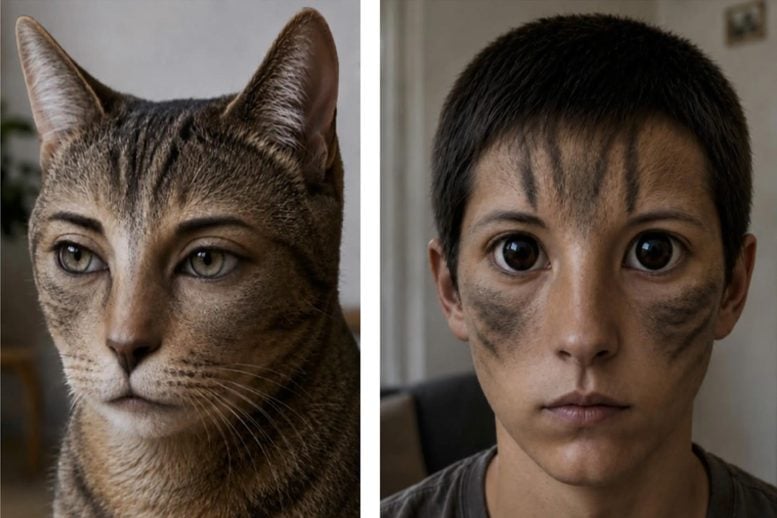
Since brain surgery, Karl sometimes looks at his cat and sees a person’s eyes looking back.
Karl, a 28-year-old man in the northeastern United States, often starts his day by looking at his gray tabby, “Luna.” On some days, Luna’s stripes, enlarged pupils, and almond-shaped eye sockets later appear on the human faces he sees in person or online.
If Karl sees a person first, the effect can go the other way. That person’s eye shape and pupils may show up on other faces throughout the day, including Luna’s.
When Earlier Images Distort Faces
The case, described in Cortex, involves two visual conditions. In palinopsia, part or all of an earlier image lingers or reappears. For Karl, those lingering features distort the faces he sees next, a form of prosopometamorphopsia, or PMO.
The episodes began two years ago after surgeons removed part of Karl’s right temporal lobe, a brain region involved in processing faces. The surgery addressed an arteriovenous malformation, a tangle of blood vessels connecting arteries and veins that can bleed into the brain.
“This case of Karl seeing his cat’s features in human faces and vice versa demonstrates that individual features can be pulled from memory and influence our ongoing perception,” says lead author Brad Duchaine, a professor and chair of psychological and brain sciences who leads Dartmouth’s Social Perception Lab.
Karl’s experience reminded Duchaine of a 1986 report in Cortex. A woman riding a bus saw a poodle on a passenger’s lap, then saw the dog’s entire face on every passenger. She had had a stroke nine months earlier. In Karl’s case, individual features carry over while the rest of each face stays recognizable.
How AI Helps Patients Show What They See
To show what Karl sees, Duchaine drew a sketch and used generative AI to turn it into a more realistic image. Karl gave feedback, and the two refined a series of images that appear in the report.
“AI provides researchers like us with the ability to generate more accurate visualizations of what people are experiencing when they’re having distorted visual perceptions,” says Duchaine. “If you know what the person is experiencing, you can much better research what they’re dealing with and try to figure out ways to control it. And now the patient can also take part in that process of creating those visualizations.”
“The use of AI is also helpful for patients who want to convey not just to their healthcare professionals, but to their friends and family, what faces look like to them,” Duchaine says.
Duchaine’s team plans to continue working with Karl. The lab has heard from more than 250 people who experience face distortions. Duchaine says some were told their symptoms were psychiatric, and some were prescribed antipsychotics. The lab describes how these visual distortions can appear on its PMO website.
Reference: “Forty years after poodle-face palinopsia: Human-to-cat and cat-to-human facial feature transfer” by Brad Duchaine, Antônio Mello and Jennifer L. Nosker, 16 October 2026, Cortex.
DOI: 10.1016/j.cortex.2026.10.003
Never miss a breakthrough: Join the SciTechDaily newsletter.
Follow us on Google and Google News.