

Specialized Brain Imaging Can Reveal New Details About Alzheimer’s Disease and Other Disorders
Alzheimer’s disease is a degenerative neurologic disease that causes brain cells to die and the brain to shrink. Alzheimer’s disease is the most prevalent form of dementia, which is defined as a progressive deterioration in cognitive, behavioral, and social abilities that limits a person’s ability to function independently.
Alzheimer’s disease affects around 5.8 million individuals in the United States aged 65 and above. Eighty percent of them are 75 or older. Alzheimer’s disease is believed to affect 60-70 percent of the roughly 50 million individuals globally who have dementia.
This has led Alzheimer’s disease to be one of the leading causes of dependency and disability among the elderly. Despite progress in comprehending the horrific brain disease, diagnostic testing is limited and there are currently no cures.
Revolutionary Neuroimaging Technique Shows Promise
Now, a new study by an assistant professor at the University of Ottawa Faculty of Medicine and a group of colleagues suggests that a revolutionary neuroimaging technique could be used in large-scale Alzheimer’s disease screenings. It may also provide insights into the disease’s early stages before symptoms appear.
The findings may help guide targeted drug development in the future, as well as pave the way for a practical, less-invasive way to screen for Alzheimer’s disease, which can cause such severe cognitive decline that sufferers lose their ability to recognize loved ones or even converse on a basic level.
Published recently in the peer-reviewed journal Neuropsychopharmacology in February, the scientists’ study suggests that the use of a high-resolution imaging method called “neuromelanin-sensitive MRI” could have promise for predicting the risk of symptoms or guiding future treatment.
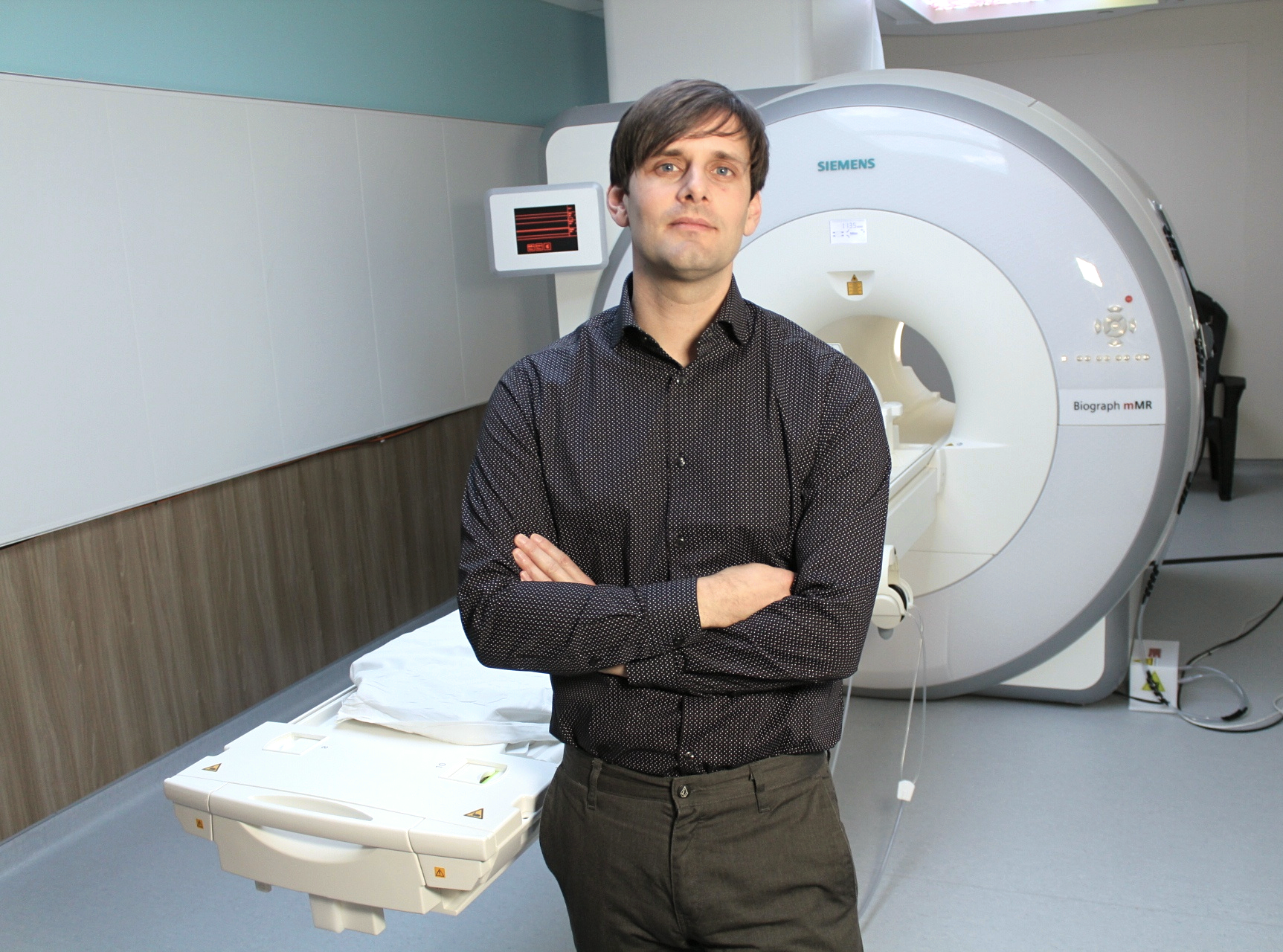
Dr. Clifford Cassidy, an assistant professor in the Faculty’s Department of Cellular & Molecular Medicine (CMM) and a scientist at The Royal’s Institute of Mental Health Research (IMHR), is the paper’s first author. The research was conducted in collaboration with the McGill Centre for Studies in Aging as part of a large study including healthy older adults, those at risk, and those with dementia.
Degeneration of the Noradrenergic System
Their findings confirm previous data that the brain’s noradrenergic system is progressively degenerating with Alzheimer’s disease. This brain system is vitally important because it may be the first area affected by Alzheimer’s and its pathology is related to the disorder’s symptoms.
For instance, the researchers found strong evidence that the integrity of the noradrenergic system is related to behavioral symptoms of one of Alzheimer’s most burdensome aspects: aggressive and impulsive behavior.
“These behaviors are often what lead people to go into homes and not be able to live independently anymore,” Dr. Cassidy says.
He says the study demonstrates a practical method to track pathophysiology in people with Alzheimer’s or those at risk. Previously, this was only possible using methods that could only be used on a small scale or in post-mortem studies.
“We still don’t understand why some people get Alzheimer’s and some don’t. We don’t know why some people are protected and some are vulnerable. So the question is: What makes you vulnerable?” he says.
Tens of millions of people across the globe are estimated to have Alzheimer’s and the prevalence of the brain disorder is only accelerating with the aging of the global population. The disease’s key marker is a protein called “tau,” which forms tangles in Alzheimer’s patient’s neurons.
Visualizing the Onset of Alzheimer’s
The specialized MRI technique visualizes neuromelanin, a dark pigment related to the melanin that colors the skin, in the control center of noradrenaline neurons. This is important because “there’s evidence that the noradrenergic area of the brain is the part that actually starts accumulating tau first, years prior to the emergence of any symptoms” Dr. Cassidy says.
Alzheimer’s was examined in this study, but Dr. Cassidy is pioneering the use of this imaging method in different contexts, exploring how it might answer different questions for a wide range of psychiatric conditions. There’s a wealth of possibilities, Dr. Cassidy says.
The neuromelanin-sensitive MRI has been used to visualize the degeneration of neurons in Parkinson’s disease and healthy aging. Schizophrenia and addiction have been examined. Cassidy and colleagues are next exploring its relevance for attention deficit hyperactivity disorder (ADHD).
“It really opens the door to examining these brain systems in humans, in vivo, in pretty much any disorder where it can be relevant. After all, if it is telling you something about the dopamine system or the noradrenaline system, those are two brain systems that are relevant for almost any condition in neurology or psychiatry,” he says.
Dr. Cassidy began collaborating with these McGill colleagues starting in 2018 and convinced them to add the neuroimaging technique to complement the many other measures available. This is the first publication from this collaboration, but their work is ongoing. Future papers will look at the data in different ways and better incorporate longitudinal datasets to observe changes over time.
Future of Neuromelanin-Sensitive MRI and Commercialization
Dr. Cassidy has developed a fully automated method of how to look at the “neuromelanin-sensitive MRI” images. Previously, this work required manual tracing, making it very labor-intensive and subjective. Now, a computer system handles the raw images.
There are hopes for commercialization. Dr. Cassidy and colleagues have partnered with a biotech company and a software company to develop their tools into a software package. It is awaiting approval from the FDA.
“This will ensure our tool could have the potential for clinical use by being fully automated and reliably providing neuroimaging measures without any manual step required or expert intervention. This is an advantage over many tools used in neuroimaging research that require much time and effort by experts in order to yield useable metrics from the raw images collected off the scanner,” he says.
Reference: “Association of locus coeruleus integrity with Braak stage and neuropsychiatric symptom severity in Alzheimer’s disease” by Clifford M. Cassidy, Joseph Therriault, Tharick A. Pascoal, Victoria Cheung, Melissa Savard, Lauri Tuominen, Mira Chamoun, Adelina McCall, Seyda Celebi, Firoza Lussier, Gassan Massarweh, Jean-Paul Soucy, David Weinshenker, Christine Tardif, Zahinoor Ismail, Serge Gauthier, and Pedro Rosa-Neto, 17 February 2022, Neuropsychopharmacology.
DOI: 10.1038/s41386-022-01293-6
Never miss a breakthrough: Join the SciTechDaily newsletter.
Follow us on Google and Google News.