
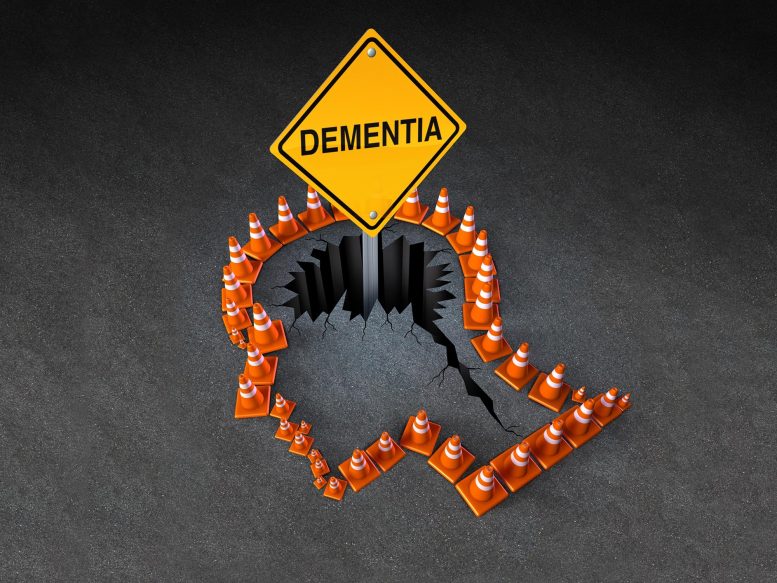
Middle-aged adults and seniors who participate in adult education reduce their risk of developing dementia conditions such as Alzheimer’s by 19% within five years.
How can we maintain cognitive sharpness as we age? It’s widely recognized that consistent mental exercises, such as brainteasers, sudokus, or specific video games, can help shield against cognitive deterioration and conditions like Alzheimer’s in our later years. But many of us regularly engage in adult education classes, for example learning a language or a new skill. Is such adult education likewise associated with a lower risk of cognitive decline and dementia?
Yes, according to researchers from the Institute of Development, Aging and Cancer of Tohoku University in Sendai, Japan who have shown for the first time, in a new study in Frontiers in Aging Neuroscience.
“Here we show that people who take adult education classes have a lower risk of developing dementia five years later,” said Dr Hikaru Takeuchi, the study’s first author. “Adult education is likewise associated with better preservation of nonverbal reasoning with increasing age.”
UK Biobank
Takeuchi and his co-author, Dr Ryuta Kawashima, a professor at the same institute, analyzed data from the UK Biobank, which holds genetic, health, and medical information from approximately half a million British volunteers, of which 282,421 participants were analyzed for this study. These had been enrolled between 2006 and 2010, when between 40 and 69 years old. On average, they had been followed for seven years by the time of the present study.
Based on their genotype at 133 relevant single-locus polymorphisms (SNPs) in their DNA, participants were given an individual predictive ‘polygenic risk score’ for dementia. Participants self-reported if they took any adult education classes, without specifying the frequency, subject, or academic level.
The authors focused on data from the enrollment visit and third assessment visit, between 2014 and 2018. At those visits, participants were given a battery of psychological and cognitive tests, for example for fluid intelligence, visuospatial memory, and reaction time.
1.1% of participants in the sample developed dementia over the study’s time window.
Reduced Risk of Developing Dementia
Takeuchi and Kawashima showed that participants who were taking part in adult education at enrollment had a 19% lower risk of developing dementia than participants who did not. This held true for both Caucasian people and those of other ethnicities.
Importantly, results were similar when participants with a history of diabetes, hyperlipidemia, cardiovascular diseases, cancer, or mental illness were excluded. This means that the observed lower risk wasn’t exclusively due to participants with incipient dementia being prevented from following adult education by symptoms of these known co-morbidities.
The results also showed that participants who took part in adult education classes kept up their fluid intelligence and nonverbal reasoning performance better than peers who did not. However, adult education didn’t affect the preservation of visuospatial memory or reaction time.
Randomized Clinical Trials Are Necessary
“One possibility is that engaging in intellectual activities has positive results on the nervous system, which in turn may prevent dementia. But ours is an observational longitudinal study, so if a direct causal relationship exists between adult education and a lower risk of dementia, it could be in either direction,” said Kawashima.
Takeuchi proposed that a randomized clinical trial be done to prove any protective effect of adult education.
“This could take the form of a controlled trial where one group of participants is encouraged to participate in an adult education class, while the other is encouraged to participate in a control intervention with equivalent social interaction, but without education,“ said Takeuchi.
Reference: “Effects of adult education on cognitive function and risk of dementia in older adults: a longitudinal analysis” by Hikaru Takeuchi and Ryuta Kawashima, 23 August 2023, Frontiers in Neuroscience.
DOI: 10.3389/fnagi.2023.1212623
The study was funded by the Wellcome Trust, the Medical Research Council, the Department of Health, the Scottish government, the Northwest Regional Development Agency, the Takeda Science Foundation, JST/RISTEX, and JST/CREST.
Never miss a breakthrough: Join the SciTechDaily newsletter.
Follow us on Google and Google News.