

An experimental drug combined with chemotherapy produced substantial tumor shrinkage in an early clinical trial, offering renewed hope for treating advanced pancreatic cancer.
For people whose pancreatic cancer has spread to other organs, the chances of long-term survival remain slim. Most patients treated with standard chemotherapy survive between eight and 11 months, and only 3% are alive five years after diagnosis. Researchers are now testing whether an experimental drug that blocks the signals driving cancer growth can make chemotherapy more effective and keep the disease under control for longer.
Early results suggest the drug, called daraxonrasib, could offer a promising new treatment option. Dr. Wungki Park, a gastrointestinal medical oncologist at Memorial Sloan Kettering Cancer Center in New York City and principal investigator of the phase I/II RMC-GI-102 trial, presented the findings on November 19, 2026, at the 38th EORTC-NCI-AACR Symposium on Molecular Targets and Cancer Therapeutics in Barcelona, Spain.
“Pancreatic cancer remains one of the most challenging cancers to treat, particularly because more than half of patients present with disease that has already spread to other organs. We need effective treatments that can achieve deep responses and prolong disease control to curb this aggressively devastating disease. For most patients with previously untreated metastatic pancreatic cancer, chemotherapy remains the foundation of treatment. Although chemotherapy can shrink tumors by a modest amount and help some patients, the cancer frequently develops resistance and begins growing again.”
Targeting cancer’s growth switch
More than 90% of pancreatic cancers carry mutations in RAS, a gene that acts like a molecular switch controlling cell growth. These mutations effectively jam the switch in the “on” position, causing cells to divide uncontrollably. Although scientists have long recognized RAS as an important treatment target, successfully blocking its activity has only recently become possible.
Daraxonrasib is designed to inhibit the active form of the RAS protein, known as RAS (ON), disrupting the signals that cancer cells rely on for survival. Researchers tested the drug alongside two standard chemotherapy medications in patients who had not previously received treatment for metastatic pancreatic cancer.
Patients took 200 mg of daraxonrasib orally each day and received intravenous gemcitabine (1,000 mg/m² of body surface area) and nab-paclitaxel (125 mg/m²) on days 1 and 15 of each treatment cycle.
Tumors shrank in most patients
“By combining daraxonrasib with chemotherapy, we are seeing remarkably deep tumor responses in a substantial proportion of patients, together with durable disease control, with a median progression-free survival exceeding one year,” said Dr. Park.
As of September 28, 2026, 61 patients had received the combination, with a median follow-up of 18.3 months, ranging from 13.1 to 23.7 months. Tumors shrank or disappeared in 60.7% of patients, including 8.2% whose tumors were no longer detectable. Overall, the disease was controlled in 90.2% of patients.
For comparison, standard chemotherapy typically produces tumor shrinkage in 23% to 42% of patients, with most tumors beginning to grow again after five to six months. The experimental combination achieved a median progression-free survival of 12.8 months.
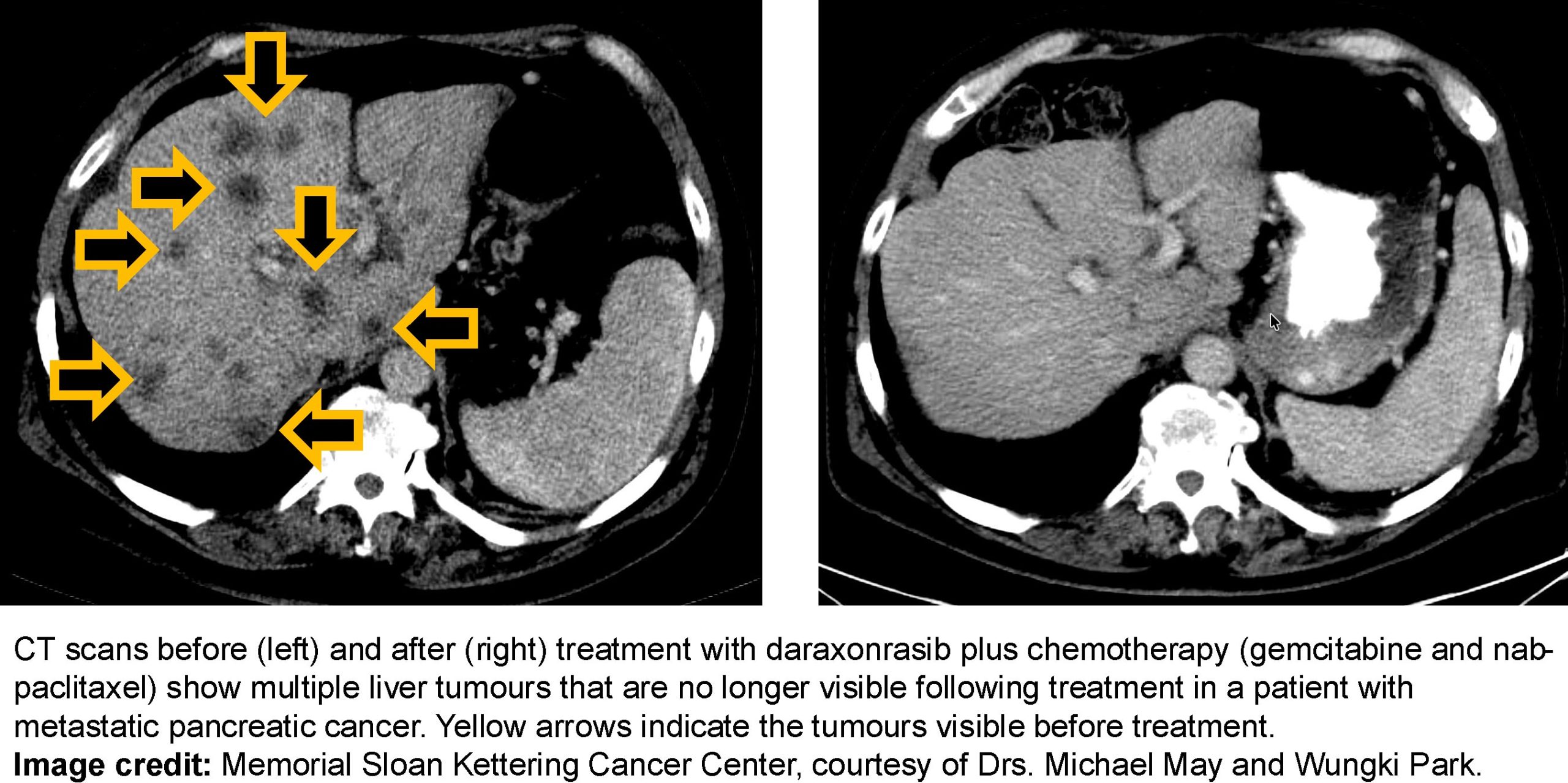
“What is particularly encouraging about these new and updated results I am presenting today is that we are beginning to see not only a higher percentage of tumor response rates, but also deeper responses and a near doubling in the duration of disease control, which may eventually translate into longer survival,” Park said.
“This represents a potentially transformative advance in first-line treatment for patients with metastatic pancreatic cancer, already outpacing the high end for the historical overall survival of 8.5-11.1 months with conventional chemotherapy.”
Progression-free survival and overall survival measure different outcomes, however, and the historical comparison does not establish that the combination helps patients live longer.
Common side effects included rash, diarrhea, fatigue, and chemotherapy-related complications such as reduced blood cell counts, known as cytopenia. These were adequately managed with standard medical interventions. Only 5% of patients discontinued treatment because of daraxonrasib-related side effects.
Longer survival remains unproven
Dr. Park said, “These more mature results are particularly exciting because we are now seeing not only substantial tumor shrinkages, including complete responses, but also durable disease control, with median progression-free survival exceeding one year, nearly doubling that reported historically with standard chemotherapy. Importantly, the 12-month overall survival rate of 76.6% provides further insight into the sustained clinical benefit. Together, these findings represent a potentially transformative advance in our pursuit of more effective first-line treatments for metastatic pancreatic cancer.
“However, this is an early-phase study, and the results must be interpreted carefully because patients were not compared with patients receiving chemotherapy alone. The next step is to determine whether these remarkable early findings translate into improved outcomes in a large randomized clinical trial. This is precisely the question being addressed by the global Phase III RASolute-303 trial, which is evaluating daraxonrasib both as a standalone treatment and in combination with gemcitabine and nab-paclitaxel, compared with chemotherapy alone.”
Park is also the principal investigator of RASolute-303.
“The results from RMC-GI-102 provide important clinical evidence supporting the treatment strategy now being evaluated in the RASolute-303 study,” he said.
Treatment potential beyond pancreatic cancer
Professor Elena Garralda, chair of the EORTC-NCI-AACR Symposium (ENA) and co-director of the Vall d’Hebron Institute of Oncology’s clinical research program, was not involved in the study. She commented, “Pancreatic cancer is one of the most difficult cancers to treat successfully, particularly if it has started to spread to other parts of the body. These results are exciting because they show the combined treatment could potentially significantly improve patients’ overall survival, as well as the time before tumors start to grow again.
“This study is one of several being presented at ENA today that demonstrate that it is now possible to target the RAS mutations driving cancer growth. Importantly, it shows that RAS-targeted therapies can be combined with existing treatments to achieve potentially more durable clinical benefits for patients, and that it can be given to patients immediately as first-line therapy, enabling the treatment to start at an earlier stage in the course of advanced disease.”
RAS mutations also drive certain lung, bowel, biliary tract, appendiceal, and gynecological cancers, opening possibilities for research beyond pancreatic cancer. Separate clinical trials would be needed to determine whether combining daraxonrasib with chemotherapy could improve outcomes for patients with these diseases.
Meeting: 38th EORTC-NCI-AACR SYMPOSIUM
Never miss a breakthrough: Join the SciTechDaily newsletter.
Follow us on Google and Google News.