
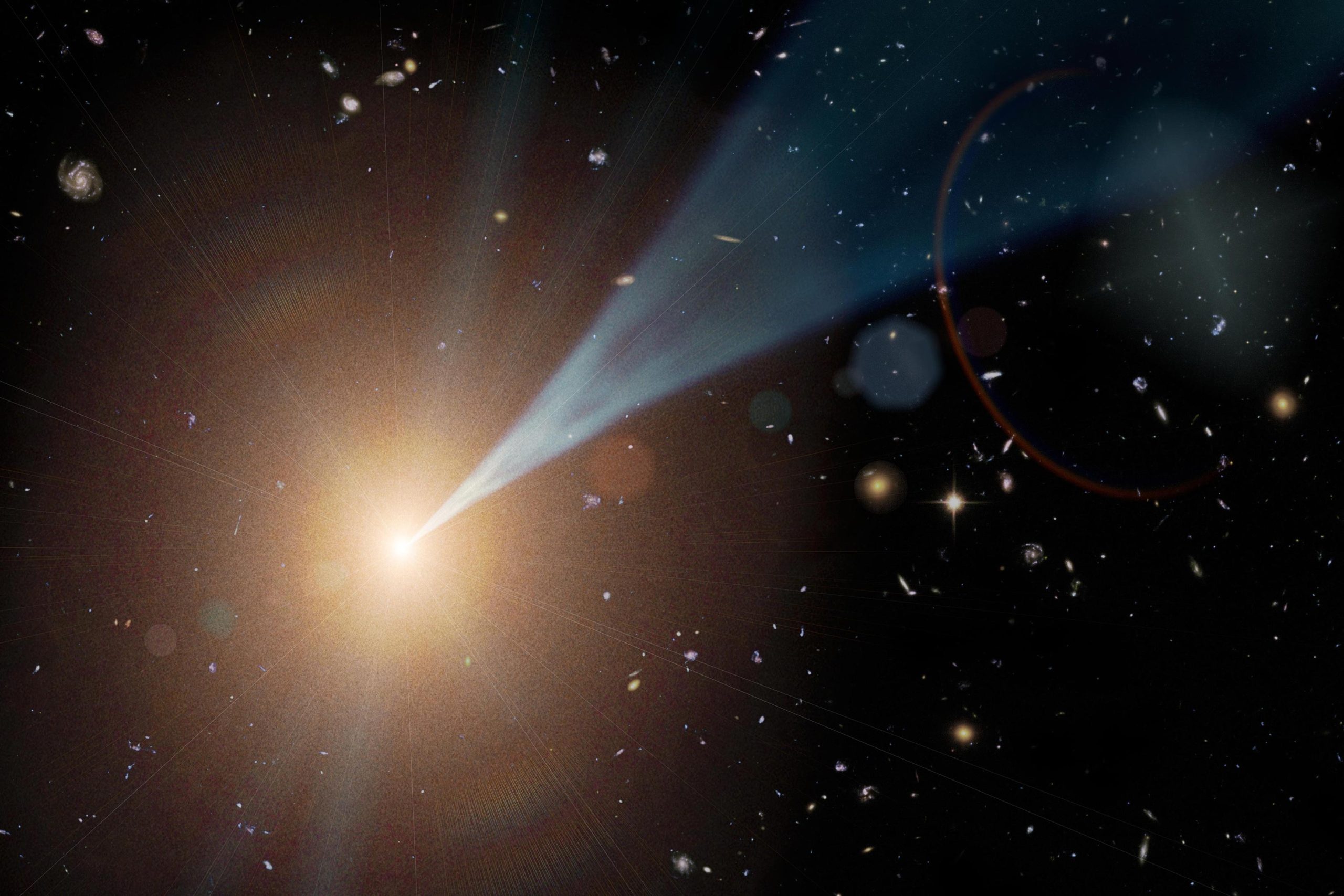
Unusual radiation from a distant galaxy powered by a supermassive black hole may offer clues to the origins of some of the universe’s most elusive particles.
Some galaxies launch jets of glowing matter that can extend tens of millions of light-years into space. When one of these jets points almost directly toward Earth, the galaxy is known as a blazar. Nearly 20 years of observations of one such galaxy have revealed patterns of radiation that challenge leading explanations for how these powerful cosmic objects behave.
Astronomers believe this activity is powered by violent processes occurring as matter falls toward a central supermassive black hole. Narrow streams of electrically charged matter emerge from near the black hole’s poles, producing radiation across a broad range of energies, from radio waves and visible light to ultraviolet light, X-rays, and gamma rays.
Understanding what drives these emissions is particularly difficult because blazars can behave unpredictably.
“The variability of blazars is a characteristic feature that has long been recognized. Blazars are capable of emitting radiation not only in different ways during different observations, but even within the same observation, when variations in some energy ranges may differ from those in others,” notes Dr. Alicja Wierzcholska of the Institute of Nuclear Physics of the Polish Academy of Sciences (IFJ PAN).
The limits of short observations
No existing observatory can continuously monitor blazars across the entire electromagnetic spectrum. Astronomers typically observe individual blazars every few months or years, collecting data over several days to around two weeks and within limited energy ranges.
To gain a more complete picture, researchers from Heidelberg University and IFJ PAN in Cracow conducted the first long-term analysis of PKS 2155-304, a blazar located 1.5 billion light-years away in the direction of the southern constellation Piscis Austrinus.
Led by Wierzcholska, the team combined nearly two decades of optical, ultraviolet, and X-ray measurements from the Neil Gehrels Swift Observatory with gamma-ray data from the Fermi Gamma-ray Space Telescope, both American satellite observatories. The Polish contribution was funded by the National Agency for Academic Exchange.
Blazar emissions defy leading models
Current theoretical models commonly assume that a single population of electrons within one region of a jet produces the observed radiation. If the same electrons generate both visible light and X-rays, changes in their emissions should follow similar patterns, perhaps with a slight delay. However, the researchers found no long-term correlation between changes in different energy ranges.
“The key conclusion from our analyses is that the currently most popular theoretical models, which assume that radiation is emitted within a single jet zone by a single population of electrons, can only describe the variability of our blazar over short time scales. However, something more complex is clearly happening in this object, which short observation campaigns are unable to capture,” says Dr. Wierzcholska.
Blazars also tend to produce proportionally more high-energy X-rays during sudden bursts of radiation known as flares. This relationship appeared during shorter observations of PKS 2155-304 but disappeared when researchers examined the full monitoring period. The pattern also differed between individual flares, suggesting that somewhat different physical mechanisms may drive each outburst.
A possible clue to cosmic neutrinos
Another unexpected finding emerged from two observations made in 2012. When astronomers plot the radiation emitted by a blazar across different energies, the resulting spectrum typically contains two peaks separated by a trough. The lower-energy peak is thought to come from electrons releasing radiation as they move through magnetic fields, a process known as synchrotron radiation.
The origin of the higher-energy peak remains uncertain. It could result from electrons transferring energy to photons through a process called inverse Compton scattering or from interactions involving hadrons, a family of particles that includes protons and neutrons. The 2012 observations revealed an additional, statistically significant dip in the spectrum.
“The presence of a new inflection in the blazar’s spectrum tells us that some additional physical mechanism must have been at work between the two observations – and this at a time when there was no outburst! Various theoretical considerations suggest that this mechanism was most likely hadronic in nature. This is extremely interesting, as theorists are increasingly arguing that neutrino production is possible in such situations,” explains Dr. Wierzcholska.
Neutrinos are among the most elusive particles in the universe. They have extremely small masses and rarely interact with ordinary matter, making them difficult to detect despite their abundance. Scientists have detected neutrinos produced by the Sun and radioactive decay deep within Earth, although the origins of high-energy neutrinos arriving from deep space remain poorly understood.
Blazars are among the suspected sources. Astronomers previously detected neutrinos arriving from the direction of another blazar, TXS 0506+056, during a powerful outburst. Although the new study did not establish that PKS 2155-304 produced neutrinos, its unusual emissions raise the possibility that blazars could generate these elusive particles even during periods of relatively quiet activity.
Reference: “20 Years of monitoring: PKS 2155-304 and PKS 1510-089 in the eyes of Swift and Fermi. I. The case of PKS 2155-304” by Alicja Wierzcholska and Michael Zacharias, 5 July 2026, Journal of High Energy Astrophysics.
DOI: 10.1016/j.jheap.2026.100688
The computational part of the research described here was carried out with the support of the Cyfronet AGH Academic Computing Center in Cracow.
Never miss a breakthrough: Join the SciTechDaily newsletter.
Follow us on Google and Google News.