
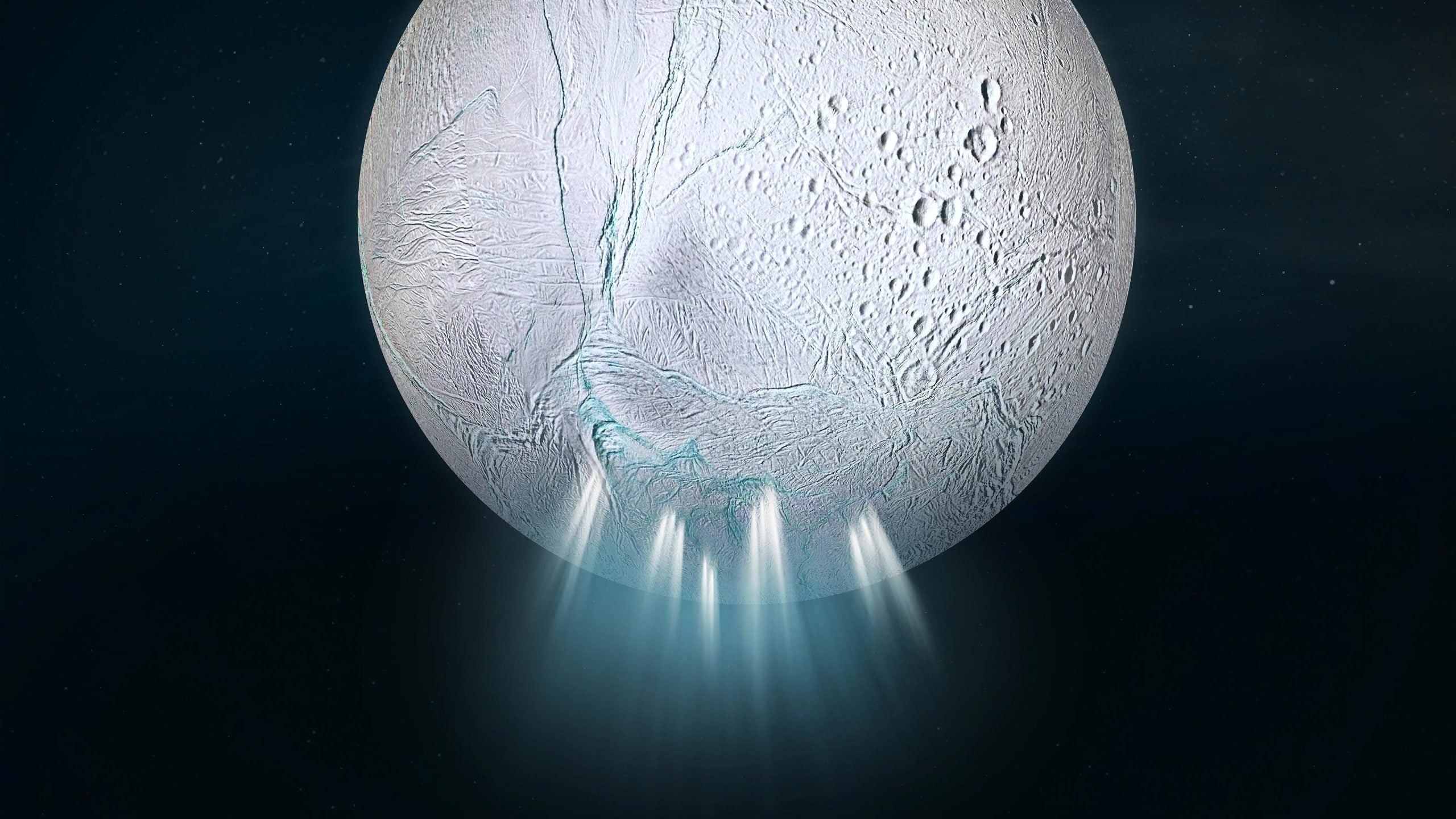
If there’s life on Saturn’s moon Enceladus, a few specks of ice hurtling into space could hold clues.
A global ocean lies beneath the thick ice crust of Enceladus, a moon of Saturn. Near the south pole, water escapes through cracks in the ice, shooting jets of vapor and ice grains hundreds of miles into space. Some of those grains feed Saturn’s E ring.
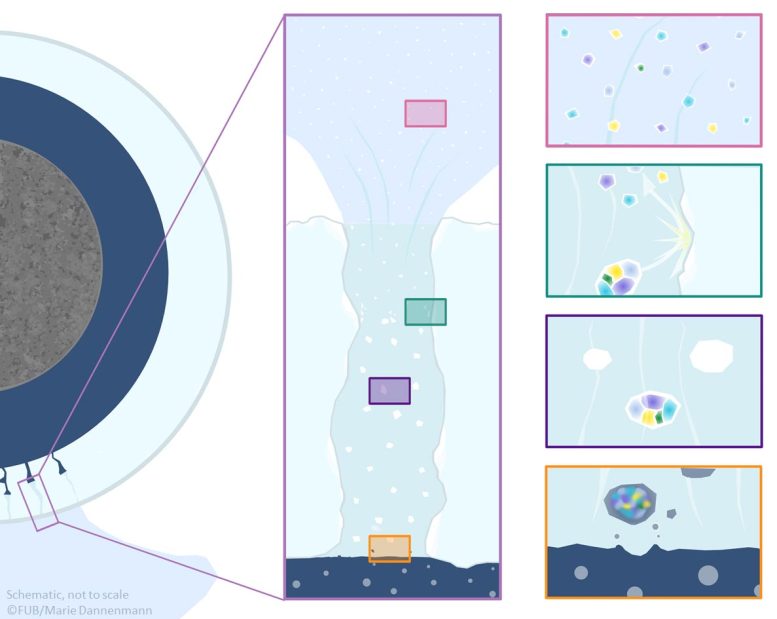
As droplets freeze on their way through the cracks, different salts can collect in different parts of the same droplet. When it breaks apart, the resulting grains carry different mixtures of salts. A study in Science Advances suggests the same process could concentrate organic molecules in individual grains, making them easier for a spacecraft to detect.
Cassini Found Different Salts in Different Grains
NASA’s Cassini spacecraft arrived at Saturn in 2004 and repeatedly flew through the plume, sampling material from the ocean without having to land or drill through miles of ice. It detected salts, organic compounds, and evidence that water reacts with rock on the moon’s seafloor.
For the new study, the team examined nearly 1,000 salt-rich ice grains recorded by Cassini’s Cosmic Dust Analyzer. Some were rich in sodium chloride, the main ingredient in table salt. Others were dominated by carbonates, phosphates, hydroxides, or salts containing potassium.
“We show that each grain is not necessarily a tiny scoop of the ocean,” said Fabian Klenner, a study co-author and assistant professor of planetary sciences at UC Riverside. “It is more of a fragment of a much larger ocean droplet in which freezing separated the salts before that droplet broke apart.”
How Freezing Sorts The Ocean Spray
The researchers combined Cassini’s observations with laboratory experiments, thermodynamic calculations, and models of how droplets cool. In the lab, they froze droplets of alkaline salt water formulated to resemble Enceladus’s ocean. Distinct pockets of salt formed in larger droplets that cooled relatively slowly. The smallest droplets froze fastest and stayed more uniform.
“When these droplets freeze relatively slowly, different salts can separate into distinct regions within a single grain,” Klenner said. “For example, sodium chloride could concentrate in one region and potassium chloride in another. As the grain is accelerated through the vents, collisions with the icy walls can break it into smaller fragments with different compositions. This is the mechanism we propose.”
What Happens Inside The Ice Vents
In the team’s model, bubbles burst at the ocean’s surface and throw droplets into the vapor rising through vents. The droplets freeze on the way up, giving salts time to separate. As the vents narrow near the surface, the vapor and frozen droplets accelerate to a few hundred miles per hour. Impacts against the icy walls can then shatter the droplets into fragments on the scale of micrometers (about 0.00004 inches per micrometer).
“Enceladus actually does a lot of the work for us in preparing samples for analysis that usually take a lot of effort in chemical labs on Earth,” said Frank Postberg, a professor of planetary sciences at Freie Universität Berlin who led the study. “The oceanic constituents are separated from each other and simultaneously concentrated into individual ice particles.”
Why Future Missions Could Sample Grain By Grain
Combining many particles in a single measurement could dilute rare compounds until they’re difficult to detect. Measuring grains individually preserves those differences, while sampling many of them can help scientists reconstruct the ocean’s chemistry.
“Analyzing a large number of individual grains increases our chances of finding interesting compositions and gives us a better picture of the ocean as a whole,” Klenner said. “The most useful information is in the differences from grain to grain. Future missions should analyze as many individual grains as possible.”
Klenner said a similar process could explain why some organic compounds are especially abundant in only a small fraction of Enceladus’s ice grains. “This tells us something important about the search for life on Enceladus,” he said. “Molecular signatures of life, if present, may be concentrated in only a few grains. A future spacecraft has to find exactly those grains.”
Reference: “Cassini CDA observes compositional segregation of Enceladus’ ice grains from slow freezing and fragmentation of oceanic spray” by Frank Postberg, Zenghui Zou, Yasuhito Sekine, Minori Koga, Jürgen Schmidt, Mark Fox-Powell, Fabian Klenner, Jon K. Hillier, Nozair Khawaja, Toshihiko Kadono, Melih Çakar, Sascha Kempf and Ralf Srama, 25 September 2026, Science Advances.
DOI: 10.1126/sciadv.aee7256
The study was funded by NASA Exobiology, the NASA Habitable Worlds Program, and the European Research Council.
Never miss a breakthrough: Join the SciTechDaily newsletter.
Follow us on Google and Google News.