
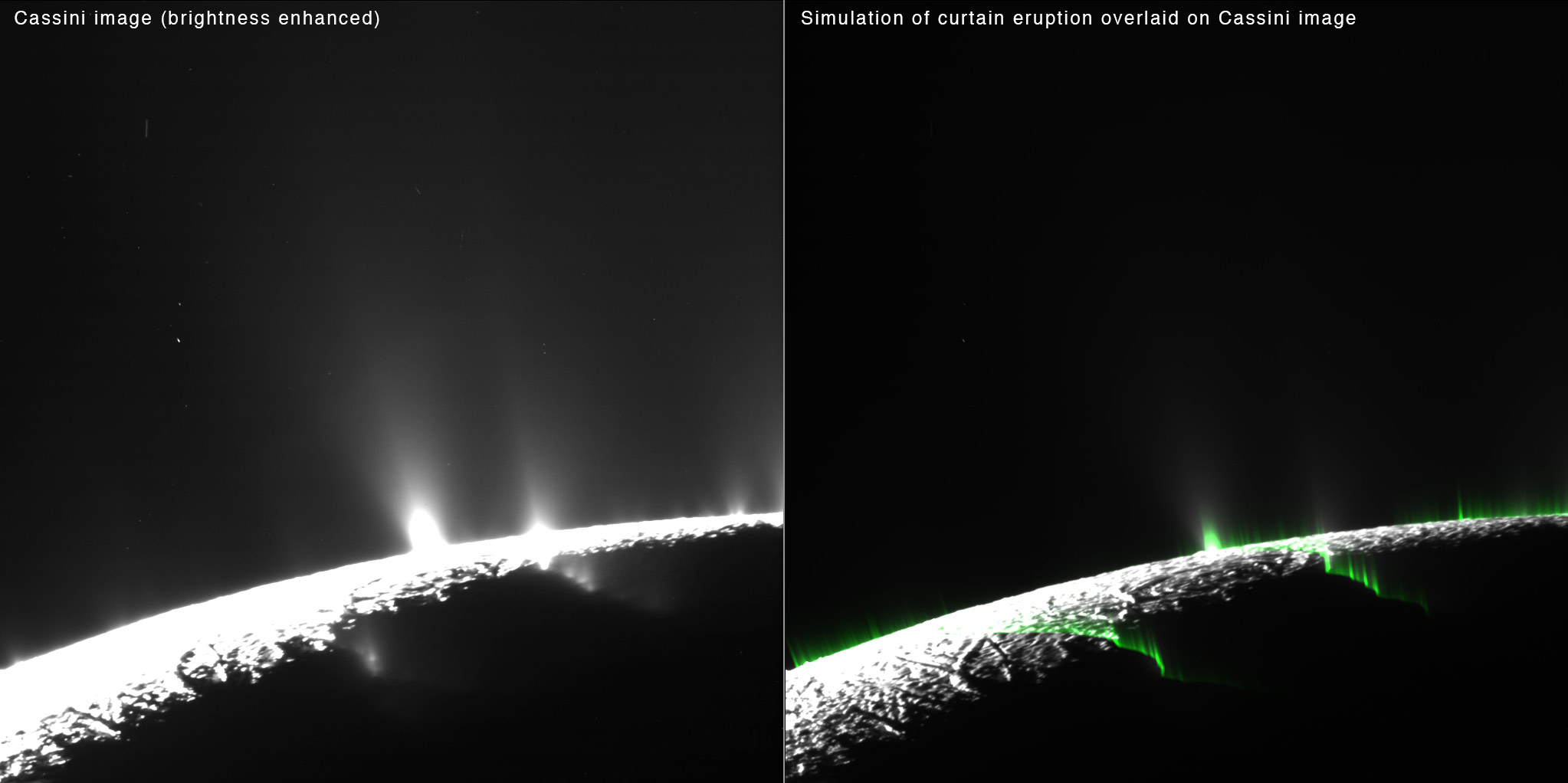
A newly published study reveals that most of the eruptions from Saturn’s moon Enceladus might be diffuse curtains rather than discrete jets.
Many features that appear to be individual jets of material erupting along the length of prominent fractures in Enceladus’ south polar region might be phantoms created by an optical illusion, according to a new study published on Thursday, May 7, in the journal Nature.
“We think most of the observed activity represents curtain eruptions from the ‘tiger stripe’ fractures, rather than intermittent geysers along them,” said Joseph Spitale, lead author of the study and a participating scientist on the Cassini mission at the Planetary Science Institute in Tucson, Arizona. “Some prominent jets likely are what they appear to be, but most of the activity seen in the images can be explained without discrete jets.”
In analyzing Cassini’s images of the eruptions on Enceladus, Spitale, and colleagues took particular note of the faint background glow present in most images. The brightest eruption features, which appear to be discrete jets, look to them to be superimposed intermittently upon this background structure.
Recent research suggests much of the eruption activity on the surface of Saturn’s moon Enceladus could be in the form of broad, curtain-like eruptions, rather than discrete jets.
The researchers modeled eruptions on Enceladus as uniform curtains along the tiger stripe fractures. They found that phantom brightness enhancements appear in places where the viewer is looking through a “fold” in the curtain. The folds exist because the fractures in Enceladus’ surface are more wavy than perfectly straight. The researchers think this optical illusion is responsible for most of what appear to be individual jets.
“The viewing direction plays an important role in where the phantom jets appear,” said Spitale. “If you rotated your perspective around Enceladus’ south pole, such jets would seem to appear and disappear.”
Phantom jets in simulated images produced by the scientists line up nicely with some of the features in real Cassini images that appear to be discrete columns of spray. The correspondence between simulation and spacecraft data suggests that much of the discrete-jet structure is an illusion, according to the researchers.
Curtain eruptions occur on Earth where molten rock, or magma, gushes out of a deep fracture. These eruptions, which often create spectacular curtains of fire, are seen in places such as Hawaii, Iceland, and the Galapagos Islands.
“Our understanding of Enceladus continues to evolve, and we’ve come to expect surprises along the way,” said Linda Spilker, Cassini project scientist at NASA’s Jet Propulsion Laboratory, Pasadena, California, who was not involved in the study. “This little ice world is becoming more exciting, not less, as we tease out new details about its subsurface ocean and astonishing geophysical activity.”
The Cassini-Huygens mission is a cooperative project of NASA, ESA (European Space Agency), and the Italian Space Agency. NASA’s Jet Propulsion Laboratory in Pasadena, California, manages the mission for the agency’s Science Mission Directorate in Washington. The Cassini imaging operations center is based at the Space Science Institute in Boulder, Colorado.
Reference: “Curtain eruptions from Enceladus’ south-polar terrain” by Joseph N. Spitale, Terry A. Hurford, Alyssa R. Rhoden, Emily E. Berkson and Symeon S. Platts, 7 May 2015, Nature.
DOI: 10.1038/nature14368
Never miss a breakthrough: Join the SciTechDaily newsletter.
Follow us on Google and Google News.